Mostrando entradas con la etiqueta Lockheed Martin. Mostrar todas las entradas

viernes, 7 de junio de 2019

Sikorsky Flies Black Hawk With Optionally Piloted Vehicle Technology

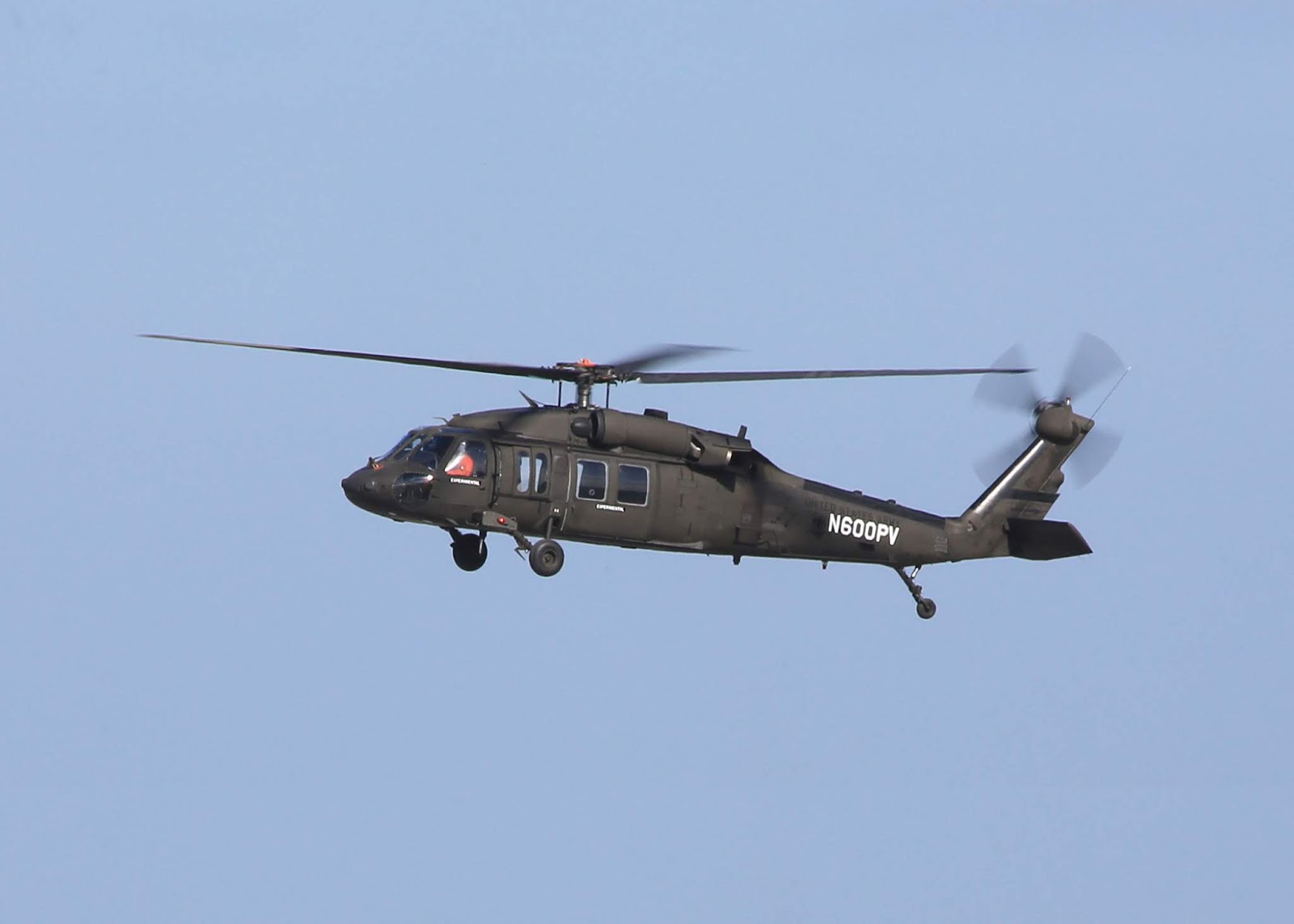
Kit developed by Sikorsky gives UH-60A helicopter full-authority fly-by-wire flight controls, marking the first step toward transforming the aircraft into an Optionally Piloted Vehicle

WEST PALM BEACH, Fla., June 6, 2019/PRNewswire/ -- A technology kit developed by Sikorsky, a Lockheed Martin company (NYSE: LMT), was used for the first time to operate a Black Hawk helicopter with full-authority, fly-by-wire flight controls. The May 29 flight marked the official start to the flight test program for the soon-to-be optionally piloted aircraft. Follow-on flight testing aims to include envelope expansion throughout the summer leading to fully autonomous flight (zero pilots) in 2020. 
"This technology brings a whole new dimension of safety, reliability and capability to existing and future helicopters and to those who depend on them to complete their missions," said Chris Van Buiten, Vice President, Sikorsky Innovations. "We're excited to be transforming a once mechanically controlled aircraft into one with fly-by-wire controls. This flight demonstrates the next step in making optionally piloted – and optimally piloted – aircraft, a reality."
This is the first full authority fly-by-wire retrofit kit developed by Sikorsky that has completely removed mechanical flight controls from the aircraft.
Through DARPA's Aircrew Labor In-Cockpit Automation System (ALIAS) program, Sikorsky is developing an OPV approach it describes as pilot directed autonomy to give operators the confidence to fly aircraft safely, reliably and affordably in optimally piloted modes enabling flight with two, one or zero crew. The program aims to improve operator decision aiding for manned operations while also enabling both unmanned and reduced crew operations.
Sikorsky has been demonstrating its MATRIX™ Technology on a modified S-76B™ called the Sikorsky Autonomy Research Aircraft (SARA). The aircraft, which has been in test since 2013, has more than 300 hours of autonomous flight.
Sikorsky announced in March that its S-92® helicopter fleet update will include the introduction of phase one MATRIX Technology that will bring advanced computing power to the platform. This foundation enables adoption of autonomous landing technology.
For more information about Sikorsky MATRIX Technology, which won an Edison award in 2018, visit https://lockheedmartin.com/en-us/products/sikorsky-matrix-technology.html.

jueves, 23 de mayo de 2019

U.S. Air Force's Space Fence Detects Debris From India Anti-Satellite Test

New radar system plays vital role as space becomes more congested and contested with satellites and orbital debris

KWAJALEIN ATOLL, Marshall Islands, May 22, 2019 /PRNewswire/ -- The U.S. Air Force Space Fence system detected the breakup field from an anti-satellite test conducted by India during a scheduled endurance exercise of the new space surveillance radar.
As MICROSAT-R was expected to pass through the un-cued surveillance fence, Space Fence automatically issued a "breakup alert" indicating there were multiple objects within close proximity. Space Fence observed a significant amount of debris tracks surrounding the time of the event crossing labeled as uncorrelated targets. Long-arc tracking was initiated within the orbital debris cloud to form accurate initial orbit determinations. With this information, the system was able to automatically predict and correlate the next crossing time.
Lockheed Martin (NYSE: LMT) system operators then prepared for the next crossing by setting up an enhanced sensitivity task volume ahead of the normal un-cued surveillance fence to increase the low altitude track duration. Although the Space Fence is currently in its test phase and not yet operational, the Space Fence un-cued surveillance coverage showed its unique ability to observe these events unfolding at different altitudes in real time. Although the anti-satellite test was conducted at approximately 300 kilometers, the debris cloud extended beyond the original parent object orbit.   
"Although the Space Fence system is still under test, it continues to demonstrate its advanced capabilities providing operationally-relevant information in all orbital regimes from Low Earth Orbit through Geosynchronous Earth Orbit," said Dr. Rob Smith, vice president and general manager of Radar and Sensor Systems for Lockheed Martin. "The criticality of space assets to both national defense and the world economy cannot be understated. As multiple new mega constellations consisting of thousands of satellites become a reality and the space domain continues to become more congested, the demand for more accurate and timely space situational awareness data will be of the utmost importance to the warfighter."
The Space Fence system continues to track objects from the anti-satellite event through the government-led testing phase which began in early April.
Colonel Stephen Purdy, Director of the Space Superiority Systems Directorate, Space and Missile Systems Center, Los Angeles Air Force Base, who oversees the Space Fence program said, "Space Fence is already proving itself as a capable system even before becoming operational. The Indian test showcased Space Fence's capabilities in a real-world event. The system was able to quickly respond to a highly dynamic situation providing critical data. Space Fence is the latest in a long line of capabilities we are collectively bringing to the warfighter as we continue to build out space capabilities for the United States."

viernes, 17 de mayo de 2019

Lockheed Martin Breaks Ground On New Production Facility

225,000-square foot building addresses U.S. government's JASSM® inventory increase

TROY, Ala., May 16, 2019 /PRNewswire/ -- U.S. Air Force and local Alabama officials joined Lockheed Martin (NYSE: LMT) executives today to break ground on the company's new strike systems production facility in Troy.
The planned 225,000-square-foot facility, combined with the current cruise missile production factory, will provide the necessary space to meet the U.S. Air Force's objectives.
"This expansion represents Pike County Operations' long-standing commitment to meet our customer's current and future needs as well as to bring more well-paying jobs to the area," said Frank St. John, executive vice president at Lockheed Martin Missiles and Fire Control. "All our employees come to work with an unwavering commitment to help our customers succeed in their mission to create a more secure and prosperous world."
Building construction is slated for completion in 2021 with Joint Air-to-Surface Standoff Missile Extended Range (JASSM-ER) production ramping up in the second half of 2022.
"We're pleased to see Lockheed Martin continue to invest in our community with the addition of this new manufacturing building," said Jason Reeves, Troy Mayor. "Their growth not only leads to more jobs – it enhances sustainable growth for our region."
Lockheed Martin's Pike County Operations is the recipient of many continuous improvement and performance excellence awards.

miércoles, 15 de mayo de 2019

Lockheed Martin Names Dean Acosta Senior Vice President, Communications

BETHESDA, Md., May 15, 2019 /PRNewswire/ -- Lockheed Martin (NYSE: LMT) has appointed Dean Acosta as senior vice president, Communications, effective May 20, 2019.
"Dean is an impressive leader who has proven himself in both public service and in the private sector," said Lockheed Martin Chairman, President and Chief Executive Officer Marillyn Hewson. "His expertise and experience will help us communicate how our company works every day to protect lives, enhance security, and advance the frontiers of science and human understanding. We welcome Dean to the Lockheed Martin team."
Dean Acosta has almost three decades of experience in communications and journalism, with much of it spent leading corporate communications teams, in the technology, energy and aerospace and defense industries. Most recently, he served as vice president and chief communications officer for Resideo, a smart home technology company, where he led employee and executive communications, media relations, social media and public affairs. In support of Resideo's recent spinoff from Honeywell, Acosta was responsible for the naming and branding of the company and the Day 1 launch campaign.  
Prior to that, Acosta was vice president of Global Communications for Honeywell's Home and Building Technologies business, and before that, for Honeywell's Automation and Control Solutions business. He served as Phillips 66's global head of Corporate Communications, and as director of Communications for Lockheed Martin's Corporate Engineering and Technology organization. Acosta also served as director of communications for Boeing's Space Exploration business and as press secretary for NASA in the aftermath of the Space Shuttle Columbia disaster and through the shuttle program's return to flight. He began his career as a broadcast journalist, winning an Emmy award for his reporting.
Acosta earned his bachelor's degree from the University of Texas at San Antonio and his master's degree in strategic communication and leadership from Seton Hall University.

domingo, 28 de octubre de 2018

Aegis Combat System Demonstrates Success During At-Sea Test Against Medium Range Ballistic Missile

USS JOHN FINN, Oct. 26, 2018/PRNewswire/ -- The latest evolution of the Aegis Combat System, Baseline 9.C2 (BMD5.1) successfully supported an MDA-led at-sea Ballistic Missile Defense System test event. During the test, the Lockheed Martin (NYSE:LMT)-built Aegis Weapon System detected, tracked, engaged and launched a missile to intercept a Medium Range Ballistic Missile (MRBM) target.
The test, called Flight Test Standard Missile–45, demonstrated the integrated capabilities of the Aegis Weapon System and how it has continually evolved to counter advanced threats. This test demonstrated the new engagement assessment functionality, bi-directional missile communications and sensor improvement algorithms.
"This test authenticates the strengthening global security of the United States and its allies as we deepen the defense capabilities with the Aegis Ballistic Missile Defense System," said Paul Klammer, director, Aegis BMD. "This exercise showed that Aegis is the most advanced combat system and the proven choice for a layered defense."
This test builds upon joint research investments by the United States and Japan and comes on the heels of a successful test with the JS ATAGO (DDG 177) in September. Lockheed Martin is developing a Baseline 9/BMD 5.1 variant computer program, for deployment on Japan's Aegis destroyers.
As a proven world leader in systems integration and development of air and missile defense systems and technologies, Lockheed Martin delivers high-quality missile defense solutions that protect citizens, critical assets and deployed forces from current and future threats. The company's experience spans missile design and production, hit-to-kill capabilities, infrared seekers, command and control/battle management, and communications, precision pointing and tracking optics, radar and signal processing, as well as threat-representative targets for missile defense tests.

miércoles, 18 de julio de 2018

LONGBOW LLC AWARDED $170 MILLION IN ORDERS FOR APACHE AH-64E FIRE CONTROL RADAR SYSTEMS

FARNBOROUGH, England, July 18, 2018/PRNewswire/ -- LONGBOW Limited Liability Company (LLC) and the U.S. Army have definitized contracts valued at $170.5 million to provide LONGBOW Fire Control Radar (FCR) hardware for Apache AH-64E helicopters supporting U.S. Army lots 7 and 8 plus three international customers.
LONGBOW LLC is a joint venture of Lockheed Martin (NYSE: LMT) and Northrop Grumman Corporation (NYSE: NOC).
The contracts include LONGBOW FCR Mast Mounted Assemblies (MMA), Radar Electronics Units (REU) and spares for the U.S. Army, United Kingdom, Saudi Arabiaand Qatar, making Qatar the 13th international customer to receive LONGBOW FCR. Production will extend through April 2021 at Lockheed Martin's Orlando and Ocala, Fla., facilities and at Northrop Grumman's Baltimore, Maryland, facility.
"We remain focused on delivering significant upgrades and products as quickly and efficiently as possible," said Jim Messina, LONGBOW LLC president and director of LONGBOW programs at Lockheed Martin Missiles and Fire Control. "This contract allows us to supply the U.S. Army fleet with REUs, which is the foundation for future enhancements like extended range, maritime mode and unmanned aerial systems detection."
"The LONGBOW FCR REU continues to provide outstanding capabilities to our customers," said Susan Bruce, LONGBOW LLC vice president and vice president Advanced Tactical Systems, Northrop Grumman Mission Systems. "The REU provides growth capabilities to LONGBOW FCR while reducing space, weight and power, along with maintenance cost."
The MMA and REU are key components of the LONGBOW FCR. The LONGBOW FCR automatically searches, detects, locates, classifies and prioritizes multiple moving or stationary targets on land or in the air, in clear or adverse weather, and in obscured battlefields – giving commanders the precision engagement capabilities necessary to win the battle.

lunes, 16 de julio de 2018

SIKORSKY DELIVERS FIRST BLACK HAWK HELICOPTER TO THE CITY OF SAN DIEGO FIRE-RESCUE DEPARTMENT

Fire suppression, advanced life support, and search and rescue are priority missions for the new aircraft

COATESVILLE, Penn., July 16, 2018 /PRNewswire/ -- Sikorsky, a Lockheed Martin company, has delivered an S-70 Black Hawk helicopter to the City of San Diego Fire-Rescue Department. When modified by a third party as a FIREHAWK®helicopter with a 1,000-gallon belly tank, retractable snorkel, extended landing gear and rescue hoist, the City of San Diego will have a multirole platform with the speed to more quickly find and extinguish wildfires, perform rescue missions, and deliver initial medical care across the city and neighboring counties.


"The Black Hawk is a game changer in its primary role of fire suppression in support of ground firefighting crews," said San Diego Fire-Rescue Air Operations Chief Chuck Macfarland during the June 27 ceremony to accept the aircraft at Sikorsky's facility in Coatesville, Pennsylvania. "Never before has the City of San Diego operated as large and as powerful a helicopter as the Black Hawk, which can accurately place almost three times more water on a wildland fire in a single drop than our current fleet. By hitting wildland fires aggressively in their initial stage, we will be able to keep fires small."
Ahead of its modifications into the FIREHAWK configuration in 2019, San Diego Fire-Rescue will press the new helicopter into aerial firefighting service later this year using an 850-gallon internal tank.
The S-70 Black Hawk helicopter has the engine power to carry over 4 US tons of water, and will operate with safe power margins in hot temperatures at high altitudes. The aircraft's high strength and corrosion resistant airframe significantly reduces maintenance costs.
Said Joe Palumbo, Sikorsky international military programs director: "Aerial firefighting is a strenuous mission for any helicopter and its crew, but this third generation Hawk platform has the proven military pedigree and reliability to endure the tremendous physical stresses of acquiring, carrying and dropping large amounts of water repeatedly throughout the course of a day or night's firefighting operations. We welcome San Diego to the Black Hawk family, and wish the Fire-Rescue Department success during the aircraft's decades-long mission to save lives and property."
The S-70 aircraft's advanced digital cockpit takes on many of the aircraft's flight functions, allowing the pilot to pre-program and manage the mission while adjusting flight parameters, such as speed, precision hover, heading and altitude, as needed. A digital moving map shows the pilot the aircraft's precise location and destination at all times.
Among its standard safety features, the S-70 aircraft includes an Integrated Vehicle Health Management System to monitor the aircraft's operational health, and a terrain and obstacle avoidance system that alerts aircrew to the proximity of potential ground hazards.
In addition to its principal mission of wildland fire suppression, San Diego's FIREHAWK aircraft can insert rescue medics, and hoist patients into the cabin for treatment and transport to a nearby hospital.
The City of San Diego is the second municipality in southern California in the past year to procure the S-70 aircraft for aerial firefighting and other life-saving missions. In December 2017, Los Angeles County Fire Department added two S-70i helicopters to its fleet of three existing FIREHAWK helicopters. In May, the California Department of Forestry and Fire Protection (CAL FIRE) selected the FIREHAWK platform to replace its older aerial firefighting helicopters.
Learn more information about the FIREHAWK helicopter.

Sikorsky Secures Sale of S-76D™ Helicopter in India

FARNBOROUGH, United Kingdom, July 16, 2018/PRNewswire/ -- Sikorsky, a Lockheed Martin company (NYSE: LMT), announced the sale of an S-76D™ aircraft to the Government of Maharashtra in India. The announcement came during the Farnborough International Airshow.

This contract marks the first sale of an S-76D helicopter in India. Delivery is scheduled in 2019.

"The S-76D helicopter introduction has been quite successful in the Indo-Pacific region, with more than 30 aircraft sold and delivered in the last five years," said Christophe Nurit, Sikorsky's Regional Executive for Asia. "The aircraft has been selected and proven for multiple mission requirements ranging from Naval and Coast Guard operations to Executive Transport. One of our clients in Asia has accumulated 10,000 hours on its S-76D fleet in less than two years. This is another great achievement for this product. Sikorsky is proud to now introduce it in India."

S-76D helicopter VIP options include a customized interior with seating for five to eight passengers. Uniquely, the S-76D helicopter can hold its rotor system still while running an engine to power the on-board air-conditioning system for safe, comfortable loading and unloading into the pre-cooled cabin during the summer season and hot climates.


A recent milestone with an Asian client, has accumulated 10,000 hours on its S-76D fleet in less than two years. Sikorsky is proud to now introduce it in India. Sikorsky has delivered more than 850 S-76® helicopters to customers globally since 1977, contributing daily to more than 7 million fleet flight hours.

For more information visit Sikorsky Commercial Systems & Services.

LOCKHEED MARTIN SIGNS TEAMING AGREEMENT WITH RAFAEL TO MARKET SPICE AIR-TO-SURFACE MISSILE KITS

FARNBOROUGH, England, July 16, 2018 /PRNewswire/ -- Lockheed Martin (NYSE: LMT) and Rafael Advanced Defense Systems Ltd., of Israel, signed a Memorandum of Understanding (MOU) to evaluate potential markets and customer requirements for Rafael's Smart, Precise Impact and Cost-Effective (SPICE™) missile guidance kits.
"SPICE is a leading air-to-surface weapon system offering U.S. and international air forces operating Lockheed Martin's platforms, as well as strategic bomber aircraft, an important complement to their existing operational capabilities," Yuval Miller, Executive Vice President, Head of Rafael's Air & C4ISR Division. "SPICE's unique features greatly enhance the U.S.' ability to operate in contested environments. We are excited to engage in cooperation with Lockheed Martin to make SPICE available as a U.S.-made system, adapted to fully meet U.S. standards."
SPICE is a family of stand-off, autonomous, air-to-surface weapon systems, capable of destroying targets with pinpoint accuracy and at high attack volumes in a GPS-denied environment. Combat-proven and in service with the Israeli Air Force and several international customers, SPICE employs a state-of-the-art electro-optical seeker with unique scene-matching algorithms, navigation guidance and homing techniques to achieve operational missions in adverse weather without GPS. The MOU covers the SPICE 1000 (453 kilogram / 1,000 pound weight class) and SPICE 2000 (907 kilogram / 2,000 pound weight class) precision guided missile kit variants.
"Lockheed Martin has a long history of successfully providing customers with missiles and missile systems that are affordable, proven and in production," said Dan Norton, vice president of Strategy and Business Development at Lockheed Martin Missiles and Fire Control. "This partnership will allow us to share our precision guided system and aircraft integration expertise with allies that can benefit from the mission flexibility that the SPICE 1000 and SPICE 2000 offer."

LOCKHEED MARTIN TO HELP UK SPACE AGENCY BUILD FIRST COMMERCIAL SPACEPORT; LAUNCH FIRST ORBITAL ROCKET

First vertical launch from Scotland planned for the early 2020s.

FARNBOROUGH, England, July 16, 2018 /PRNewswire/ -- The UK Space Agency has selected Lockheed Martin (NYSE: LMT) to help implement its vision for the UK Spaceflight Programme, an innovative initiative to create a world-leading commercial launch market that grows the UK economy through regular, reliable and responsible access to space.


"The countdown to the first orbital rocket launch from UK soil has officially begun," said Patrick Wood, Lockheed Martin's UK Country Executive for Space. "The UK Government has stated its desire to grow the UK's space sector to ten percent of the global space economy by 2030. We are proud to be selected to help them achieve this goal. This initiative will not only spark advancements in science and innovation, it will create new opportunities for current and future UK-based suppliers to become part of the next space age."


With a recent grant from the UK Space Agency, Lockheed Martin is leading a team to execute several strategic projects to support the UK Spaceflight Programme, with a goal of providing the first vertical space launch in the early 2020s.
  • The UK's First Space Port: The team will support the development of the nation's first commercial spaceport at the Sutherland site in Melness, Scotland. The site aims to be the UK's first vertical orbital rocket launch site. Overall site development is being led by Scottish government economic and community development agency Highlands & Islands Enterprise, with Lockheed Martin providing strategic support and guidance.
  • Innovative CubeSat Delivery Vehicle: Once it reaches orbit, the first rocket launched will release a Small Launch Orbital Manoeuvring Vehicle (SL-OMV), built specifically by Moog in the UK for the UK Spaceflight Programme. This agile platform will carry up to six 6U CubeSats, such as Lockheed Martin's LM 50 platform, which the vehicle can deploy at the most optimal times and positions for their respective missions. The team is currently taking requests from potential customers to fill its CubeSat manifest for this first launch.
  • Advanced 6U CubeSat Pathfinder: As part of the programme, Lockheed Martin teammate Orbital Micro Systems will create and fly a UK-built pathfinder test to validate the performance of the SL-OMV and ground system. The pathfinder will help lay the ground work for planned satellite constellations that are designed to deliver low latency weather observation to commercial and government customers.

"This historic 'pathfinder' launch for the UK will also demonstrate the tremendous potential small satellites and CubeSats have across a wide range of commercial and government data collection applications," said Wood. "We believe, as the UK Space Agency does, that this effort will help bring the UK to the forefront of the rapidly-growing, global small satellite market and support the UK's maturing space supply chain."

Lockheed Martin brings significant space experience to the UK's Spaceflight Programme, from ground systems, to launch vehicles, to on-orbit missions. The company's LM 50 CubeSat platform is an innovative and powerful platform that can be customized to a wide array of missions and payloads. It's one of four modernized satellite platformsLockheed Martin offers its customers, including the LM 400 small satellite, LM 1000 remote sensing bus, and the flagship LM 2100 geostationary bus.

Lockheed Martin's team includes: Moog, Orbital Micro Systems, the University of Leicester, Surrey Satellite Technology, Satellite Applications Catapult, SCISYS, Lena Space, Reaction Engines and Netherlands Space Office.

domingo, 1 de julio de 2018

SALUTING A STAR: LOCKHEED MARTIN CELEBRATES THE C-5 GALAXY’S 50TH ANNIVERSARY

Lockheed Martin Aeronautics Company celebrated the 50th anniversary of the C-5 Galaxy strategic transport on June 26 at the company’s Marietta, Georgia, facility. Georgia Gov. Nathan Deal served as the principal speaker for the event, which was attended by Lockheed Martin employees, elected officials and representatives from the U.S. Air Force. 

The C-5 Galaxy strategic transport has been operated solely by the U.S. Air Force since 1970. All production C-5s were built at Lockheed Martin’s Marietta site. The first C-5A rolled out of the Marietta facility on March 2, 1968, at a ceremony with U.S. President Lyndon Johnson in attendance. The first C-5 made its initial flight on June 30, 1968.
A total of 131 C-5s were built between 1968-1975 (81 C-5As) and 1985 and 1989 (50 C‑5Bs). The C-5 is the largest aircraft in the U.S. Air Force inventory, and is capable of carrying two 78-ton M1A1 main battle tanks or helicopters and other large equipment intercontinental distances. Fully loaded, a C-5 has a gross weight of more than 800,000 pounds.
In 2006, the Air Force awarded a contract to Lockheed Martin to modernize 52 C-5 Galaxy through the U.S. Air Force’s Reliability Enhancement and Re-engining Program (RERP).
The C-5 RERP incorporates 70+ improvements and extends the aircraft’s service life to at least 2045. C‑5M modernization provides greatly improved reliability, efficiency, maintainability and availability, while ensuring this critical national strategic airlift resource continues serving the warfighter well into the 21st century.
The final RERP C-5 served as the backdrop for today’s ceremony and it will be delivered to the 439th Airlift Wing, the Air Force Reserve Command unit at Westover Air Reserve Base, Massachusetts, in the coming weeks. C-5Ms are also based at Dover Air Force Base, Delaware; Travis Air Force Base, California; and Joint Base San Antonio-Lackland, Texas.

lunes, 25 de junio de 2018

LOCKHEED MARTIN APPOINTS BOB HARWARD TO LEAD MIDDLE EAST BUSINESS

Harward’s role to expand beyond the UAE to support regional business growth in one of the company’s most important global markets


ABU DHABI, UAE, June 25, 2018– Lockheed Martin (NYSE: LMT) today announced Robert (Bob) S. Harward will expand his role to lead the company’s growing Middle East business as the Chief Executive for Lockheed Martin in the Middle East. In this new role he will be responsible for the company’s strategy, operations and growth in the UAE, Bahrain, Kuwait, Oman, Jordan, Lebanon, Qatar, Pakistan, Iraq and Afghanistan.
“Bob has exceptional experience across the region and unparalleled knowledge of how our technology can help solve our Middle East partners’ greatest security challenges,” said Richard H. (Rick) Edwards, Executive Vice President of Lockheed Martin International. “I am confident that under Bob’s leadership we will continue to drive our Middle East business forward and help strengthen global security.”
Harward previously served as the company’s Chief Executive for the United Arab Emirates. A lifelong national security leader, he served on the National Security Council for the Bush Administration, commissioned the National Counter Terrorism Center, and has extensive combat and counterterrorism experience as a United States Navy SEAL. Prior to joining Lockheed Martin in 2014, he was a Vice Admiral (SEAL) in the United States Navy.

LOCKHEED MARTIN AWARDED CONTRACT TO BUILD F-16 BLOCK 70 AIRCRAFT FOR BAHRAIN

World's first Block 70 aircraft will be built in Greenville, South Carolina


FORT WORTH, Texas, June 25, 2018/PRNewswire/ -- Lockheed Martin (NYSE: LMT) received a $1.2 billion contract from the U.S. government to produce 16 new F-16 Block 70 aircraft for the Royal Bahraini Air Force. The Undefinitized Contract Action award represents the first F-16 Block 70 sale and the first F-16 production program to be performed in Greenville, South Carolina.

The Kingdom of Bahrain is the first customer to procure the F-16 Block 70, the newest and most advanced F-16 production configuration.

"We value our long-standing relationship with the Kingdom of Bahrain and look forward to beginning production activities on their first Block 70 aircraft at our facility in Greenville," said Susan Ouzts, vice president of Lockheed Martin's F-16 Program. "This sale highlights the significant, growing demand we see for new production F-16s around the globe."

Lockheed Martin expects F-16 production to create between 150 and 200 new jobs in Greenville. F-16 production also supports hundreds of U.S.-based Lockheed Martin engineering, procurement, sustainment and customer support jobs and thousands of U.S. supplier jobs. The F-16 supply chain is currently supported by 450 U.S. suppliers in 42 states.

The F-16 Block 70 features advanced avionics, a proven Active Electronically Scanned Array radar, a modernized cockpit, advanced weapons, conformal fuel tanks, an automatic ground collision avoidance system, an advanced engine and an industry-leading extended structural service life of 12,000 hours.

The combat-proven F-16 continues to prove itself as the world's most successful, combat-proven multi-role fighter. To date, 4,604 F-16s have been procured by 28 customers around the world. Approximately 3,000 operational F-16s are flying today with 25 leading air forces, including the U.S. Air Force.

martes, 19 de junio de 2018

Sikorsky S-76®, un mito con 41 años de servicio

S-76C+ Gardacostas de Galicia (Pesca 2)
©Roi R. Labrador/Hlcopters/HLCm™
Con más de 7 millones de horas de vuelo acumuladas a través de todas las evoluciones del modelo (desde el S-76 Spirit al actual S-76D) y de la flota mundial de unidades entregadas, superior a los 860 helicópteros, el 5 toneladas de Sikorsky fue anunciado por el fabricante en 1975 y designado como S-76 puesto que era el año en el que se tenía previsto su salida al mercado, finalmente no fue asi y el prototipo #1 del Spirit realizó su primer vuelo el 13 de marzo de 1977.

El S-76® nació en un principio enfocado para la exigente misión Oil & Gas, como prácticamente el 100% de los helicópteros de su misma clase, pero el excelente rendimiento de la máquina en Offshore desembocó en su introducción al SAR, llegando en esta configuración a representar el 65% (un 10% bajo condiciones meteorológicas muy adversas) del total de horas de vuelo acumuladas por el ya mítico helicóptero norteamericano.

Todas las evoluviones del S-76® además han tenido sus variantes de transporte ejecutivo, transporte VIP, aerolínea, EMS, e incluso militar.

El número de S-76® construidos en total, y dentro de sus diferentes evoluciones, es el siguiente:

S-76A™ y S-76A+™: 307 unidades fabricadas.

S-76B™: 103 unidades fabricadas.

S-76C™ y S-76C+™: 191 unidades fabricadas.

S-76C++™: 214 unidades fabricadas.

S-76D™: no disponible, puesto que es el modelo actualmente en producción.

Como curiosidad actualmente en España hay 10 unidades operativas, S-76C™ y S-76C+™, las primeras son operadas por el Ejército del Aire, dentro del 781 Escuadrón -Ala 78- (instrucción + SAR), y los dos C+ por Babcock MCS para el Gardacostas de Galicia (SAR + Vigilancia Pesquera). Hubo alguno más de las versiones más antiguas del modelo, pero ya no se encuentran operativas. 

Sikorsky/Lockheed Martin se ha comprometido a seguir apoyando el proyecto, desde programas de retrofit (como ocurrió con el C+ a C++) hasta continuar evolucionando el S-76®; un helicóptero que cuenta con más de 130 clientes en todo el mundo. 


viernes, 15 de junio de 2018

Sikorsky S-76D™, SOFTWARE V400

El software de aviónica V400 para el helicóptero S-76D™, aumenta las capacidades de la aeronave y permite que el helicóptero pueda ser operado por un solo piloto en instrumental (IFR). 
Sikorsky, antigua filial de United Technologies Corp, fue adquirida por Lockheed Martin tras un acuerdo alcanzado con UTC el 20 de julio del 2015 por un coste de 9 mil millones de dólares.
El V400 amplía las capacidades de aviónica permitiendo un abanico superior, como la operación con un solo piloto y otras características que reducen la carga de trabajo en el cockpit al tiempo que mejoran la seguridad de las operaciones con el S-76D. El software V400 proporciona una magnífica solución de aviónica integrada, permite la opción de superposición opcional del SiriusXM™ en el Moving Map, lo que proporciona una gran información en el cockpit al disponer de las diferentes condiciones meteorológicas sobre el terreno a sobrevolar durante el transcurso de la misión. Transmisión del Transpondedor en Modo S, Automatic Dependent Surveillance - Transmisión de datos, y Localizador con Orientación Vertical, tanto para pistas como helipuertos.
La nueva generación de helicópteros S-76D, a través de sus modernas tecnologías, proporciona un aumento sustancial en el rendimiento, potencia y pilotaje. El equipo básico del helicóptero S-76D incluye potentes y eficaces motores Pratt & Whitney Canada PW210S; un avanzado sistema de aviónica integrado THALES TopDeck® y un piloto automático de cuatro ejes; Sistema HUMS (Health and Usage Monitoring, monitoreo de salud y uso de la aeronave, incorporado al monitoreo y análisis de la flota); control de vibración activa; palas del rotor principal tolerantes a fallos, de completa fabricación en materiales compuestos.
Sikorsky ha entregado más de 800 helicópteros S-76 a clientes en todo el mundo desde 1979, acumulando un total de más de 7 millones de horas de vuelo por toda la flota mundial.

martes, 12 de junio de 2018

CH-53K KING STALLION FLIGHT TESTING BEGINS TRANSITION TO PATUXENT RIVER NAVAL AIR STATION

The CH-53K King Stallion arrives at Naval Air Station, Patuxent River on June 30, 2017. Photo courtesy U.S. Navy.


PATUXENT RIVER, Md., July 5, 2017/PRNewswire/ -- Lockheed Martin (NYSE:LMT) today announced the CH-53K King Stallion program has successfully completed its first extended "cross country" flight from Sikorsky's West Palm Beach, Florida, facility to Naval Air Station Patuxent River, Maryland. This is the first of several such flights that will occur during 2017 and 2018 as the CH-53K flight test program transitions to the flight test facilities at Patuxent River(PAX).
The CH-53K helicopter flew on June 30 from Sikorsky's Development Flight Center in West Palm Beach to PAX, a distance of approximately 810 miles. Total flight time was six hours, with two en route fuel stops at Naval Air Station Mayport, Florida, and Marine Corps Air Station New River, North Carolina. View the video.
"This first movement of CH-53K flight testing to our customer's facility denotes that the aircraft have achieved sufficient maturity to begin transitioning the focus of the test program from envelope expansion to system qualification testing," said Dr. Michael Torok, Sikorsky Vice President, CH-53K Programs. "This has been the plan from the beginning and is another important step toward getting these fantastic aircraft into the hands of the U.S. Marine Corps."
The four CH-53K Engineering Development Model (EDM) aircraft have already completed more than 450 hours of flight testing at Sikorsky's Development Flight Center in West Palm Beach, and continue to drive to the edges of the operational envelope with both internal and external loads. The flight test program will continue to operate as it has from the beginning under an Integrated Test Team (ITT) that is comprised of Sikorsky, U.S. Navy Naval Air Systems Command (NAVAIR), and U.S. Marine Corps (USMC) personnel. Testing will continue in both locations, West Palm Beach and Patuxent River throughout the transition period.
"Bringing the CH-53K flight test program to PAX is an exciting milestone; many of the employees dedicated to its advancement now have the opportunity to work right down the street from it," said Col. Hank Vanderborght, U.S. Marine Corps program manager for the Naval Air Systems Command's Heavy Lift Helicopters program, PMA-261.
In April, the CH-53K King Stallion Program successfully passed its Defense Acquisition Board (DAB) and achieved a Milestone C decision that approves funding for low rate initial production.
The CH-53K provides unmatched heavy lift capability with three times the lift of the CH-53E that it replaces. With the increased payload capability and a 12-inch wider internal cabin compared to the predecessor CH-53E, the CH-53K's increased payload capability can take the form of a variety of relevant payloads ranging from multiple U.S. Air Force standard 463L pallets to an internally loaded High Mobility Multipurpose Wheeled Vehicle (HMMWV) or a European Fennek armored personnel carrier. In addition, the CH-53K can carry up to three independent external loads at once providing incredible mission flexibility and system efficiency.
The CH-53K offers enhanced safety features for the warfighter. Safety is enhanced with full authority fly-by-wire flight controls and mission management that reduces pilot workload and enables the crew to focus on mission execution because the CH-53K all but "flies itself."  Features include advanced stability augmentation, flight control modes that include attitude command-velocity hold, automated approach to a stabilized hover, position hold and precision tasks in degraded visual environments, and tactile cueing that all permit the pilot to confidently focus on the mission at hand.
Further, the CH-53K has improved reliability and maintainability that exceeds 89 percent mission reliability with a smaller shipboard logistics footprint than the legacy CH-53E.
The U.S. Department of Defense's Program of Record remains at 200 CH-53K aircraft. The first six of the 200 Program of Record aircraft are under contract and scheduled to start delivery next year to the Marine Corps. Two additional aircraft, the first low rate initial production aircraft, are under long lead procurement for parts and materials, with deliveries scheduled to start in 2020. The Marine Corps intends to stand up eight active duty squadrons, one training squadron, and one reserve squadron to support operational requirements.

PENTAGON AND LOCKHEED MARTIN DELIVER 300TH F-35 AIRCRAFT

F-35 Enterprise Ramps Up Production and Reduces Costs


FORT WORTH, Texas, June 11, 2018/PRNewswire/ -- The F-35 Joint Program Office and Lockheed Martin [NYSE: LMT] delivered the 300th production F-35 aircraft, demonstrating the program's continued progress and momentum. The 300th aircraft is a U.S. Air Force F-35A, to be delivered to Hill Air Force Base, Utah.
"The F-35 weapons system is a key enabler of our National Defense Strategy and is providing our warfighters the combat proven, advanced capabilities they need to meet mission requirements," said Vice Admiral Mat Winter, program executive officer for the F-35 Joint Program Office. "The 300th production aircraft delivery is a significant milestone that highlights the effective F-35 Enterprise collaboration across the JPO, U.S. services, partners and industry. Moving forward, our F-35 team remains committed to driving costs down, quality up and faster delivery timelines across our development, production and sustainment lines of effort."
The first 300 F-35s include 197 F-35A conventional takeoff and landing (CTOL) variants, 75 F-35B short takeoff/vertical landing (STOVL) variants, and 28 F-35C carrier variants (CV) and have been delivered to U.S. and international customers. More than 620 pilots and 5,600 maintainers have been trained, and the F-35 fleet has surpassed more than 140,000 cumulative flight hours.
"This milestone is a testament to the hard work and dedication of our joint government and industry team as we collaborate to deliver transformational F-35 capabilities to the men and women in uniform," said Greg Ulmer, Lockheed Martin vice president and general manager of the F-35 program. "We are focused on reducing costs, increasing efficiencies, and ensuring the highest level of quality as we ramp to full rate production and sustainment of the operational fleet."
Increasing Production, Reducing Costs
As production volume increases and additional efficiencies are implemented, Lockheed Martin is on track to reduce the cost of an F-35A to $80 million by 2020, which is equal to or less than legacy 4th generation aircraft. With the incorporation of lessons learned, process efficiencies, production automation, facility and tooling upgrades, supply chain initiatives and more, the F-35 enterprise has already significantly reduced costs and improved efficiency. For example:
  • The price of an F-35A has come down more than 60 percent from the first contract.
  • Touch labor has been reduced by about 75 percent over the last five years.
  • Production span time has decreased by about 20 percent since 2015.
The F-35 enterprise met its 2017 delivery target of 66 aircraft, representing more than a 40 percent increase from 2016. In 2018, the team is targeting 91 aircraft deliveries and is preparing to increase production volume year-over-year to hit a rate of approximately 160 aircraft in 2023.
Economic Impact
The F-35 is built by thousands of men and women in America and around the world. With more than 1,500 suppliers in 46 states and Puerto Rico, the F-35 program supports more than 194,000 direct and indirect jobs in the U.S. alone. The program also includes more than 100 international suppliers, creating or sustaining thousands of international jobs.
With stealth technology, supersonic speed, advanced sensors, weapons capacity and range, the F-35 is the most lethal, survivable and connected fighter aircraft ever built. More than a fighter jet, the F-35's ability to collect, analyze and share data is a powerful force multiplier that enhances all airborne, surface and ground-based assets in the battlespace and enables men and women in uniform to execute their mission and return home safe.