Mostrando entradas con la etiqueta Defense news. Mostrar todas las entradas

domingo, 28 de octubre de 2018

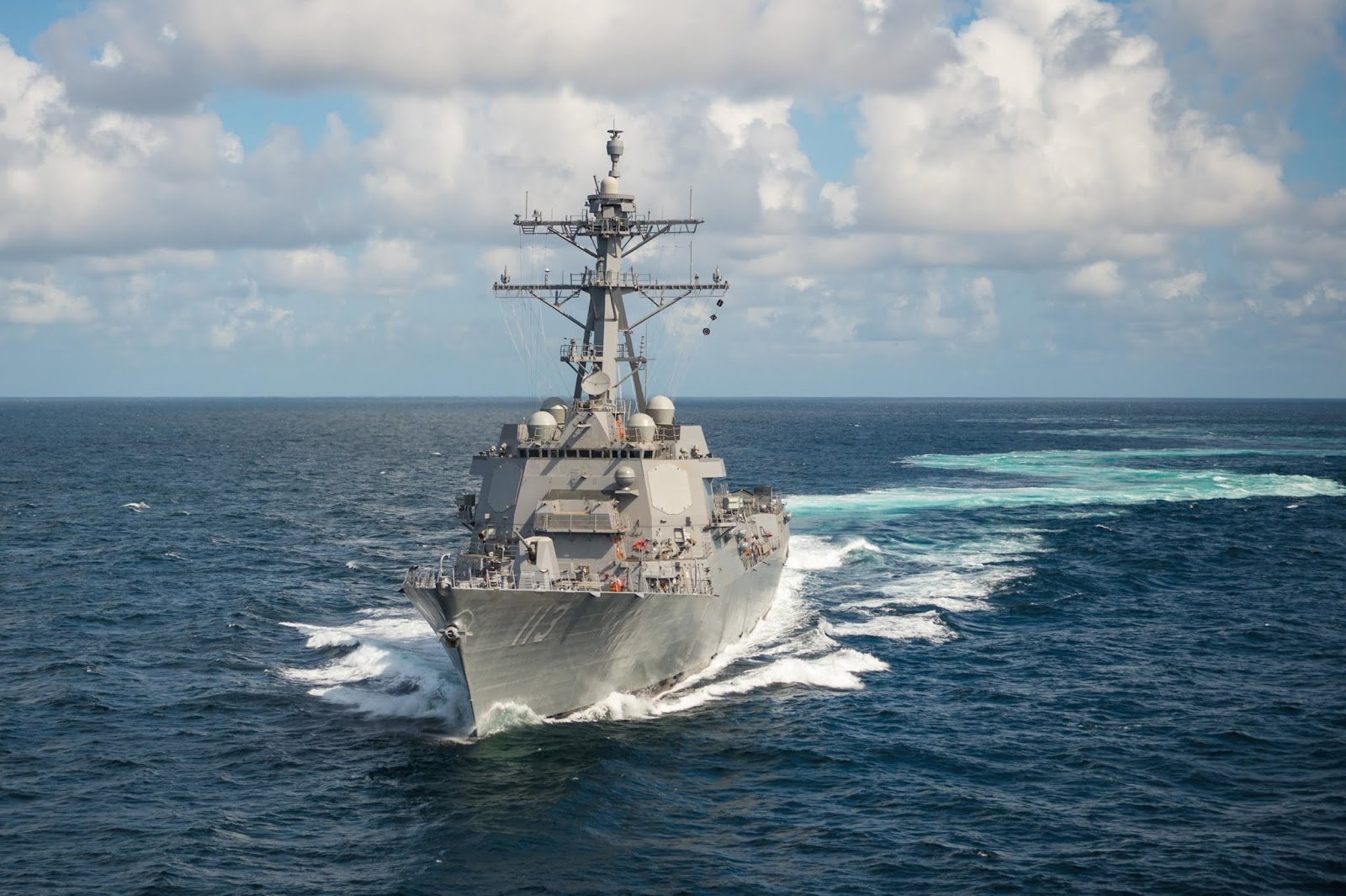
Aegis Combat System Demonstrates Success During At-Sea Test Against Medium Range Ballistic Missile

USS JOHN FINN, Oct. 26, 2018/PRNewswire/ -- The latest evolution of the Aegis Combat System, Baseline 9.C2 (BMD5.1) successfully supported an MDA-led at-sea Ballistic Missile Defense System test event. During the test, the Lockheed Martin (NYSE:LMT)-built Aegis Weapon System detected, tracked, engaged and launched a missile to intercept a Medium Range Ballistic Missile (MRBM) target.
The test, called Flight Test Standard Missile–45, demonstrated the integrated capabilities of the Aegis Weapon System and how it has continually evolved to counter advanced threats. This test demonstrated the new engagement assessment functionality, bi-directional missile communications and sensor improvement algorithms.
"This test authenticates the strengthening global security of the United States and its allies as we deepen the defense capabilities with the Aegis Ballistic Missile Defense System," said Paul Klammer, director, Aegis BMD. "This exercise showed that Aegis is the most advanced combat system and the proven choice for a layered defense."
This test builds upon joint research investments by the United States and Japan and comes on the heels of a successful test with the JS ATAGO (DDG 177) in September. Lockheed Martin is developing a Baseline 9/BMD 5.1 variant computer program, for deployment on Japan's Aegis destroyers.
As a proven world leader in systems integration and development of air and missile defense systems and technologies, Lockheed Martin delivers high-quality missile defense solutions that protect citizens, critical assets and deployed forces from current and future threats. The company's experience spans missile design and production, hit-to-kill capabilities, infrared seekers, command and control/battle management, and communications, precision pointing and tracking optics, radar and signal processing, as well as threat-representative targets for missile defense tests.

lunes, 10 de septiembre de 2018

Northrop Grumman to Highlight Leading Global Security Capabilities at Defense Expo Korea 2018

FALLS CHURCH, Va. – Sept. 9, 2018 – Northrop Grumman Corporation (NYSE: NOC) will highlight its advanced global security capabilities at Defense Expo Korea 2018 (DX Korea), booth 8D-31, in Ilsanseo-gu, Republic of Korea (ROK), Sept. 12-16. Known for its integrated digital avionics mission equipment package and capabilities in autonomous systems, C4ISR and multi-generation fighter interoperability, Northrop Grumman will feature its world-leading technology for the ROK Army and visitors.


On display at DX Korea will be Northrop Grumman’s integrated mission equipment package, which enables platform modernization that is affordable, safe and agile. Based on an open architecture design, Northrop Grumman’s advanced avionics solution enables rapid integration with existing hardware, making the system applicable to numerous platforms and missions.


The company will showcase its fully integrated digital avionics mission equipment package, which enables platform modernization that is affordable, safe and agile. Northrop Grumman’s mature, proven solution is based on an open architecture that enables rapid integration with existing hardware, simplifying upgrades and keeping life cycle costs low.
Northrop Grumman’s integrated mission equipment package can be applied to numerous platforms, including the ROK UH-60P fleet. The result is standardization across ROK military aircraft fleet, interoperability with the U.S. Army’s fleet, and a cost-effective avionics solution over the program’s life cycle. Warfighters benefit from improved situational awareness and mission safety, as well as reduced pilot workload. The company has provided its advanced technology for several U.S. military avionics upgrade programs, including E-2D, H-1 and the UH-60V.
The company’s combination of autonomous systems will help enhance the ROK’s intelligence, surveillance and reconnaissance (ISR) capability and national security. Northrop Grumman’s Global Hawk autonomous high altitude long endurance system and MQ-8C Fire Scout, the U.S Navy’s next generation autonomous helicopter, provide the capacity to unlock the full potential of South Korea’s ISR capabilities while protecting regional interests and national security.
In C4ISR, Northrop Grumman offers differentiated capability and battlefield/situational awareness with an integrated network of manned/unmanned platforms. The company is leading the development of the Integrated Air and Missile Defense (IAMD) Battle Command System (IBCS), a revolutionary command-and-control system developed to deliver a single, unambiguous view of the battlespace, as recently demonstrated over vast distances via the multi-node distributed test. This significantly enhances aircraft and missile tracking and improves the ability of combatant commanders and air defenders to make critical decisions within seconds. With a modular open systems architecture, IBCS allows integration of current and future sensors and weapon systems. IBCS enables “any sensor, best shooter” operations to optimize limited resources and facilitate flexible defense designs.
Northrop Grumman provides critical systems to enhance communications and situational awareness, including the APG-81 Active Electronically Scanned Array and the Freedom 550TMsoftware-defined radio. The company’s Multi-Role Electronically Scanned Array (MESA) Surveillance Radar provides air-to-air coverage, air-to-surface coverage, integrated identification friend or foe, special track beams and focused sector operation.

lunes, 6 de agosto de 2018

LOCKHEED MARTIN DELIVERS 52ND C-5M SUPER GALAXY

Delivery Completes Modernization Program


MARIETTA, Ga., Aug. 6, 2018 /PRNewswire/ -- Lockheed Martin (NYSE: LMT) delivered the 52nd C-5M Super Galaxy strategic transport modernized under the U.S. Air Force's Reliability Enhancement and Re-engining Program (RERP) on Aug. 2 at the company's Marietta, Georgia, facility.
The delivery completes the RERP upgrade, which extends the service life of the C-5 fleet out until the 2040s.
"With the capability inherent in the C-5M, the Super Galaxy is more efficient and more reliable, and better able to do its job of truly global strategic airlift," said Patricia Pagan, Lockheed Martin Air Mobility and Maritime Missions Strategic Airlift director, "I am very proud of the contractor-government team than carried out the C-5 fleet modernization effort. We've worked very hard to ensure the C-5Ms are the absolute best strategic airlifters possible for our armed forces."
An Air Force Reserve Command aircrew from the 439th Airlift Wing at Westover Air Reserve Base, Massachusetts, ferried the final C-5M to Stewart Air Force Base, New York, where the aircraft will undergo interior paint restoration. Once that work is complete, the aircraft will be flown to Westover where it will be the eighth C-5M assigned to the base.
Lockheed Martin began RERP development work in 2001. RERP incorporates more than 70 improvements that improve reliability, efficiency, maintainability and availability. RERP included changes or modifications to the airframe structure; environmental and pneumatic systems; hydraulic systems, electrical system; fuel system; landing gear; and flight controls.
The heart of the system is the GE F138 turbofan engine (known as a CF6-80C2L1F in the commercial world) de-rated to 50,000 pounds of thrust on the C-5M. This engine provides 22 percent more thrust than the out-of-production TF39 turbofans on the earlier C-5A/B/C aircraft. The engines also allow the C-5M to meet the FAA's Stage 4 noise reduction requirements.
These changes, taken together, result in a 22 percent increase in thrust, a shorter takeoff roll; a 58 percent improvement in climb rate; allows the C-5M to cruise—at maximum gross weight—in the Communication/Navigation/Surveillance / Air Traffic Management (CNS/ATM) flight environment; and greatly enhanced fuel efficiency and less tanker support demand.
First flight of a modified aircraft to the C-5M standard came in Marietta, Georgia, on June 19, 2006. The first operational C-5M was delivered to Dover Air Force Base, Delaware, on February 9, 2009. A total of 49 C 5Bs, two C-5C aircraft, and one original C-5A was modified under RERP.
The C-5M holds 89 FAI-certified world aviation records, the most by any aircraft type. These records include time-to-climb with payload, altitude with payload, and greatest payload carried.
The C-5 Galaxy has been operated solely by the U.S. Air Force since 1970 and is the largest strategic airlifter in the U.S. Air Force's fleet. The C-5 is capable of carrying two 78-ton M1A1 main battle tanks or helicopters and other large equipment intercontinental distances. Fully loaded, a C-5 has a gross weight of more than 800,000 pounds. All of the C-5s were built at Lockheed Martin's Marietta site.
In addition to Westover, C-5Ms are assigned to active duty and Air Force Reserve Command units at Dover Air Force Base, Delaware (436th and 512th Airlift Wings) and Travis Air Force Base, California(60th and 349th Air Mobility Wings). The C-5 aircrew training squadron is part of the 433rd Airlift Wing, the Reserve wing at Joint Base San Antonio-Lackland, Texas.

Northrop Grumman Supports Final Critical Design Review for the USCG Offshore Patrol Cutter

CHARLOTTESVILLE, Va. – Aug. 6, 2018 – Northrop Grumman Corporation (NYSE: NOC) supported Eastern Shipbuilding Group (ESG) in their Final Critical Design Review (FCDR) for the U.S. Coast Guard’s (USCG) Offshore Patrol Cutter (OPC) Program.


The Coast Guard Offshore Patrol Cutter. Rendering courtesy Eastern Shipbuilding Group.


Northrop Grumman serves as ESG’s C4ISR and control systems integrator for OPC, with responsibilities that include the integrated bridge, navigation, command and control, computing network, data distribution, machinery control, and propulsion control system design and production.
“Northrop Grumman has been a trusted member of the ESG team since the inception of the OPC program,” said Joey D’Isernia, president, ESG. “Their expertise in systems design and integration has contributed to ESG’s ongoing success in achieving the USCG’s requirements for the OPC platform.”
The OPC will be the Coast Guard’s newest class of cutters, with 25 ships planned for the class. It will provide the majority of offshore presence by the Coast Guard’s cutter fleet, assisting in missions ranging from combating transnational organized criminal networks off Central America to patrolling in the increasingly accessible Arctic.
“Northrop Grumman’s C4ISR and control systems architecture for OPC is innovative, affordable and open,” said Todd Leavitt, vice president, maritime systems, Northrop Grumman. “FCDR approval establishes a C4ISR/control systems design baseline that fulfills the newest generation of Coast Guard mission requirements, and is easily scalable for future platforms.”
FCDR was held on June 27-28, with OPC Production Readiness Review to follow later this year. Northrop Grumman will operate the OPC Test and Integration Facility for C4ISR, and the Land-Based Test Facility for control systems, at their facility in Charlottesville.

Northrop Grumman Serves as “Titanium Patron” of 2018 Space and Missile Defense Symposium

Company to highlight expanded portfolio of missile defense capabilities at the annual conference

HUNTSVILLE, Ala. – Aug. 6, 2018 – Northrop Grumman Corporation (NYSE: NOC) will be presenting an expanded portfolio of transformative modular, scalable and software-enabled air and missile defense technologies, products and services at this year’s Space and Missile Defense (SMD) Symposium.


As global threats evolve, so does Northrop Grumman – harnessing flight proven technology and the disruptive force of digital transformation to deliver a decisive advantage. Our interceptors, targets, propulsion systems, and modular open architecture enable secure, affordable and reliable capabilities to address and outpace the advancing threat. That’s why we’re a leader in missile defense.


Northrop Grumman will have an expanded presence at the show with the addition of its new Innovation Systems (IS) sector. IS adds a range of capabilities to Northrop Grumman’s portfolio, to include targets, interceptors, propulsion systems and satellites.
The annual defense conference in Alabama’s “Rocket City” brings together government and industry leaders from around the world, with a focus on defending warfighters and civilian populations from some of the world’s most devastating threats. As the titanium sponsor, Northrop Grumman will host the annual “Salute to the Warfighter” celebration to recognize those who serve in the defense of our nation.
In keeping with this year’s theme, “Space and Missile Defense: Sharpening the Military’s Competitive Edge,” Northrop Grumman will be discussing how our missile defense solutions can help customers keep pace with new and evolving threats from undersea to space.
“Northrop Grumman harnesses the disruptive force of digital transformation to deliver software-driven, hardware-enabled solutions, giving the U.S. and its allies a decisive advantage,” said Bob McCaleb, Northrop Grumman’s corporate lead executive for Huntsville and SMD Symposium industry chair. “To succeed, we apply innovation to all of our programs, and multiply that through partnerships with small business suppliers who share our commitment to our national defense.”
The symposium takes place at the Von Braun Center in downtown Huntsville, with Northrop Grumman exhibiting at booth 501. Guests can experience an interactive augmented reality demonstration of short, mid and long-range missile defense solutions. There will be models of targets and interceptors available for viewing.
Northrop Grumman will participate in speaking panels and presenting a number of white papers at the conference. Kenneth Todorov, vice president of missile defense solutions, Northrop Grumman, will be the company’s lead presenter.
“We’re very proud to be the top sponsor of this important event,” Todorov said. “By harnessing the combined products, technologies and services of our four business sectors, Northrop Grumman is ready now to shape the future to ensure our customers continue to outpace ever-developing threats.”
During the symposium, Northrop Grumman executives will engage with customers about how our digital transformation can solve challenges in an increasingly complex threat environment. They will also discuss how the complementary capabilities of Innovation Systems allow Northrop Grumman to provide end-to-end air and missile defense solutions from “left of launch” to intercept and assessment.
Northrop Grumman is a key supplier of transformative space and missile defense products, both as a leading prime and strategic supplier. We are responsible for critical portions of the U.S.’s top missile defense programs including the Missile Defense Agency’s Ground-based Midcourse Defense (GMD), U.S. Army’s Integrated Air and Missile Defense Battle Command System (IBCS) and missile targets.

miércoles, 25 de julio de 2018

Leonardo launches LEAP2020 programme to optimise its supply chain

- The  LEAP2020  programme  (Leonardo  Empowering  Advanced  Partnership  2020)  is  a  new model  for  Leonardo’s  supply-chain  which  will  drive  growth  in  the  Aerospace,  Defence and  Security  sector.  Visible  results  in  scale  and  quality  are  expected  in  the  short  and long  term   

- Profumo:  “LEAP2020,  one  of  the  strategic  drivers  of  our  Industrial  Plan,  is  an  innovative approach  to  supply  chain  management,  creating  a  virtuous  circle  that  will  strengthen both  Leonardo  and  the  industrial  structure  of  the  country  system” 

- In  its  initial  phase,  the  programme  will  focus  on  strategic  suppliers,  those  which  the Company spends  around  1 billion  Euros  with

Rome,  25  July  2018  –  Leonardo  has  launched  the  LEAP2020  (Leonardo  Empowering  Advanced Partnerships  2020)  programme,  an  initiative  outlined  in  the  Company’s  2018-2022  Industrial  Plan  which will  create  a  new  model  for  the  relationship  between  Leonardo  and  its  suppliers.  The  project’s  aim  is  to drive  the  growth  of  Leonardo’s  supply  chain  in  terms  of  both  scale  and  quality,  starting  with  the Company’s  Italian  supply  chain  but  extending  internationally.  Named  to  evoke  the  concepts  of momentum  and  progress,  LEAP2020  will  see  Leonardo  and  its  suppliers  sharing  future  challenges  and opportunities,  enabling  Leonardo  to  improve  its  performance  in  areas  such  as  quality  and  on-time delivery. 

“The  LEAP2020  programme,  one  of  the  initiatives  in  our  2018-2022  Industrial  Plan,  is  an  innovative approach  to  supplier  management”  said  Alessandro  Profumo,  CEO  of  Leonardo,  adding  “It  will  create  a virtuous  circle  that  will  strengthen  the  Company  and,  more  broadly,  the  industry  as  part  of  country system  as  well  as  presenting  more  consolidation  opportunities  in  the  sector.  The  project  is  based  on  an open  platform  that,  starting  with  one-to-one  relationships  with  each  supplier,  will  lead  to  real,  mutually beneficial  partnerships”.   

In  its  initial  phase,  LEAP2020  will  focus  on  suppliers  which  are  considered  of  strategic  importance  to Leonardo,  those  that  the  Company  spends  around  1  billion  Euros  with  and  which  supply  to  multiple Leonardo  divisions.  The  programme  defines  a  model  for  the  selection  of  a  new  “growth  partner”  based on  an  independent  assessment  of  a  supplier  in  terms  of  capability,  competitiveness,  transparency, traceability  and  sustainability.  Clusters  of  similar  suppliers  will  be  created  (from  peers  to  “national  and international  champions”)  and for  each  cluster  Leonardo  will  establish  an  approach  tailored  to  drive  their growth  in  size  and  levels  of  quality.  Leonardo  is  looking  to  grow  alongside  suppliers  which  offer  high levels  of  technology  and  capabilities,  offering  support,  closer  integration  and  new  business opportunities. 

The  LEAP2020  programme  will  generate  benefits  in  the  short  term,  with  larger  gains,  in  some  cases  in the  region  of  20%  improvements  in  deliveries  and  quality,  expected  in  2020.  The  programme  will  help meet  the  objectives  of  Leonardo’s  Industrial  Plan  which  credibly  foresees  medium  to  long-term  growth with  a  strong focus  on  execution.

Wider  benefits  of  the  programme  will  include  more  solid  and  sustainable  relationships  between Leonardo  and  its  best-performing  partners,  a  strengthening  of  the  supplier  base  in  identified  highimpact  categories,  and  a  level  of  promotion  for  the  companies  who  play  a  part  in  Leonardo’s  productive eco-system.  The  long-term  partnerships  will  also  benefit  from  capacity-building  initiatives  aimed  at transferring  technical  and  management  skills  and  improving  supplier’s  business  relations  with  the sector’s  main  international  players. 

Overall,  LEAP2020  is  a  win-win  approach  that  offers  meaningful  opportunities  for  both  Leonardo  and  its suppliers.  Leonardo  will  be  able  to  improve  the  sustainability,  performance  and  capability  of  its business,  allowing  it  to  more  effectively  meet  the  requirements  of  its  customers,  achieve  important  cost savings  and  streamline  its  purchasing  activity.  On  the  supplier’s  side,  the  “country  system”  will  benefit from  better-performing  and  more  innovative  companies  with  a  stable  investment  horizon,  better  able  to compete  in  the  global  marketplace. 

lunes, 23 de julio de 2018

Northrop Grumman Appoints Nick Chaffey as Chief Executive, UK and Europe


LONDON - July 23, 2018 - Northrop Grumman Corporation (NYSE:NOC) named Nick Chaffey as chief executive for the United Kingdom and Europe, effective Aug. 28, 2018. He will play a leading role supporting the company's current programmes, developing strategies for growth and identifying new business opportunities for the company's activities in the U.K. and Europe, including NATO countries.
Chaffey joins Northrop Grumman after a 25-year career at PA Consulting Group where he was the founder and lead for PA’s Global Defence and Security Business, and previously the Global Head of Consulting Services, and a Member of the Board of PA Holdings Limited. Prior to that he spent six years in the Royal Corps of Naval Constructors at the Ministry of Defence.
"Nick brings a wealth of experience to Northrop Grumman as well as deep industry knowledge in defence and security gained in the consulting and public sectors," said David Perry, corporate vice president and chief global business development officer, Northrop Grumman. "His appointment is important for our future success in the U.K. and Europe as we continue expanding our international presence and broadening our market focus to one that is increasingly global. I am delighted that he is joining us at this time."
Chaffey earned a bachelor’s degree in electronic and optoelectronic engineering from University College London and a master’s degree from Imperial College Business School, specialising in strategic programme design and delivery.
Northrop Grumman is a leading global security company providing innovative systems, products and solutions in autonomous systems, cyber, C4ISR, strike, and logistics and modernization to customers worldwide. Please visit news.northropgrumman.comand follow us on Twitter, @NGCNews, for more information.

martes, 17 de julio de 2018

LOCKHEED MARTIN AND THALESRAYTHEONSYSTEMS JOIN FORCES TO PROVIDE THE NATO ALLIANCE WITH BATTLESPACE INTELLIGENCE SYSTEM

NATO countries soon to be protected by the development of an advanced territorial Ballistic Missile Defence to protect The Alliance's European populations and territories


FARNBOROUGH, England, July 17, 2018/PRNewswire/ -- Lockheed Martin (NYSE: LMT) and ThalesRaytheonSystems are joining forces to provide the NATO Alliance with a territorial Ballistic Missile Defence (BMD) command and control capability.  This Teaming Agreement, signed in the presence of Raytheon and Thales, the two shareholders of the joint venture, establishes a transatlantic team that combines the depth and breadth of decades of expertise from Lockheed Martin and Raytheon, with the European air command and control capabilities of Thales.  The overall team will include industry representatives from across the Alliance to deliver a low risk capability for NATO's Air Command and Control BMD program.
At the 2010 Lisbon Summit, NATO leaders decided to develop a Missile Defence Capability to protect all NATO European populations and territories against ballistic missile attacks.  The Alliance's Heads of State and Government stated that they see this as a core element of NATO's collective defence task in view of the growing threat of the proliferation of ballistic missile technology and weapons of mass destruction.  The focus of the Programme is the upgrade, test and integration of NATO's command and control (C2) systems and underlying communication network to enable effective information exchanges between various NATO and national missile defence systems. This integrated system-of-systems architecture will provide NATO forces, whether deployed within or beyond NATO's area of responsibility, with the capability to defend NATO populations and territories.
Dave Gulla, vice president of Mission Systems and Solutions, Raytheon Integrated Defense Systems, stated, "Our companies are committed to providing the best technical and program talent available to provide a low risk and operationally relevant NATO BMD capability.  We are confident that this teaming framework creates the best value for NATO and ensures delivery of a timely and effective territorial BMD capability."
"Lockheed Martin delivered the Defence Design System for NATO's BMD planning capability. We will leverage that success, as well as our expertise in command and control, weapon system development and systems integration to achieve the Alliance goals," said Dr. Rob Smith, vice president of C4ISR for Lockheed Martin's Rotary and Mission Systems.  "Lockheed's success in delivering the C2 capability for US Ballistic Missile Defense System is a result of our focus on end user needs.  We delivered a very complex C2 capability that is intuitive and effective for mission execution.  We accomplished this in partnership with Raytheon and other US companies and we look forward to delivering this capability with Thales and TRS." 
"This teaming agreement is perfectly aligned with our four companies orientations towards both system of systems innovative solutions and reinforcing existing partnerships, which proved its value through the previous joint successes such as Theater Missile Defense," said Thomas Got, Head of the Air Operations and Weapons System line of business for Thales Group.  "Our companies will join the best of each in meeting NATO's command and control needs."
According to Eric Marceau, CEO of the TRS Joint Venture, "This Teaming Agreement codifies the relationship established with Lockheed Martin in 2008 to deliver NATO's Theater Missile Defence capability.  It will further our collaboration to deliver the full spectrum capability the Alliance requires for territorial Ballistic Missile Defense.  This team will provide the operational command and control capability for the protection for all NATO European populations, territory and forces against the threats posed by ballistic missiles."

miércoles, 11 de julio de 2018

Leonardo and PGZ sign letter of intent on the AW249 combat helicopter

Leonardo and Polska Grupa Zbrojeniowa S.A. (PGZ) signed a Letter of Intent (LoI) that will see the two companies collaborate on the AW249, the only new combat helicopter currently being designed, aiming to meet the Polish Army’s requirement for a new combat helicopter.  

With this LoI, Leonardo and PGZ will explore collaboration in a number of areas including design, manufacturing, final assembly, marketing and aftersales support for the AW249 helicopter.  

The document reinforces PGZ and Leonardo’s common interest in the development and production of a new combat helicopter, created for the needs of the Italian Army, and its Polish variant which is being considered under Poland’s "Kruk" procurement.  

Thanks to this collaboration, Poland’s defence industry will have the unique opportunity to participate in a brand new helicopter development programme, while at the same time contributing to the modernization plans of the Polish Armed Forces with a new state-of-the-art platform. 

Gian Piero Cutillo, Managing Director of Leonardo Helicopters, said: “This agreement is a significant milestone in the on-going cooperation between Italian and Polish defence industries, involving the latter in the most important ongoing combat helicopter programme. Leonardo, through PZL-Swidnik, has been working with the Polish Ministry of National Defence for years and this agreement opens new avenues of response to the Kruk programme, allowing us to address the future of Polish defence alongside PGZ.”  

Jakub Skiba, President of the Management Board of PGZ, said: “Today's agreement opens up new opportunities for PGZ Companies in the Aviation Domain. Cooperation with Italian industry in the joint development of solutions for our Armed Forces in the "Kruk" programme will allow us to expand our capabilities and  involve our companies – in close cooperation with Leonardo’s PZL-Swidnik plant - in the AW249 programme. This high technology programme, led by Leonardo, will be also promoted in further markets”. 

The AW249 will feature all the latest technology developments in its market segment and will benefit from the extensive operational expertise logged by Leonardo’s AW129 and the know-how of the Company in this specific helicopter sector.  

With  a  MTOW  in  the  range  of  7-8  tonne  and  useful  load  in  excess  of  1800kgs,  the AW249  will  have  speed  and  endurance  that  is  able  to  sustain  the  most  difficult  close air  support  and  armed  escort  operations.    The  AW249  will  feature  state-of-the-art communication  and  battlefield  management  systems;  its  mission  system  is  able  to operate  and  manage  UAVs  and  features  a  number  of  situational  awareness  aids  to reduce  pilot  workload  and  increase  safety.  Additionally,  thanks  to  its  advanced technologies  and  design  philosophy,  the  AW249  will  have  significant  improvements  in life-cycle  costs  over  previous  generation  helicopters.   

In  addition  to  a  turreted  gun,  the  AW249  will  have  a  flexible  weapon  system  with  six wing  store  stations  that  can  carry  a  combination  of  air-to-ground  or  air-to-air  missiles, unguided/guided  rockets  or  external  fuel  tanks.  Two  powerful  engines  will  allow  for operations  in  all  environmental  conditions  (cold,  hot  &  high  and  maritime). 

Leonardo  and  PGZ  have  an  established  dialogue  on  defence  and  security  industrial cooperation,  with  multiple  agreements  signed  in  2016,  2017  and  2018.  The  aim  of these  agreements  is  to  strengthen  cooperation  between  the  PGZ  Group  and Leonardo,  particularly  in  relation  to  the  helicopters  offered  by  Leonardo  to  the  Polish Ministry  of  Defence.  Should  Leonardo  be  selected  by  the  Polish  MoD  for  the  new helicopter  requirements,  companies  in  the  PGZ  Group  will  take  part  in  the manufacture  and  servicing  of  helicopters.

Leonardo  signed  a  multiyear  contract  with  the  Italian  Ministry  of  Defence  in  January 2017,  aimed  at  meeting  the  requirement  of  the  Italian  Army  to  replace  the  current fleet  of  AW129s,  which  are  expected  to  be  retired  from  service  by  2026  following  over 35  years  in  operations.  It  will  allow  the  service  to  introduce  an  even  more technologically  advanced  product,  with  greater  performance  and  lower  operating costs,  to  meet  arising  needs  in  evolving  scenarios  for  the  next  30  years. 

martes, 26 de junio de 2018

Australia to Purchase Triton Aircraft System, Delivering Unprecedented Maritime Domain Awareness

The first operational MQ-4C Triton comes in for a landing at Naval Base Ventura County, Point Mugu, on November 9. (Photo credit: U.S. Navy)


The Australian Department of Defence­ officially announced its plan on June 26, 2018 to purchase the Northrop Grumman Corporation (NYSE: NOC)-built Triton aircraft system, further cementing the company’s commitment to a longstanding U.S. ally.
An unmanned aircraft system with an autonomous capability built for maritime intelligence, surveillance and reconnaissance, Triton is the first Northrop Grumman-built aircraft system Australia has purchased. The system will be operated by the Royal Australian Air Force (RAAF).
“Northrop Grumman looks forward to bringing the Triton unmanned system with its autonomous capability to Australia,” said Ian Irving, chief executive officer, Northrop Grumman Australia. “Working with the Royal Australian Air Force and the U.S. Navy, we are confident that we can provide the best capability to fulfill Australia’s maritime mission.”
(L to R) Northrop Grumman Chairman and CEO Wes Bush, Prime Minister of Australia Malcolm Turnbull, Australian Minister for Defence Marise Payne, Australian Minister for Defence Industry Christopher Pyne and Australia’s Chief of Air Force Air Marshal Leo Davies AO, CSC.
Triton can fly at altitudes of 55,000 feet for 24 hours at a time and is equipped with sensors that provide high-resolution imagery and near real-time video. Pilots and sensor operators fly the Triton from ground stations, which can command flights all over the world.
“Triton provides unprecedented endurance and 360-degree coverage through its unique sensor suite,” said Doug Shaffer, vice president of Triton programs, Northrop Grumman. “Australia has one of the largest sea zones in the world over which it has rights to use marine resources, also known as an Economic Exclusion Zone. As a flexible platform, Triton can serve in missions as varied as maritime domain awareness, target acquisition, fisheries protection, oil field monitoring and humanitarian relief.”
Triton builds on Northrop Grumman’s legacy of success in autonomous systems. The U.S. Navy recently acquired two operational Triton aircraft and is under contract for six more. These aircraft will go to Guam later this year and provide the Navy with an unprecedented common operating picture of the maritime environment. Triton can detect, classify and track ships over large swaths of ocean and littorals. The U.S. Navy program of record is for 68 aircraft.
Northrop Grumman has been building its presence Down Under for many years. The global aerospace and technology company will be the anchor tenant of an AUD $50 million Electronic Sustainment Centre of Excellence, to be established at the Badgerys Creek Airport precinct in western Sydney. The new centre will support advanced electronics such as communications and electronic warfare equipment, and targeting pods. Northrop Grumman will bring together highly skilled technicians, engineers and other professionals whose work will be further supported by the company’s high-end technology and software expertise.
Through a Global Supply Chain Deed signed with the Australian Department of Defence in 2011 and renewed in 2017, Northrop Grumman is identifying opportunities for Australian industry to be part of the company's global supply chain. For example, Northrop Grumman’s largest Australian F-35 Lightning II joint strike fighter supplier, Quickstep Technologies, demonstrated that its new production facility is equipped and qualified to manufacture and deliver quality composite parts for the F-35’s centre fuselage. At a new facility opened in Bankstown, Sydney, in 2012, Quickstep is expected to manufacture over 36,000 parts for the F-35.
Northrop Grumman also works with CEA Technologies, one of Australia's leading military electronic systems and radar companies, and Electro Optics Systems, which develops products incorporating advanced electro-optic technologies for the global aerospace market.
“Australia and the United States are celebrating 100 Years of Mateship this year, marking an alliance that goes back to the trenches of WWI. Northrop Grumman is proud to partner with such a loyal friend and provide this unprecedented capability to the RAAF,” said Irving. “We consider Triton and its autonomous technology to be the future of the next centennial of aviation, and we are honored to be part of this century-long partnership.”
lunes, 25 de junio de 2018

LOCKHEED MARTIN APPOINTS BOB HARWARD TO LEAD MIDDLE EAST BUSINESS

Harward’s role to expand beyond the UAE to support regional business growth in one of the company’s most important global markets


ABU DHABI, UAE, June 25, 2018– Lockheed Martin (NYSE: LMT) today announced Robert (Bob) S. Harward will expand his role to lead the company’s growing Middle East business as the Chief Executive for Lockheed Martin in the Middle East. In this new role he will be responsible for the company’s strategy, operations and growth in the UAE, Bahrain, Kuwait, Oman, Jordan, Lebanon, Qatar, Pakistan, Iraq and Afghanistan.
“Bob has exceptional experience across the region and unparalleled knowledge of how our technology can help solve our Middle East partners’ greatest security challenges,” said Richard H. (Rick) Edwards, Executive Vice President of Lockheed Martin International. “I am confident that under Bob’s leadership we will continue to drive our Middle East business forward and help strengthen global security.”
Harward previously served as the company’s Chief Executive for the United Arab Emirates. A lifelong national security leader, he served on the National Security Council for the Bush Administration, commissioned the National Counter Terrorism Center, and has extensive combat and counterterrorism experience as a United States Navy SEAL. Prior to joining Lockheed Martin in 2014, he was a Vice Admiral (SEAL) in the United States Navy.

LOCKHEED MARTIN AWARDED CONTRACT TO BUILD F-16 BLOCK 70 AIRCRAFT FOR BAHRAIN

World's first Block 70 aircraft will be built in Greenville, South Carolina


FORT WORTH, Texas, June 25, 2018/PRNewswire/ -- Lockheed Martin (NYSE: LMT) received a $1.2 billion contract from the U.S. government to produce 16 new F-16 Block 70 aircraft for the Royal Bahraini Air Force. The Undefinitized Contract Action award represents the first F-16 Block 70 sale and the first F-16 production program to be performed in Greenville, South Carolina.

The Kingdom of Bahrain is the first customer to procure the F-16 Block 70, the newest and most advanced F-16 production configuration.

"We value our long-standing relationship with the Kingdom of Bahrain and look forward to beginning production activities on their first Block 70 aircraft at our facility in Greenville," said Susan Ouzts, vice president of Lockheed Martin's F-16 Program. "This sale highlights the significant, growing demand we see for new production F-16s around the globe."

Lockheed Martin expects F-16 production to create between 150 and 200 new jobs in Greenville. F-16 production also supports hundreds of U.S.-based Lockheed Martin engineering, procurement, sustainment and customer support jobs and thousands of U.S. supplier jobs. The F-16 supply chain is currently supported by 450 U.S. suppliers in 42 states.

The F-16 Block 70 features advanced avionics, a proven Active Electronically Scanned Array radar, a modernized cockpit, advanced weapons, conformal fuel tanks, an automatic ground collision avoidance system, an advanced engine and an industry-leading extended structural service life of 12,000 hours.

The combat-proven F-16 continues to prove itself as the world's most successful, combat-proven multi-role fighter. To date, 4,604 F-16s have been procured by 28 customers around the world. Approximately 3,000 operational F-16s are flying today with 25 leading air forces, including the U.S. Air Force.

jueves, 21 de junio de 2018

Airbus technologies take the spotlight at one of the world’s largest defence and security exhibitions

Meeting today’s defence and security challenges requires increasingly connected solutions, as underscored by Airbus’ diversified product lines that were exhibited during this month’s Eurosatory international exhibition near Paris.

One of the capabilities highlighted at Eurosatory was Airbus’ hybrid networks, bringing seamless connectivity management services spanning disparate networks – whether digital or analogue; and deployed on the ground, in the air or in space.

Airbus’ solution provides collaboration between networks having their own characteristics, without the need to create a new network. The company’s offer addresses a wide range of users’ requirements, including government customers (defence and public safety) as well as commercial operators (large corporations and critical infrastructure).

Key features of Airbus hybrid networks include intelligent tactical routing, authentication that ensures end-to-end security, and the adaptability to such new technologies as SDN (software defined networking) and NFV (network function virtualisation).

Augmented decision-making
The Eurosatory exhibition also provided the venue for Airbus’ display of its augmented decision-making capabilities with the innovative “Holographic Tactical Sandbox.” Using augmented reality technology and high-resolution 3D imagery to create a holographic map, the “Holographic Tactical Sandbox” creates a highly accurate representation of the battlefield that is viewable via augmented reality helmets.

This decision-making tool provides real-time shared situational awareness and enhanced mission effectiveness, enabling operators to view information and create situations for mission preparation, mission briefings and rehearsals – which then can be shared with higher decision-making levels of command.

The “Holographic Tactical Sandbox” is interoperable with Airbus’ Fortion® TacticalC2 tactical battle management software – a single software solution for use throughout the command chain with automatic data synchronisation.

A greater focus on connectivity
The connectivity theme at Eurosatory extended as well to Airbus’ agile imagery capabilities. It brings “space-eye” views from Airbus-built smart constellations of radar and optical satellites together with real-time video and information using the company’s Zephyr high altitude pseudo-satellite (HAPS), as well as images from enduring drones at high, medium and low altitudes (illustrated at Eurosatory by the ALIACA and DVF 2000 ER unmanned aerial vehicles from Airbus’ Survey Copter subsidiary, and the VSR 700 rotary-wing system developed for naval applications based on Airbus helicopter expertise).

Eurosatory visitors are given a demonstration of Airbus’ innovative “Holographic Tactical Sandbox” decision-making tool, which provides real-time shared situational awareness and enhanced mission effectiveness

martes, 19 de junio de 2018

Northrop Grumman Opens New Illinois Facility with Ribbon Cutting and Reception

ROLLING MEADOWS, Ill. – June 19, 2018 – Northrop Grumman Corporation (NYSE: NOC) hosted a ribbon cutting ceremony and reception for the opening of its newest facility in Illinois. Congressman Raja Krishnamoorthi, 8th District of Illinois, Congressman Peter Roskam, 6th District of Illinois, Arlington Heights Mayor Thomas W. Hayes and local community leaders were special guests for the celebration.


Congressman Raja Krishnamoorthi and Congressman Peter Roskam, alongside Northrop Grumman executives and state and local leaders, celebrate the opening of the newest Northrop Grumman facility in Arlington Heights, Ill. (L – R: Ken Crews, vice president business management, land & avionics C4ISR, Northrop Grumman Mission Systems; Congressmen Raja Krishnamoorthi; Mary Petryszyn, vice president & general manager, land & avionics C4ISR, Northrop Grumman Mission Systems; Congressman Peter Roskam; Arlington Heights Mayor Thomas Hayes; and State Senator Julie Morrison.)


“It’s wonderful to see Northrop Grumman opening this new facility as it will continue creating jobs, bringing new investment to our area, and helping to ensure that our men and women in uniform will have the best technology and equipment available,“ said Congressman Raja Krishnamoorthi. “I’m also heartened by Northrop Grumman’s ongoing commitment to STEM education partnerships, internships, and other programs which strengthen its workforce along with that of our entire region.”
Northrop Grumman’s new facility is 40,000 square feet situated at 1421 West Shure Drive in Arlington Heights. The location will provide additional office space for employees supporting Northrop Grumman’s land and avionics C4ISR division. The building is a concrete symbol of the company’s growing presence in the greater Chicago region.
“I want to congratulate Northrop Grumman on opening a new facility in Arlington Heights that will employ many people in the Sixth District,” said Congressman Peter Roskam. “Their strong ties to the community – promoting STEM education through robotics competitions and scholarships to Space Camp and partnering with community organizations – is an added value to Arlington Heights and I’m pleased that they’ve chosen our state to call home. This new facility paves the way for an increase in innovation while also creating many jobs in the process. I’m looking forward to the positive impact the new facility will have on my constituents, opening up the possibility for great opportunities.”
“Our expanded footprint enables us to better serve our customers in support of national security,” said Mary Petryszyn, vice president and general manager, land and avionics C4ISR, Northrop Grumman. “This investment in our employees and in the local community will also enable a variety of new opportunities.”
The ceremony took place at the new Northrop Grumman facility with remarks by Congressman Krishnamoorthi, Congressman Roskam and Mayor Hayes. The event was attended by other elected officials, members of the community, local partners in science, technology, engineering and mathematics (STEM) education, as well as Northrop Grumman employees.