miércoles, 28 de marzo de 2018

A King Has Arrived: Sikorsky CH-53 King Stallion Heavy Lift Helicopter Arrives in Germany for International Debut

King Stallion will demonstrate its flight capabilities and maneuverability at ILA Berlin Air Show


HOLZDORF, GermanyMarch 28, 2018 /PRNewswire/ -- A CH-53K heavy lift helicopter built by Sikorsky, a Lockheed Martin company (NYSE: LMT), arrived in Holzdorf, Germany, ahead of its international debut at the ILA Berlin Air Show next month.
This is the first time a King Stallion helicopter has been loaded into a C-17 Globemaster and transported to the base of a European ally.
"We are excited for the opportunity to showcase the capabilities of this all new CH-53K heavy lift helicopter to an international audience. This is the only true heavy lift helicopter in production," said Sikorsky President Dan Schultz.
Sikorsky demonstrated the King Stallion's strategic airlift capability during an exercise at the Sikorsky Development Flight Center in West Palm Beach, Florida, prior to the departure for Germany.
A trained Sikorsky crew partially disassembled the CH-53K helicopter, loaded it into the C-17 cabin and then unloaded the helicopter while representatives from Naval Air Systems Command and the U.S. Marine Corps observed the exercise. As a result, the CH-53K program achieved its Air Transportability Test Loading Activity certification from the U.S. Air Force.
The CH-53K King Stallion test program recently completed the following milestones: maximum weight single-point cargo hook sling load of 36,000 pounds (16,329 kilograms); forward flight speed of 200 knots; 60 degrees angle of bank turns; 12-degree slope landings and takeoffs; external load auto-jettison; and gunfire testing. These milestones come just weeks ahead of Sikorsky delivering the first CH-53K helicopter to the U.S. Marines.
The helicopter will remain at the Holzdorf Air Base, a military airfield operated by the German Air Force (Luftwaffe), until the start of the ILA Berlin Air Show. The CH-53K will showcase its capabilities, maneuverability and advanced fly-by-wire technology during demonstration flights at the air show.
The CH-53K aircraft is an all-new aircraft, using modern intelligent design. The rugged CH-53K is designed to ensure reliability, low maintenance, high availability and enhanced survivability in the most austere and remote forward operating bases.
The CH-53K helicopter is the best choice for completing missions like humanitarian aid, troop transport, casualty evacuation, support of special operations forces, and combat search and rescue. No matter the mission, the aircraft will provide the highest degree of safety for its crew and occupants in all conditions.
For additional information, visit our website: https://lockheedmartin.com/ch-53k

martes, 27 de marzo de 2018

Honeywell: SmartRunway and SmartLanding

TOTAL RUNWAY POSITIONAL AWARENESS

Lockheed Martin to Integrate its Tank Protection Technology for Testing on U.S. Army Vehicles

ORLANDO, Fla.March 27, 2018 /PRNewswire/ -- The U.S. Army's Tank Automotive Research, Development and Engineering Center (TARDEC) has awarded Lockheed Martin (NYSE: LMT) a next-phase contract to continue maturing the Modular Active Protection Systems (MAPS) controller base kit hardware and software and to support government integration efforts ahead of platform demonstrations scheduled to take place through 2019.
MAPS is designed to enable protection of vehicles and their occupants by integrating sensors and countermeasures in a common framework to detect and defeat existing and emerging threats.
Lockheed Martin delivered five MAPS controllers to TARDEC in 2017. As part of the 16-month follow-on effort, its engineers will work with TARDEC to mature the base kit hardware and software and to support integration of the MAPS Base Kit with existing sensors and countermeasures for U.S. Army virtual and range demonstrations on combat vehicles.
"Our MAPS offering is ready to support field tests using today's platforms and active protection system components," said Paul Lemmo, vice president of Sensors & Global Sustainment at Lockheed Martin Missiles and Fire Control. "A modular and open-architecture design means any component can be selectively upgraded across all MAPS-enabled platforms to address emerging threats. That promotes affordability by extending the system's life cycle, and boosts protection for the warfighter without increasing vehicle weight."
The TARDEC MAPS Base Kit, delivered by Lockheed Martin, consists of a controller, user interface, power management distribution system and application software. It integrates Modular APS Framework (MAF)-compliant components, sensors and countermeasures to detect and defeat threats targeting MAPS-equipped vehicles. In addition to current combat vehicle platforms, it is designed to support future vehicle protection system capabilities. A "MAPS: Ahead of the Threat Curve" videoprovides additional information about the system.

Sikorsky, a Lockheed Martin Company, Recognizes Top Suppliers

WEST PALM BEACH, Fla.March 27, 2018 /PRNewswire/ -- Lockheed Martin's (NYSE: LMT) Sikorsky line of business honored its top suppliers at a recent ceremony in West Palm Beach, Florida
Twenty-six suppliers were recognized March 15, including 19 that received honors as Sikorsky Elite Suppliers for best-in-class performance in achieving on-time delivery, cost and quality standards during 2017.
Sikorsky Program Supplier of the Year award recipients
  • Black Hawk program support:  Safran – Chihuahua, Mexico, provided the main harnesses for the UH-60M and HH-60M aircraft models resulting in historic cost savings over Multi-Year VIII prices. Safran also was honored as an Elite Supplier (see below).
  • HH-60W Combat Rescue Helicopter: RA Lalli - Stratford, CT. RA Lalli was awarded 90 new parts on the CRH program, offering competitive pricing while beating the lead time requirements of the program.
  • VH-92A: TIGHITCO - Berlin, CT. TIGHITCO provides the complex forward and aft stair doors for the VH-92 development program.  TIGHITCO accepted the challenge of this complicated component and has delivered to its commitment.
  • S-97 Raider®: Triumph Gear Systems – Park City, UT. Triumph worked collaboratively with Sikorsky to develop a plan to reduce lead time on the gear box for the Raider program, supporting aircraft build schedule, while also supporting the JMR SB1> DEFIANT™ program.
  • Aftermarket: Senior Aerospace - Enfield, CT. Senior provides world class customer service and support, as well as quick turn times to quote requests. Their Enfield facility is an industry leading shop.
  • CH-53K King Stallion:  UTAS-Rome - Rome, NY. UTAS provides the tail drive components, shafts, bearing assemblies and disconnect couplings for the CH-53K.  The company has supported quick repair turn-around time, early flight tests and has been forward looking on product improvements using the latest technologies.
  • Canadian Maritime Helicopter Program CH-148 Cyclone:  Global Tooling Systems (GTS) – Macomb, MI, GTS provided the straightening tool prototype for the CMHP program that were well received by the customer and performed beyond expectations.  
Sikorsky Elite Supplier honorees
  • Aero Gear, Windsor, CT, engineering and manufacturing of aerospace gears, geared systems and gearbox assemblies for the global aerospace industry. First achieved Gold status in April 2016 and has been a Sikorsky supplier for 30 years.
  • Alpha Q, a small business supplier located in Colchester, CT.  Alpha Q has over 50 years experience in precision machining, manufacture, assembly and test of aerospace alloy components.
  • ATI Cudahy, WI (ATI Ladish LLC – Forging) and ATI East Hartford, CT (ATI Ladish Machining – Machining) is a global manufacturer of technically advanced specialty materials and complex components.  For Sikorsky, ATI provides critical rotor and transmission components for key helicopter programs.  These components are produced from various titanium and steel alloys forged and heat treated at ATI's Cudahy Operations in Wisconsin.  In addition, many of these forgings are then finish machined at ATI's East Hartford Operations in Connecticut.
  • Aurora Flight Science, Columbus, MI - A Sikorsky Supplier for over 10 years, Aurora's Aerostructures business unit specializes in complex design, build-to-print, and rapid prototyping of airframe structures and assemblies.
  • Cherokee Nation Distributors, Stillwell, OK - Cherokee Nation's engineering & manufacturing products include wire harness assemblies, electro-mechanical assemblies, interconnect solutions, distribution, and kitting. Additionally, CND offers laser and water-jet fabrication, 5-Axis machining, welding, and assembly for military aircraft, ground vehicles, missile, and UAV programs.
  • GE Aviation, Clearwater, FL, provides the latest avionics systems technology to the aerospace commercial and military markets including navigation and guidance systems, mission management, data transfer systems, aviation computing and interface solutions.  
  • Hexcel Kent, WA, and Hexcel Salt Lake City, UT, is a global leader in manufacturing advanced composite materials and structures for the commercial aerospace, space and defense, and industrial markets. Hexcel is the proud supplier of a broad range of carbon fiber, prepreg, honeycomb core, composite parts and structure, to multiple Sikorsky rotorcraft programs.
  • IAI RAMTA, a division of Israeli Aerospace Industries, Ltd. , is an entirely government-owned and controlled corporation of the State of Israel.  IAI RAMTA specializes in the design, conversion and manufacture of military and civilian aircraft and helicopter parts/aerostructures, and specializes in the re-design of aircraft components from metallic to composite materials.
  • LORD, Dayton, OH – provider of Elastomeric Bearings. In 2017, Lord supported Sikorsky with tail blade bearings for retrofit. LORD Corporation is a diversified technology and manufacturing company, developing highly reliable adhesives, coatings, motion management devices, and sensing technologies that significantly reduce risk and improve product performance.
  • Safran Electrical & Power - Chihuahua, Mexico, and Denton, Texas, is a global aerospace and defense company, and a world leader in electrical wiring Interconnection systems, ventilation and electrical power generation. Their capabilities support the entire electrical value chain from engineering design and certification, to manufacturing, integration, installation and aftermarket support.  Safran Electrical and Power participates on multiple defense and commercial platforms for Sikorsky and Lockheed Martin including the Black Hawk, S-92® and F-16 programs. 
  • Senior Aerospace, Enfield, CT, is an aerospace components manufacturer, specializing in complex machining, assembly and coatings. Products include rotorcraft main rotor and tail rotor dynamic components, transmission and gearbox assemblies, and aero-engine components including rotating and non-rotating components.
  • TATA Advanced Systems Ltd. is a wholly owned subsidiary & strategic entity of the global business conglomerate of TATA Sons in India. It is focused on providing integrated solutions for aerospace, defence and homeland security. It is also the global single source for Sikorsky's S-92 helicopter cabins with 140+ TASL made cabins flying worldwide.
  • Triumph Fabrications, an operating company of Triumph Precision Components, located in Hot Springs, AK, manufactures  chemical milled, hydroformed, stretch formed, hot formed, and superplastic formed parts and assemblies for the aerospace and defense industries. 
  • Turkish Aerospace Industries, Inc. (TAI) is Turkey'scenter of technology in design, development, modernization, manufacturing, integration and life cycle support of integrated aerospace systems, from fixed and rotary wing air platforms to UAVs and satellites.
  • TEK Precision based in Deer Park, NY, was the first Sikorsky-sponsored Supplier Gold manufacturer, celebrating their 10th year as a Gold/Elite supplier.  TEK is a lean based manufacturer and provider of rotary mission system components for the UH-60 and derivative platforms.
  • TFab Manufacturing, LLC (TFab), a subsidiary of Tyonek Manufacturing Group, Inc., manufactures and assembles numerous products including relay panels for Sikorsky. In 2017, the company marked a significant milestone when the 10,000th relay panel for the Black Hawk was shipped. TFab was named Sikorsky's Supplier of the Year for Black Hawk Programs, Lockheed Martin Rotary and Mission Systems' Outstanding Small Business,  and has achieved Sikorsky Supplier Gold status since 2015.
Presenting the awards were Dan Schultz, Sikorsky President, and Mike Ciocca, Vice President,  Supply Chain.

Leonardo: Poland grows its M-346 fleet with an order worth more than €115 millions for four additional aircraft

- The four  additional  M-346  aircraft  will  be  delivered  by  2020  and  will  join  the  fleet  of  eight already  in service

- CEO, Alessandro  Profumo:  “This  contract  reinforces  Leonardo’s  close partnership  with Poland,  a  country  where  our  technologies  and  skills  are  deeply  rooted and  which recognizes  the  unique  capabilities  of  our  integrated  training  system  based on  the  M-346 aircraft”

- The M-346  is  the  most  advanced trainer  aircraft  in  the  world  with  72  aircraft  ordered  by Italy,  Poland,  Singapore and  Israel 

Rome,  27  March  2018  –  Leonardo  and  the  Armament  Inspectorate  of  the  Polish  Ministry  of  National Defense  have  signed  a  contract  to  supply  four  additional  M-346  Advanced  Jet  Trainers  (AJT)  that  will join  the  Polish  Air  Force’s  existing  fleet  of  eight  aircraft  by  2020.  The  contract,  worth  more  than  115 million  euro,  includes  a  support  package.

It  also  contains  options  for  additional  four  aircraft  and  support package.   Alessandro  Profumo,  Leonardo’s  Chief  Executive  Officer,  said:  “This  contract  reinforces  Leonardo’s close  partnership  with  Poland,  a  country  where  our  technologies  and  skills  are  already  deeply  rooted, and  which  recognizes  the  unique  capabilities  of  our  integrated  training  system  based  on  the  M-346 aircraft”,  adding  “training  will  be  an  increasingly  important  part  of  Leonardo’s  strategy,  as  outlined  in  the Company’s  2018-2022  Industrial  Plan,  as  it  allows  us  to  develop  a  deep  understanding  of  our customers’  needs  and  to    collaborate  with  them  in  the  long  term”.   

This  latest  success  builds  on  Leonardo’s  significant  footprint  in  Poland  where  it  has  3000  highly-skilled employees  at  its  PZL  helicopter  site  in  Świdnik.  In  Poland,  Leonardo  has  a  long  standing  collaboration with  Polish  Armaments  Group  (PGZ)  for  the  Rosomak  programme  providing  the  30  mm  Hitfist  Turret  to the  Polish  Army.  Leonardo  supplies  also  several  defence  and  security  systems  like  the  ground  segment for  the  COSMO-SkyMed  earth  observation  satellites,  early  warning  radar  and  coastal  surveillance systems  contributing  significantly  to  the  security  of  Poland.  Across  the  aerospace,  security  and  cyber domains,  Leonardo  partners  with  the  Polish  Government  and  local  industries  to  meet  their requirements. 

The  M-346  is  the  most  advanced  trainer  aircraft  available  on  the  market  today  and  is  unique  in  its  ability to  prepare  pilots  to  fly  the  latest  generation  high-performance  aircraft.  Its  wide  flight  envelope,  high thrust/weight  ratio  and  extreme  maneuverability  allows  the  M-346  to  offer  flight  conditions  similar  to those  of  new-generation  combat  aircraft  maximizing  training  effectiveness  and  reducing  the  need  to  fly sorties  on  the  far  more  expensive  and complex  variants  of  frontline  aircraft.

The  Embedded  Tactical  Training  Simulation  (ETTS)  allows  the  M-346  to  emulate  sensors, countermeasures  and  armaments,  as  well  as  allowing  pilots  to  interact  in  real  time  with  a  virtual  tactical scenario,  further  enhancing  flexibility  and  cost  reduction.  Thanks  to  its  Helmet  Mounted  Display,  in-flight refueling  probe  and  pylons  for  up  to  3,000  kilos  of  external  loads,  the  M-346  can  carry  out  a  complete tactical  training  syllabus.   The  M-346  is  the  basis  of  the  T-100  Integrated  Training  System,  the  solution  offered  by  Leonardo  DRS in  the  T-X  competition  for  the  U.S.  Air  Force’s  advanced  pilot  training  system  programme.

lunes, 26 de marzo de 2018

First high capacity space-to-ground laser communications system for the new European external ISS Platform Bartolomeo

Bremen, 26/03/2018 - The first high capacity space-to-ground laser communication system is to be installed on the Bartolomeo platform of the International Space Station (ISS) as part of a collaboration between Airbus Defence and Space, the Institute of Communications and Navigation of DLR (German Aerospace Center) and Tesat-Spacecom GmbH & Co. KG. The system called OSIRIS will provide direct to earth (DTE) technology with a data rate of 10 Gbps over range of about 1.500 km.
Small size and lightweight, OSIRIS will directly link to several ground stations providing unparalleled data downlink capacity to Bartolomeo and its experimental payloads. The goal is to make OSIRIS an operational system embedded in the ISS infrastructure. This new European capability will enhance the utilization opportunities on the European Columbus module and make Bartolomeo the go-to platform for data-intensive payloads on the ISS.
”Laser communications using Bartolomeo will pave the way for digitalisation of ISS operations enabling direct access to huge volumes of data to benefit customers,” said Oliver Juckenhöfel, Head of On-Orbit Services and Exploration at Airbus.
Airbus is developing “Bartolomeo”, the new European external payload platform on the ISS, a commercial partnership between ESA and Airbus. The platform hardware is in development at Airbus' Bremen site and is currently undergoing a design review with the European Space Agency and NASA. Bartolomeo will be operated by Airbus and attached to the outside of the Columbus European module ready for commercial operations from 2019. Bartolomeo will be able to host a wide range of different payloads e.g. for Earth Observation or in-orbit validation and demonstration.
DLR and Tesat-Spacecom have entered into a long-term cooperation regarding research, development and industrialization of systems for optical space-to-ground links.
DLR’s novel design, optimized for high performance, small size and low complexity, combined with Tesat’s long-term in orbit experience of laser communications, have resulted in OSIRIS having very high data rates and an affordable price point.

Leonardo to exhibit at the FIDAE Air Show, looking to Latin America as a sustainable-growth market

- On  display  will  be  two  Peruvian  Air  Force  C-27J  aircraft  and  a  Carabineros  de Chile  AW139  helicopter

- A new Leonardo office  has  opened  in Santiago

Rome,  26  March  2018  –  Leonardo  is  ready  to  attend  FIDAE  2018,  one  of  the  most  important Aerospace,  Defence  and  Security  exhibitions  in  South  America,  which  opens  its  doors  on  the  3rd April  in  Santiago,  Chile.  Looking  to  grow  its  business  in  Latin  America,  Leonardo  (stand  B44)  will be  exhibiting  a  range  of  products  that  can  meet  the  needs  of  the  armed  forces  of  Chile  and  other Latin American  nations  as  well  as  those of  commercial  helicopter  operators.

Leonardo  will  be  showcasing  several  of  its  rotorcraft  for  military  and  commercial  customers including  the  medium-heavy  three-engine  AW101  and  the  single-engine  AW119Kx  helicopters.  An intermediate  twin-engine  AW139  helicopter  operated  by  the  Carabineros  de  Chile  will  be  exhibited in  its  law  enforcement  configuration  in  the  customers’  static  display  area.  With  over  20  helicopters in  service  in  Chile  including  the  AW119,  AW109,  AW139  and  W-3A  Sokol  models,  and  over  400 military  and  civil  helicopters  operational  in  the  wider  region,  Leonardo  is  a  major  force  in  the helicopter  sector.  The  Company’s  helicopters  are  used  for  a  wide  range  of  applications  including naval  roles,  law  enforcement  and  homeland  security,  emergency  medical  service,  search  and rescue,  firefighting  and  disaster  relief,  utility,  VVIP-VIP/corporate and  offshore  transport. 

FIDAE  Air  Show  will  also  host  two  Peruvian  Air  Force  C-27Js,  a  type  chosen  by  the  customer  for its  ability  to  operate  safely  and  efficiently  from  high  altitude,  unprepared  airstrips  in  the  Andes  and from  local  airfields.  One  of  the  key  roles  of  the  C-27J  is  the  efficient  and  cost  effective  delivery  of humanitarian  aid.  The  C-27J  allows  Armed  Forces  to  rapidly  deliver  aid,  cargo  and  vehicles  for emergencies,  in  all  weather  conditions,  night  and  day,  to  any  geographical  location  (including  the Andes,  the  Antarctic  and  the  Chilean  Pacific  Islands),  all  the  while  providing  a  high  level  of  safety for  the  crew  and passengers.   

Leonardo  has  been  present  in  Latin  America  since  the  1930s,  with  its  fixed-wing  trainers  present  in the  region  since  the  ‘60s.  All  South  American  countries  have  operated  Siai  Marchetti  or  Aermacchi (both  now  Leonardo)  trainers  and  fighter-bombers,  used  with  great  success  in  defence  and security  operations.  Leonardo’s  trainers  meet  requirements  across  the  region  and  the  new  M-345 and  M-346  Fighter  Attack  aircraft  perfectly  match  the  needs  of  several  Latin  American  air  forces due to  their  low  acquisition  and  operational  costs  compared  with other  basic-advanced  trainers  and for  their  high  performance  versus  other  air  policing/airspace  control  aircraft.

Leonardo  has  contributed to the  security  of  Chile  by  providing  the  Armed  Forces with  world-leading electronic  systems  and  sensors.  The  Company  has  delivered  land  communications  equipment  to Chile  for  many  decades.  To  meet  new  net-centric  requirements  and  to  improve  effectiveness  of joint  operations,  Leonardo  has  developed  new  SDR  (Software  Defined  Radio)  communication systems  for  soldiers  and  tactical  vehicle  systems  that  will  be  showcased  alongside  the  Company’s hand-held IR  camera. 

Its  experience  and  expertise  in  the  field  of  electronics,  defence  and  security  systems  makes Leonardo  a leader  in the  domain,  able to provide  solutions such  as  the  Falco  Evo  Remotely-Piloted Air  System  (RPAS),  which  can  carry  multiple  sensors  to  provide  persistent  surveillance.  Other technologies  on-show  include  an  Identification  Friend  or  Foe  (IFF)  system  which  meets  the  new Mode  5  standard,  the  future  NATO  and  allied  forces  baseline  which  will  replace  Mode  4  by  2020, and  the  readily-exportable  Miysis  Directed  Infra-Red  Counter  Measure  (DIRCM)  system,  which provides  protection  for  airborne  platforms  against  heat-seeking missiles. 

Sikorsky Announces S-76C+™ Upgrade Program


Image of an S-76C+™ from Galician Coast Guard (SAR)
Release recovered
LOUISVILLE, Ky., March 1, 2016 /PRNewswire/ -- Sikorsky today introduced a program that will enable operators to upgrade their S-76C+™ aircraft to the S-76C++™configuration. The announcement was made at the 2016 Helicopter International Association Heli-Expo show. Sikorsky is a Lockheed Martin company (NYSE: LMT).
The upgrade increases performance capabilities by expanding the aircraft's mission envelope to S-76C++ profiles, including greater take-off and cruising power, reduced pilot workload and higher useful loads. The S-76C++ design introduces features such as dual digital engine control units (DECU) and engine inlet barrier filters that increase reliability and lower maintenance costs. The upgraded aircraft enables maximum utilization of the S-76C+ platform to expand existing mission requirements, and it reaffirms Sikorsky's commitment to supporting its products throughout their full lifecycle.
The upgrade is accomplished by the installation of an airframe kit manufactured by Sikorsky, and a separate upgrade of the Turbomeca 2S1 engine to the 2S2 variant, which may be obtained directly from Turbomeca. The upgrade to the engine is not part of Sikorsky's airframe kit. Sikorsky plans to make the airframe kit available for order in the second quarter of 2016. Installation training for operators will be conducted via webcast.
Upgraded aircraft also become eligible for enrollment in Sikorsky's Total Assurance or Power Assurance programs. These maintenance assurance programs were specifically developed in response to customers' requirements to operate their fleets within a fixed, known budget, reducing the risks of unplanned costs.
"We are pleased to provide our customers with a cost effective solution that enhances their aircraft's performance," said Dana Fiatarone, vice president, Sikorsky Commercial Systems & Services. "This is another example of integrating innovation and technology along with Sikorsky's commitment to continuous product improvement."
Sikorsky has delivered more than 850 S-76® helicopters to customers globally since 1979, including more than 150 C+ and 200 C++ variants, contributing daily to a growing 6.9-million-plus fleet flight hours total.


domingo, 25 de marzo de 2018

CHC and Sikorsky Commemorate Historic Transatlantic Flight

DALLAS, TEXAS, May 31, 2017 – CHC Group and Sikorsky, a Lockheed Martin Company, are marking the 52nd anniversary of their collaboration on the first transatlantic ferry flight by a civilian helicopter, which was also the first unescorted crossing of the Atlantic by helicopter. This milestone was completed in a Sikorsky S-61N operated by Okanagan Helicopters, which later became CHC.
The aircraft was selected to support a joint venture between Okanagan and British European Airways (BEA) Helicopters, named International Helicopters Ltd., to provide offshore support for Shell in the United Kingdom. The decision to fly the Atlantic rather than ship it saved $26,000 (about $200,000 today) and helped put the aircraft and crew in the history books. The joint venture also introduced the very first Sikorsky S-61N helicopters to support offshore oil and gas exploration in the North Sea.
Okanagan and Sikorsky worked together to prepare the helicopter for the trip, including building the route, securing an increase in gross weight of 21,500 lbs and fitting with a long-range cabin fuel tank to help increase the safety margin for the trip. The all-Canadian ferry crew was composed of World War II veterans from Okanagan and United Aircraft of Canada (UAC - Sikorsky’s Canadian agent) with more than 60 years of combined experience: Okanagan pilot Thomas C. Scheer, UAC test pilot W. Ross Lennox, Okanagan maintenance engineer Keith Rutledge and Thomas Harrison, a UAC senior service representative.
The aircraft, S-61N, CF-OKY, followed a flight path that featured several stops and difficult weather in a number of locations. They first left Longueuil, Quebec on May 14 headed north, eventually reaching Frobisher Bay, Baffin Island (now Iqaluit, Nunavut). They encountered strong winds and freezing rain with low ceilings in northern Quebec that kept the S-61N on the ground in Knob Lake for several days. Heavy fog delayed the departure for Cape Dyer for two days and fog was closing in when the crew found a small hole over the remote airstrip that allowed them to land in zero ceiling and 1/8 mile visibility.
The first extended overwater portion of the flight was a 260-nm leg from Cape Dyer across the Davis Straight to Sondrestrom Air Base, Greenland on May 20. The next day, the S-61N climbed to 11,000 feet for a 350-nm crossing of the massive Greenland ice cap to Kulusuk on the mountainous east coast. The lack of visual references over the vast white landscape meant constant instrument monitoring even though the sky was clear.
The longest leg of the flight was across the open ocean from Kulusuk to Reykjavik, a distance of 404 nm.  The helicopter flew over pack ice before hitting the open waters of the Atlantic. Primary navigation was one low frequency ADF and dead reckoning, as well as radar fixes provided by USAF early warning radar surveillance orbiting over the Atlantic.   
In Reykjavik, the S-61N was met by newspaper and radio reporters and the Canadians enjoyed the warm Icelandic hospitality. The crew pushed on, flying around the south coast of Iceland to Hoft on the east coast, and then across the Atlantic to Vagar in the Faeroes on May 27 (255 nm), and the next day to Prestwick, Scotland (420-nm). From there, the final destination was the BEA Helicopters base at London Gatwick Airport, where CF-OKY was delivered to International Helicopters on May 29.
The helicopter flew a total of 37 hours, 11 minutes on its trans-Atlantic journey and covered a distance of 3,720 nm at an average ground speed of 100.2 knots. The uneventful flight proved that civil helicopters could safety cross the Atlantic without a fixed-wing aircraft escort and this route evolved into a ferry route that is still in use by CHC and other operators today.
“Since 1952, Sikorsky has worked with us to find new ways to reach beyond limitations and obstacles to help shape the modern helicopter industry,” said Karl Fessenden, President and CEO of CHC Helicopter. “The crew and others who made this flight possible helped open new doors for what rotorcraft are capable and we are proud to be a part of such a historic moment for civil and commercial aviation.”
“The transatlantic flight was an historic moment in the helicopter industry, and Sikorsky is proud to have been a part of it together with CHC,” said Sikorsky Vice President, Commercial Systems & Services, Dana Fiatarone. “We look forward to continue working together with CHC to pioneer innovative new technologies and broaden the mission capability of the helicopter well into the future.”

Sikorsky Presents Winged-S Rescue Award to Bristow S-92® Helicopter Crew

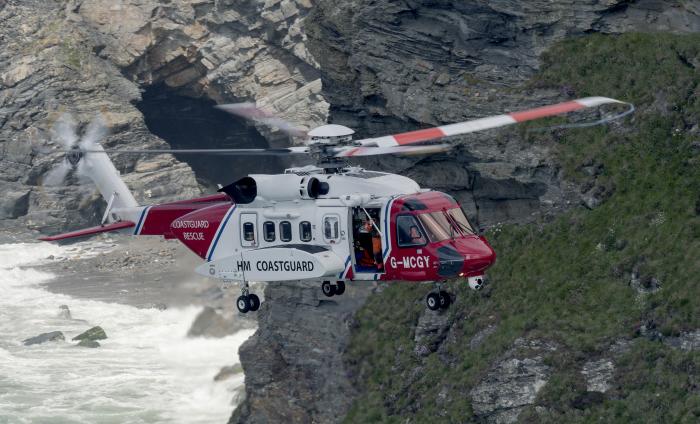
Helicopters operates S-92 helicopters on behalf of the UK Maritime and Coastguard Agency. (Image of Newquay SAR aircraft G-MCGY, photo copyright Bob Sharples Photography)
LONDON, September 12, 2017 – Sikorsky, a Lockheed Martin company, today presented Bristow Helicopters Limited with the Sikorsky Winged-S Rescue Award in recognition of a recent life-saving mission in the North Atlantic.  The award was accepted during the 2017 Defence and Security Equipment International exhibition. 
Bristow Helicopters currently operates S-92 helicopters on behalf of the UK Maritime and Coastguard Agency (MCA) for the critical mission of search and rescue (SAR), following the award of the 10-year UK SAR contract by the Department for Transport in March 2013. Since April 2015, an estimated 4,500 search and rescue missions have been executed, many utilizing the UK SAR S-92 helicopters. 
In May 2017, a Bristow crew operating an S-92 helicopter out of the HM Coastguard Prestwick SAR base rescued 22-year-old Matthew Bryce who was stranded at sea for 32 hours.  Bryce ventured out from the west coast of Scotland to enjoy a day of surfing on a Sunday morning, later causing concern to his family when he did not return.  Authorities were alerted the following day, and after an extensive multi-agency air and sea search lasting several hours, Bryce was found by the crew of the Prestwick S-92, call sign “Rescue 999” drifting off the coast of Northern Ireland.  During a mission lasting over six hours, the crew of Rescue 999 hoisted Bryce from the sea that Monday evening. He was safely transported to a Belfast hospital and later recovered. 
The Prestwick SAR base is one of the busiest in the UK. The latest UK SAR helicopter statistics issued by the UK Department for Transport (DfT) show that in the latest quarter, April to June 2017, the Prestwick base was the third busiest base, responding to 79 taskings, and carrying out the second highest number of land taskings, with many in or near Loch Lomond and the Trossachs National Park. 
“We have been successfully operating S-92 helicopters for more than ten years.  The high reliability of our S-92 helicopter fleet throughout that time has been absolutely critical to our time-sensitive mission,” said Damien Oliver, Assistant Director, UK MCA Aviation.
“Bristow is proud to operate the S-92 helicopter to fulfill the UK Maritime and Coastguard Agency’s mission to save lives, and our team is honored to receive this recognition,” said Neil Ebberson, Project Manager, Bristow UK Search and Rescue. “Sikorsky’s legacy in lifesaving, coupled with the latest technology of the S-92 helicopter, provides an outstanding solution for the high operational demands of our SAR business.”  
Beginning in 1950, the Winged-S Rescue Award Program honors those who perform rescues flying a Sikorsky helicopter. Through this award, Sikorsky acknowledges the humanitarian efforts of pilots and crewmembers who put themselves in harm's way to save others, fulfilling Igor Sikorsky's vision of the helicopter. 
Since 2004, Sikorsky has delivered more than 275 S-92 helicopters, predominantly to operatorsserving the worldwide offshore oil and gas industry, and for civil search and rescue operations. Eleven nations fly the S-92 helicopter for their head of state missions. In May 2014, Sikorsky was selected to build the next U.S. Presidential Helicopter Fleet, the world’s most advanced executive transport helicopter, using the S-92 platform. 

sábado, 24 de marzo de 2018

Breaking The Ice: The Canadian Coast Guard Tackles Many Different Missions

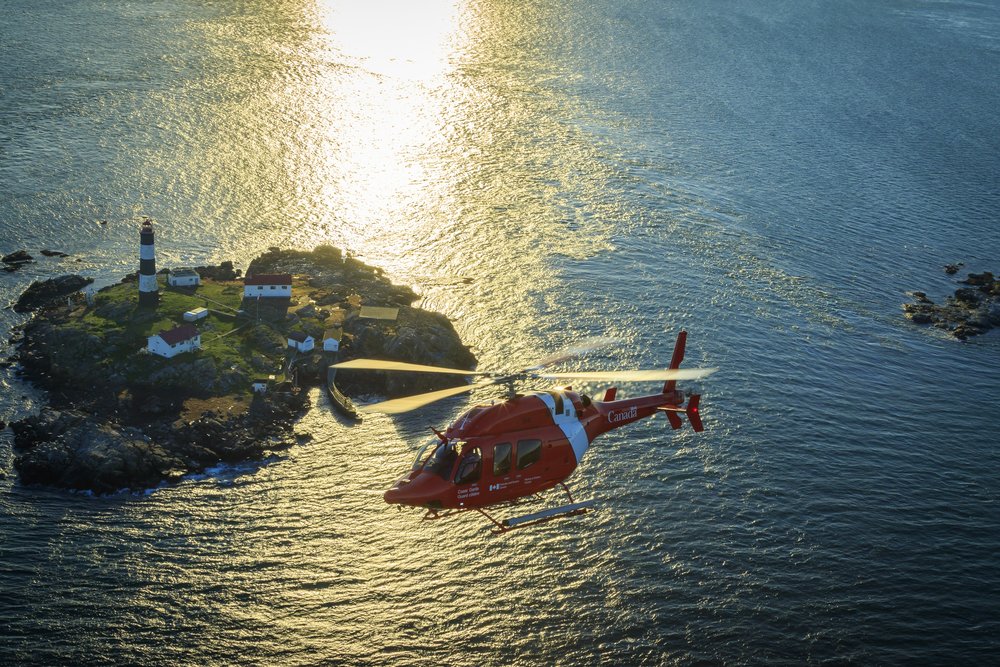
The Canadian Coast Guard is the bright red eye in the sky.

In a beautiful landscape of sprawling forests and icy tundra, the Canadian Coast Guard’s Bell 429 adds a pop of bright red to the scenery. For most people, a coast guard helicopter flying overhead indicates that someone is in danger - but that is not always true. Saving Canadian citizens stuck at sea or stranded on mountains is a key priority for the Canadian Coast Guard (CCG), but this organization uses their Bell fleet for more than search and rescue missions.

The northern Canadian climate consists of below freezing temperatures, which can impede business operations and transportation. To solve this problem, the CCG utilizes large ships to break up big chunks of ice in the Nova Scotia region. During the winter ice-breaking program, the CCG’s aircraft operates from shore-based facilities or the decks of the ships themselves to ensure that most Canadian ports are open for business year-round.

The Bell 429s act as reconnaissance tools, flying over the ice and giving vessel masters information about ice conditions within five kilometers, which is used to update the ice charts and assist in ice routing to commercial ships. In doing so, it reduces demand for direct icebreaker support, saving money and reducing shipping delays. The CCG ensures the safety of other marine traffic by transporting technical equipment to remote bases up and down the Canadian shoreline. Helicopters allow them to gain access to these bases, surrounded by rugged terrain and extreme weather conditions. The CCG's Bell 429s also possess bubble doors to allow greater vertical visibility. While this modification is common now, the CCG's pilots were the first to operate with this change in aircraft doors.

The CCG also uses the aircraft for speedy response to oil spills or environmental hazards and to support oceanographic and hydro-graphic science and fisheries management programs. From maintaining safe operations despite a harsh environment to assisting in scientific research, this government program continues to expand the versatility of their helicopter fleet. Look out for the Canadian Coast Guard’s bright red Bell 429 flying overhead, keeping Canadian coasts operational and safe.

viernes, 23 de marzo de 2018

Airbus Helicopters Strengthens Position as UK Market Leader

  • - Year on year sales growth builds on new facilities and services
  • - Growth in exports, UK defence business and European business aviation key to success

Oxford, Airbus Helicopters UK has defied market conditions with a new high of 14 civil aircraft booked in 2017, demonstrating a year-on-year average growth in the civil market of  36% since 2013.  As a result, the company has reinforced its position as UK market leader with 46% of the civil and parapublic market. This follows the company’s long-term commitment, made in 2015, to invest in increasing its industrialisation in the UK; an Airbus home country.
“As a home country, it is Airbus Helicopters’ role to invest in current and future UK-based rotary wing solutions and technology for the benefit of customers at home and overseas; in this way helping to make the UK and Airbus Helicopters more competitive on the global market” said Colin James, Managing Director Airbus Helicopters UK. “Furthermore, by leveraging on our civil business know-how we are helping to drive efficiencies into the UK defence helicopter market” he added.
CIVIL:2017 has seen continued growth in the commercial market, including the export to an undisclosed European customer of two H125s in border security configuration, an area where Airbus Helicopters’ UK design team is recognised as having a world-leading capability. In addition, the company welcomed the order for four, heavily customised H125s for Qinetiq and which will be used as the new single-engine helicopter for the Empire Test Pilot School.
The company also received orders for six new aircraft, a mix of single and twin-engine helicopters, in the private and business aviation segment, a core part of the company’s UK market and the result of the UK team’s expertise and offering in this sector. Since becoming the European hub for the newly launched Airbus Corporate Helicopters (ACH) last year, the company has set up an integrated sales network across Europe and inaugurated a new private and business customer facility at the company’s Oxford-based headquarters. 
DEFENCE:The company’s success in the defence market was marked by achievements with UK Military Flying Training System (MFTS), where Airbus Helicopters UK delivered 25 H135 Juno – the highest number of H135s ever delivered to a single customer in a year.  As aircraft service provider to UK MFTS, the company has now established its presence at RAF Shawbury, operating out of two hangars and where fully trained personnel are able to provide full maintenance and logistics support for the 29 H135 Juno helicopters. Similar facilities have been set up at RAF Valley to support the three H145 Jupiter helicopters based there.  In addition, in late 2017 the company signed the £100m Puma 2 Follow-on Support Arrangement contract with the option for an extension until the currently planned out of service date of March 2025. As a result, Airbus Helicopters continues to strengthen its partnership with the UK MoD, ensuring a strong and sustainable base for the future growth of Airbus Helicopters core activities in the UK. 
INDUSTRIAL GROWTH:Since the company’s commitment in 2015 to increase industrialisation in the UK, Airbus Helicopters UK has expanded its teams, services and operations on all fronts.  In support of the growing business and commitment to customers, the workforce has grown by more than 50% over the last four years. New services have been established to support maintenance for the latest, Helionix-equipped Airbus helicopters, while a new Helionix training simulator, at the company’s Oxford-based headquarters, helps pilots familiarise themselves with the full spectrum of advanced avionics and auto-pilot suite.
Furthermore, following the launch of the company’s first UK research and development projects in 2015 (helicopter blade research through the Aerospace Growth Partnership and light, malleable armour through the Defence Growth Partnership), 2017 saw two new UK R&D projects approved, firstly on the use of virtual and augmented reality in maintenance operations and secondly on autonomous deck landings. The launch of these projects is scheduled for 2018 and will see Airbus Helicopters work closely with UK Government, industrial and academic partners to develop these capabilities
Today, Airbus Helicopters is by far the largest supplier of turbine helicopters in the UK including 100 helicopters operating with the Ministry of Defence, 100 per cent of the UK police helicopter fleet, as well as the majority of aircraft flying in support of the UK’s critical national infrastructure.

Double A400M delivery launches celebrations of 20th anniversary of OCCAR Convention signature

Seville, 22 March 2018 – Airbus has for the first time formally delivered two A400M new generation airlifters to two different nations in one day. The company handed over the aircraft on 20 March to the European Organisation for Joint Armament Cooperation (OCCAR), in charge of the management of the A400M Programme, representing Germany and France – at a ceremony in Seville, Spain. OCCAR Director Arturo Alfonso-Meiriño said: “It is a great pleasure to see two of the leading OCCAR nations receiving these superb aircraft on the same day in a year when the organisation is itself celebrating the 20th anniversary of the signature of its Convention. This is testimony to the effective work performed by OCCAR’s A400M team over many years in managing this exceptionally complex programme.” These latest deliveries were the 60thand 61st A400Ms to be handed over and take the German and French fleets to 18 and 14 aircraft respectively. The photo shows the Airbus and OCCAR delivery teams, and French and German crews in front of the two aircraft following the official handover ceremony.

Airbus Helicopters to provide 16 Additional UH-72A Lakotas for the U.S. Army

GRAND PRAIRIE, Texas, Airbus Helicopters, Inc. has received a contract valued at approximately $116 million to deliver 16 additional UH-72A Lakotas for the United States Army. The contract is the company’s second this year, highlighting the U.S. Army’s confidence and growth capability of the Lakota program.
“We are proud of our partnership with the U.S. Army. As the world’s best Helicopter Trainer provider, we recognize how important an asset the Lakota is for Army Aviation and our nation. Our employees at Airbus are committed to delivering every aircraft on-cost and on-schedule, without exception,” said Chris Emerson, President and CEO of Airbus Helicopters, Inc. and Head of the North America Region. 
This new contract includes the UH-72A production aircraft, associated technical and flight operator manuals and program management in training configuration for the Initial Entry Rotary Wing mission at Ft. Rucker. The aircraft provided under this contract are from a 2016 fiscal year (FY) procurement decision.
“Our mission of providing this vital national asset is crucial to the protection of our country and the closure of the pilot shortage gap,” Emerson said.
The UH-72A is a twin-engine utility helicopter used for a wide range of military operations including troop and light cargo transport, MEDEVAC, VIP transport, border security, and Homeland Defense.
Airbus has delivered more than 423 UH-72A Lakota aircraft from its facilities in Columbus, MS, since the award of the first contract in 2005.  The new contract enhances the Lakota fleet and its training mission. With additional aircraft in the fleet, Lakota operators have more capability to conduct and support disaster relief and counter-drug operations in support of civil agencies or national emergencies.
Available in multiple configurations, the UH 72A Lakota is the lowest cost to buy, own and operate of any U.S. military helicopter in production.  The Lakota is a key component of the Army’s Aviation Restructuring Initiative (ARI) and the primary rotary-wing trainer for the U.S. Army Aviation Center of Excellence at Fort Rucker, Ala.
The UH 72A Lakota is fielded in and out of the Continental United States in several different configurations, performing a number of essential missions for the U.S. Army, U.S. Navy, and the National Guard.

Airbus Helicopters H215

Con la H Generation, de Airbus Helicopters, se ha sustituido el “AS” por “H” en casi todas sus aeronaves de ala rotatoria a partir del 1 de enero de 2015. Con ello las variantes AS332 L1e y C1e (modelos inmediatamente anteriores al más grande y avanzado de la familia Super Puma/Cougar, el H225) pasaron a denominarse H215.

Ambos son exactamente el mismo helicóptero exceptuando en longitud, ya que el L1 es más largo que el C1 (16,29 metros para el primero frente a los 15,53 metros del segundo).

La variante militar AS532 ALe, pasó a designarse H215M (ésta también es de fuselaje largo, compartiendo las mismas dimensiones que la versión civil H215 L1). Los tres mantienen el mismo diámetro de rotores, principal de 15,60 m y antipar de 3,05 m, ademas de altura total y ancho del fuselaje con sponsons y estabilizador (4,94 m y 3,79 m respectivamente).

Con el H215 el fabricante trasladó al mercado un nuevo concepto comercial e industrial, cuyo objetivo fue la actualización de un helicóptero con una célula más que probada sobre todo tipo de ambientes, bajo cualquier condición meteorológica y en todos los tipos de misión, que además está diseñado para equilibrar unos bajos costes de mantenimiento y operación a lo largo de toda su vida útil (dentro de su categoría y en comparación con otros helicópteros de su misma clase, 8 Tons).

El H215 es un helicóptero bimotor muy versátil y robusto (combina los más modernos sistemas de aviónica sobre una plataforma muy fiable), con capacidad multimisión bajo condiciones adversas, largo alcance y radio de acción, potencia en OEI suficiente para salir casi de cualquier situación (dependiendo lógicamente de peso a bordo y la no ausencia de vientos), alta velocidad de crucero y VNE, buena capacidad de carga (interna y externa al gancho baricéntrico), así como un magnífico régimen de ascenso en entornos con elevadas temperaturas y a gran altitud sobre el nivel del mar.

El H215 está equipado con los sistemas electrónicos y mecánicos más modernos, además de incluir un cockpit con instrumentación totalmente digital, se le ha sustituido el anterior AFCS por el mismo del H225 (con cuarto eje de serie), el cual asegura una total protección durante toda la envolvente de vuelo, máxima precisión y estabilidad durante estacionarios y ferrys incluso bajo las condiciones más duras para la operación (entre otros).

Está certificado para volar en VFR con un solo piloto (+ un miembro de la tripulación cualificado). En IFR es multi-pilot (2 pilotos).