martes, 27 de noviembre de 2018

Lockheed Martin And NASA JPL Successfully Land On Mars

Lockheed Martin-built InSight Lander successfully lands on the surface of the Red Plant to study the deep interior of Mars.

DENVER, Nov. 26, 2018 /PRNewswire/ -- NASA has a new spacecraft operating on the surface of Mars. This afternoon, the InSight Mars Lander, which was designed, built and tested by Lockheed Martin (NYSE: LMT), navigated the dramatic entry and descent through the Martian atmosphere and touched down on Elysium Planitia in the equatorial region of Mars. Lockheed Martin is the prime contractor responsible for the complete spacecraft system – cruise stage, aeroshell and the lander itself. Mission management and navigation were handled by NASA Jet Propulsion Laboratory (JPL) and spacecraft operations were performed by engineers at Lockheed Martin Space's Mission Support Area in Littleton, Colorado.
At 12:47 p.m. MST, onboard software commands, developed by Lockheed Martin, fired six separation nuts and jettisoned the cruise stage of the spacecraft while it was 78 miles above the surface. That started a series of events that took the spacecraft through six different configurations and from a speed of 12,300 mph to a gentle touchdown on the surface. The data signal confirming the spacecraft had successfully landed was received on Earth at 12:52 p.m. MST.
"The InSight lander is a remarkable spacecraft. Through the entire entry, descent and landing it performed flawlessly," said Stu Spath, InSight program manager and director of Deep Space Exploration at Lockheed Martin Space. "NASA's JPL, which has been a pioneer in Mars exploration for decades, partners with both academia and private industry to bring the best expertise and innovation forward to make important exploration missions like InSight a success."
After landing, the spacecraft waited approximately seven minutes to use its X-band small deep space transponder to send a tone confirming the health of the spacecraft. Then, 25 minutes after that, the lander deployed its two solar arrays, with a width of 19 feet, 8 inches, to begin recharging the spacecraft's batteries
Two NASA orbiters, Mars Reconnaissance Orbiter (MRO) and 2001 Mars Odyssey, were also involved in this historic mission. MRO received and recorded InSight data during its journey to the surface, and will send it back to Earth later today. Both MRO and Odyssey will provide UHF relay during the entirety of the InSight surface mission – Odyssey in the morning and MRO in the afternoon. Both MRO and Odyssey spacecraft were built by Lockheed Martin and both are operated for JPL by the company.  
Lockheed Martin has been an industry partner with NASA and the JPL for more than four decades in the exploration of the surface of Mars. Beginning in 1976 with Viking missions, Lockheed Martin has been at the forefront in the development of eleven Mars-bound spacecraft and has played a significant role in all NASA missions to Mars.
"Our team is thrilled by the successful landing of the InSight spacecraft," Lisa Callahan, vice president and general manager of Commercial Civil Space at Lockheed Martin Space. "With missions like this, there are no guarantees; historically, less than half of the world's missions to Mars have been successful. Every arrival at another planet is an incredibly complex engineering challenge. But that's what we do best at Lockheed Martin. It's an honor for us to partner with NASA and JPL on yet another Mars mission."
JPL manages InSight for NASA's Science Mission Directorate. InSight is part of NASA's Discovery Program, managed by the agency's Marshall Space Flight Center in Huntsville, Alabama. Lockheed Martin Space in Denver built the InSight spacecraft, including its cruise stage and lander, and supports spacecraft operations for the mission.
A number of European partners, including France's Centre National d'Études Spatiales (CNES), the Institut de Physique du Globe de Paris (IPGP) and the German Aerospace Center (DLR), are supporting the InSight mission. CNES and IPGP provided the Seismic Experiment for Interior Structure (SEIS) instrument, with significant contributions from the Max Planck Institute for Solar System Research (MPS) in Germany, the Swiss Institute of Technology (ETH) in Switzerland, Imperial College and Oxford University in the United Kingdom, and JPL. DLR provided the Heat Flow and Physical Properties Package (HP3) instrument, with significant contributions from the Space Research Center (CBK) of the Polish Academy of Sciences and Astronika in Poland. Spain's Centro de Astrobiología (CAB) supplied the wind sensors.

lunes, 26 de noviembre de 2018

Lockheed Martin Awarded $108 Million For IRST21 Sensor System

ORLANDO, Fla., Nov. 26, 2018 /PRNewswire/ -- Lockheed Martin (NYSE: LMT) received a contract for phase II of the F/A-18E/F Super Hornet Block II Infrared Search and Track (IRST) program for the U.S. Navy, awarded by aircraft prime contractor Boeing.
Under this contract, Lockheed Martin will complete development, platform integration, flight test, and qualification of the IRST21® Block II sensor system. These efforts will further enhance IRST21's proven detection, tracking and ranging capabilities in radar-denied environments.
"We are continuing a long legacy of delivering unmatched sensor technologies to our customers around the globe," said Michael Williamson, vice president of Sensors & Global Sustainment at Lockheed Martin Missiles and Fire Control. "The IRST21 sensor system provides U.S. Navy F/A-18E/F operators with superior detection and survivability capabilities."
The IRST21 sensor system uses state of the art infrared search and track technology to passively detect and track airborne threats in radar-denied environments. Contributing to both the U.S. Navy and U.S. Air Force, IRST21 will deliver a critical warfighting capability to meet any threat and directly support U.S. Combatant Commanders' operational demands. Currently, IRST21 is mounted in the nose of the F/A-18E/F's centerline fuel tank and in Legion Pod® for other fighter and on-fighter platforms.
Lockheed Martin's IRST sensor system is in full rate production and has logged more than 300,000 flight hours on the U.S. Navy's F-14 and F/A-18E/F, international F-15 platforms, and the U.S. Air Force's F-15C and F-16.

At 500,000 flight hours, Eurofighter is combat proven and ready for the future battlespace

Europe‘s largest and most successful defence collaboration programme – the Eurofighter Typhoon combat aircraft – continues to demonstrate its mission capabilities in surpassing the 500,000-flight hour milestone.
The Typhoon is based on the strength of four European nations and their aerospace/defence industries: the UK, Germany, Italy and Spain; with the deployed Eurofighter fleet rapidly accumulating hours aloft – particularly in recent years based on the increase of operational tempo for air policing and combat operations.

“As a partner company in the Eurofighter programme, we’ve played a major part in this success”.

“In total, we’ve performed the final assembly for 219 Eurofighter aircraft in our final assembly lines in Getafe, Spain, and Manching, Germany during the almost 25-year history of this hugely successful fighter aircraft”.

Kurt Rossner, Head of Combat Aircraft at Airbus Defence and Space

Airbus’ production and support roles for the Typhoon

Rossner added that all right-hand wings and slats are produced in Getafe, while the centre fuselages are integrated in Manching – an impressive 571 of them to date.

“And through the maintenance and overhaul services at our sites at Getafe, Manching and Morón in Spain, we’re contributing to the operational readiness of the fleets every day”.

Kurt Rossner, Head of Combat Aircraft at Airbus Defence and Space.

The number of Typhoons in service now totals nearly 500, with the potential for this figure to grow substantially in the coming decades.

Looking ahead, the Typhoon will play a key role in the evolving battlespace, and is to be a central pillar in the future European combat air system.  By developing and integrating key technologies – including a new electronically-scanned array radar, enhanced human-machine interface and new weapons – the Eurofighter combat aircraft will remain ready to defend against threats for decades to come.

In acknowledging cumulative time logged by the Typhoons in service, aircraft from the air force fleets of Germany, Spain, Italy and the UK had the same “500,000 flying hours” message painted on their fuselage.

domingo, 25 de noviembre de 2018

Airbus presenta su nuevo simulador de vuelo del A330MRTT en Sevilla

Airbus ha presentado su nuevo simulador completo de vuelo y misión (FFS, Full Flight Simulator) del avión A330 MRTT Multirole Tanker Transport en su Centro Internacional de Formación (ITC, International Training Center) en Sevilla. 

El simulador, desarrollado por la propia Airbus junto con la compañía española Indra, se une a los programas A400M, C295 y CN235, reafirmando las capacidades del Airbus ITC en Sevilla como centro de referencia para la capacitación del personal en todos los programas de transporte militar de la cartera del fabricante.

Con 60 pedidos en firme de 12 naciones y 33 aviones entregados, el Airbus A330 MRTT es hoy en día el único avión multimisión, cisterna/transporte, de nueva generación que ha sido certificado y probado en misiones reales sobre zonas de conflicto.

viernes, 23 de noviembre de 2018

Coast Guard, local partners rescue boater from disabled vessel near Charleston

CHARLESTON, S.C. — The Coast Guard and local partners rescued one boater Thursday from a sailing vessel near Charleston.

The 27-foot sailing vessel "Hay Seed" became disabled and drifted into the Charleston Harbor south jetty.

A Coast Guard Air Station Savannah MH-65 Dolphin helicopter crew noticed flares while on patrol at 7:30 p.m. and diverted to investigate. Local agencies, including the Charleston Fire Department, arrived on scene but were unable to reach the vessel due to severe weather conditions. The Dolphin crew hoisted the boater and transported him to the Charleston Coast Guard Air Facility at approximately 9 p.m.

The boater was reported to be in good condition with no medical concerns.

The vessel is being monitored while the owner creates a salvage plan.

For more breaking news follow us on Twitter and Facebook.

-USCG-

Serbia receives first out of nine H145Ms

Donauwörth, The Serbian Minister of Defence Aleksandar Vulin visited the Airbus Helicopters Donauwörth site to accept the first H145M for the Serbian Air Force. In December, two H145Ms will be delivered to the Serbian Ministry of Interior. Altogether, Serbia will receive nine H145Ms, earmarked for the Air Force and for the Ministry of Interior. Four of the Air Force’s aircraft will be equipped with the HForce weapon management system.
“We assess the implementation of the contract as an example of successful cooperation and positive business practice,” said Aleksandar Vulin. “All the activities so far have been carried out within the agreed deadlines, and we expect the future activities to be implemented in the same manner. We are particularly pleased to point out that the activities of the industrial cooperation covered by the contract are taking place within the planned timelines.”
“I would like to thank the Serbian government and personally Defence Minister Vulin for their trust in the latest member of our H145 family and for the smooth cooperation since the negotiations started in 2016,” said Wolfgang Schoder, CEO of Airbus Helicopters Germany. “We see a lot more opportunities for the H145M in Europe and beyond.”
The contract between Airbus Helicopters and Serbia foresees transfer of technology, spare parts, tools and documentation for the helicopters’ maintenance and repair. Airbus Helicopters will also certify Serbia's Moma Stanojlovic aeronautical plant as a centre for the maintenance of Gazelle helicopters and will include it in its overhaul network. Airbus will also support Serbian manufacturing plants and research and development institutions to obtain relevant qualifications and certificates to become a supplier.
The H145M has several optional equipment packages that can be installed or removed depending on the assigned mission. With a maximum take-off weight of 3.7 tonnes, the H145M can be used for a wide range of tasks, including troop transport, utility, surveillance, air rescue, armed reconnaissance and medical evacuation.
The Serbian aircraft will be equipped with a fast roping system, high-performance camera, fire support equipment, ballistic protection as well as an electronic countermeasures system to support the most demanding operational requirements. The HForce system, developed by Airbus Helicopters, will allow Serbia to equip and operate their aircraft with a large set of ballistic or guided air-to-ground and air-to-air weapons.
The H145M is a tried-and-tested light twin-engine helicopter that was first delivered in 2015 to the German Armed Forces and has since been ordered by Hungary, Thailand and Luxemburg. The programme’s maturity allows Airbus Helicopters to execute orders on cost and on schedule. Mission readiness of the H145Ms already in service is above 95 percent.
Powered by two Safran Arriel 2E engines, the H145M is equipped with full authority digital engine control (FADEC) and the Helionix digital avionics suite. It includes a high-performance 4-axis autopilot, increasing safety and reducing pilot workload. Its particularly low acoustic footprint makes the H145M the quietest helicopter in its class.

Coast Guard rescues 3 people and dog near Bayou Herron

MH-65 Dolphin ©USCG (archive)
NEW ORLEANS – The Coast Guard rescued three people and a dog after a boat capsized near Bayou Herron, Mississippi, Friday.

Watchstanders at Coast Guard Sector Mobile received a report at 11:32 p.m. Thursday of a capsized vessel with three people in the water as well as their dog in the vicinity of Bayou Herron.

Watchstanders directed the launch of a Coast Guard Air Station New Orleans MH-65 Dolphin helicopter crew.

The helicopter crew arrived on scene, located the survivors and hoisted the three people and dog. The survivors were transported to Mobile Airport in reportedly good health.

-USCG-

Luke AFB K-9 Helicopter Training with Papago Army National Guard Medics

Luke AFB K-9 unit trained with Papago Army National Guard Medics to familiarize themselves with giving dogs medical attention, getting them in and out of the helicopter, and getting in the air.

USS Green Bay, HMAS Adelaide Cross Deck Flight Ops

CORAL SEA


181119-N-DX072-1037 CORAL SEA (Nov. 19, 2018) Aviation Boatswain’s Mate (Handling) 3rd Class Walter Rutherford, from Cheyenne, Wyo., signals a UH-1Y Huey helicopter, assigned to Marine Light Attack Helicopter Squadron (HMLA) 469, as it takes off from the flight deck of the amphibious transport dock ship USS Green Bay (LPD 20) prior to cross deck flight operations with the Royal Australian Navy helicopter landing dock ship HMAS Adelaide (L01). Green Bay, part of Commander Amphibious Squadron 11, is operating in the region to enhance interoperability with partners and serve as a ready-response force for any type of contingency. (U.S. Navy photo by Mass Communication Specialist 2nd Class Anaid Banuelos Rodriguez)

jueves, 22 de noviembre de 2018

Boeing, Caribbean Airlines Announce Selection of 737 MAX

Airline announces decision to renew its fleet with more efficient and longer-range MAX
12 737 MAX 8 jets will replace current fleet and provide up to 16 percent fuel savings
PORT OF SPAIN, Trinidad, Nov. 21, 2018/PRNewswire/ -- Boeing [NYSE: BA] and Caribbean Airlines today announced the airline has chosen to enhance and renew its single-aisle fleet with the 737 MAX 8. The carrier, which has long operated the Next-Generation 737, will take delivery of 12 MAX airplanes in the coming years. 
The airline commemorated the selection of the MAX during a ceremony featuring national dignitaries, including the Prime Minister of Trinidad and Tobago, the Honorable Keith Rowley, and Caribbean Airlines Chief Executive Officer, Garvin Medera.
"Boeing has been by our side since Caribbean Airlines was founded twelve years ago using the 737-800. The 737 MAX allows us to continue offering a safe and comfortable experience for our passengers, while significantly improving fuel efficiency and environmental performance," said Medera. "All of these elements position us for long-term success."  
The 737 MAX 8 – part of a fuel-efficient family of airplanes – will seat up to 160 passengers in Caribbean Airlines' three-class configuration featuring the "Caribbean Plus" Cabin, and provide more than 500 nautical miles more range than the existing aircraft.
The airplane incorporates the latest technology CFM International LEAP-1B engines, Advanced Technology winglets, and other airframe enhancements to improve performance and reduce operating costs. Caribbean Airlines projects the MAX 8 will provide up to 16 percent fuel savings compared to its current fleet.
The MAX, outfitted with the popular Boeing Sky Interior and designed to be quieter than previous jets, will also offer Caribbean's customers the latest in passenger comforts.
"We are honored that Caribbean Airlines has placed its trust once again in the Boeing airplane family and chosen to bridge to the future with the 737 MAX 8. Its selection reaffirms the partnership we have built together with the Next-Generation 737 family," said Ihssane Mounir, senior vice president of Commercial Sales & Marketing for The Boeing Company.
In addition to flying Boeing airplanes, Caribbean Airlines also uses Boeing's services to optimize its operations. The carrier participates in the Fuel Dashboard Program, for example, which allows operators to look across their fleet and identify fuel savings. Caribbean also uses Boeing's consumable and expendable material services to ensure it has the parts it needs when it needs it.
The 737 MAX family is the fastest-selling airplane in Boeing history, accumulating about 4,800 orders from more than 100 customers worldwide. Boeing has delivered more than 200 737 MAX airplanes since May 2017.

miércoles, 21 de noviembre de 2018

Sea Lion takes next steps towards first delivery

Donauwörth – The NH90 Sea Lion has recently achieved two important milestones ahead of the first delivery at the end of 2019.
Completion of the German Navy Sea Lion qualification tests
In the beginning of November, all ground and flight tests for the qualification of the new NH90 variant for the German Navy, the NH90 Sea Lion, were concluded. The formal closure of the qualification is expected in the first quarter of 2019, followed by the military type certification by the German authorities in the second quarter of 2019.
The qualification aircraft, the second Sea Lion prototype, is now entering the lay-up phase for upgrading the helicopter to serial configuration and preparing it for delivery to the Bundeswehr. A total of 18 helicopters are on order.
Electrical power-on of first serial German Navy
On 24 October 2018, the first serial German Navy Sea Lion helicopter successfully completed the first power-on of all electrical systems in the final assembly line at Airbus Helicopters in Donauwörth.
This milestone marks an important step towards the first contractual delivery in the fourth quarter of 2019.

Airbus appoints Michael Schöllhorn as Chief Operating Officer

Amsterdam, 21 November 2018 – Airbus SE (stock exchange symbol: AIR) has appointed Michael Schöllhorn, 53, as Chief Operating Officer (COO) for Airbus Commercial Aircraft, effective 1 February 2019. Schöllhorn, currently COO for BSH Home Appliances GmbH in Munich, will succeed Tom Williams, 66, who retires 31 December 2018 after 50 successful years in the aerospace industry, 19 of which were in top Airbus management positions.
“Michael brings a vast amount of expertise in digitalisation, end-to-end process optimisation, manufacturing, quality and supply chain management – key assets to transition our company to the next levels of production efficiency,” said Guillaume Faury, President Airbus Commercial Aircraft. “Michael’s leadership will be crucial for the future success of Airbus. I am thrilled to welcome him to the team and thank the Board of Directors for their support in this selection process.”
Michael Schöllhorn will report to Guillaume Faury who will succeed Tom Enders as Airbus CEO following the shareholders Annual General Meeting on 10 April 2019. He will also become a Member of the Airbus Executive Committee.
On the appointment, Airbus CEO Tom Enders said: “We are glad to welcome Michael, and we bid farewell to Tom Williams, a great personality and leader both in Airbus and the wider European aerospace industry for many years. Tom braved countless challenges during his time with Airbus, always overcoming them in the best interest of the company and its customers, and never losing his dry Scottish humour. Tom’s impressive career took him from the shop floor as an apprentice with Rolls-Royce in 1969 to the Airbus Executive Committee. I am forever grateful for his engagement, leadership and friendship. I wish him a well-deserved retirement.”
Michael Schöllhorn’s wealth of diverse manufacturing and production expertise was gained from 1999 at the Bosch Group. Most notably, between 2012 to 2014 he was Executive Vice President Manufacturing and Quality, additionally heading the Global Business unit for chassis and safety sensors. Prior to this, he held several international management positions in the US and Czech Republic. From 2004 to 2008 he was Vice President of Quality Management and from 2012 to 2014, Executive Vice President Manufacturing and Quality. In 2015, Michael was appointed COO and Member of the Management Board for BSH Home Appliances GmbH (100 percent subsidiary of the Robert Bosch GmbH), one of the world’s leading home appliance manufacturers.
Michael Schöllhorn holds a degree in Mechanical Engineering and a PhD in Control Engineering from the Helmut Schmidt University in Hamburg. He served in the German Armed Forces as a helicopter pilot and officer from 1984 to 1994.

martes, 20 de noviembre de 2018

Coast Guard Air Station Borinquen crew rescues Good Samaritan following vessel capsizing off Rio Grande, Puerto Rico

The crew of a Coast Guard MH-65 Dolphin helicopter from Air Station Borinquen with a survivor of a capsized vessel at the Luis Munoz Marin airport in San Juan Nov. 19, 2018, following his rescue by the Coast Guard aircrew off Point Picua in Rio Grande, Puerto Rico.
SAN JUAN, Puerto Rico – A Coast Guard MH-65 Dolphin helicopter crew rescued a Good Samaritan boater from the water Monday night, after his vessel ran aground, capsized and sank while rendering assistance to a disabled vessel just off Point Picua in Rio Grande, Puerto Rico.
"Having the right equipment accessible helped this case have a positive outcome," said Lt. Cmdr. Jim Cepa, Air Station Borinquen MH-65 Dolphin aircraft commander. "The gentlemen was wearing his life jacket, which greatly enhanced his survivability and likelihood of detection from our search assets. Our crew was fortunate to be able to help this gentlemen return to safety."
Coast Guard watchstanders in Sector San Juan received a call from a 911 emergency operator relaying a report from a source who claimed there seemed to be a disabled vessel near Point Picua and two red flares had been sighted coming from the vessel.
A Coast Guard MH-65 Dolphin helicopter from Air Station Borinquen and a Boat Station San Juan 45-foot Response Boat Medium responded to search for the reported distress and provide any needed rescue assistance.
The Coast Guard crews arrived on scene and reported there was a vessel that was just arriving to shore. The original reporting source, who remained at the scene, relayed that the vessel was the one originally reported to be disabled and that there was still a person in the water from a another vessel that had capsized.
The Coast Guard helicopter crew proceeded to conduct a shoreline search of the area and shortly thereafter located a man in the water waving his hands for assistance. The crew deployed their rescue swimmer via the aircraft’s hoist line, who was able to reach and secure the survivor to his rescue harness and hoist him safely onboard the aircraft.
Following the rescue, the survivor relayed to the Coast Guard aircrew that he had gone out aboard his 10-foot boat to render assistance by taking spare engine to a disabled vessel that had fired two flares. In the process, his vessel ran aground and was struck by a large wave that capsized the boat and forced him into the water until his rescue.
The Coast Guard aircrew transported the survivor to the Luis Munoz Marin Airport in San Juan, Puerto Rico, where awaiting Emergency Medical Service personnel received him for further evaluation.
-USCG-

Boeing, Jeju Air Announce Order for up to 50 737 MAX Airplanes

Deal is largest ever order from a Korean low-cost carrier; includes 40 firm orders and 10 options
Airline says 737 MAX 8 is ideal airplane to grow and meet rising passenger demand

SEOUL,South Korea, Nov. 19, 2018/PRNewswire/ -- Boeing [NYSE:BA] and Jeju Air announced the airline is ordering 40 737 MAX 8 airplanes with options for 10 additional jets. The deal, valued at up to $5.9 billion at list prices, is the largest order ever placed by a Korean low cost carrier and reflects rising demand for air travel in South Korea.
"With Korea's growing commercial aviation market, we are excited to take the next step in expanding our business with the 737 MAX, a world-class airplane that will allow us to improve our operation and continue to provide a safe and enjoyable experience for our passengers," said Seok-Joo Lee, President and CEO of Jeju Air. "The 737 MAX 8 and its superior performance and economics make it an ideal airplane to implement our growth strategy as we look to expand beyond Asia in the coming years."
Jeju Air, based in South Korea's Jeju Island, began operation in 2005 as the country's first low-cost carrier. Since that time, the carrier has spearheaded the rapid development of Korea's LCC market and contributed to the expansion of the broader Korean commercial aviation industry.
Flying a fleet of nearly 40 Next-Generation 737-800s, Jeju Air has steadily expanded its business and its profits. The airline has achieved 25 percent annual sales growth over the past five years and recorded 17 consecutive quarters of profitability.
Jeju Air is looking to build on its success with the enhanced version of the 737 jet. The 737 MAX 8 provides more range and offers 14 percent better fuel efficiency and environmental performance thanks to the latest CFM International LEAP-1B engines, Advanced Technology winglets, and other aerodynamic improvements.
"We are extremely proud that Jeju Air has become a leader in the vibrant LCC market by flying the Boeing 737. And we are delighted that the airline has chosen to build their future fleet with this major order for the 737 MAX," said Ihssane Mounir, senior vice president of Commercial Sales & Marketing for The Boeing Company.
Along with the new airplanes, Boeing Global Services will provide Jeju Air with digital tools to reduce their operating costs. The solutions include the Fuel Dashboard Program, which allows operators to look across their fleet and identify areas where they can optimize their fuel spending. 
Jeju Air serves 60 domestic and international routes with approximately 200 daily flights. The carrier is a founding member of the Value Alliance, the first pan-regional low-cost carrier alliance formed with eight airlines based in Asia.  
The 737 MAX is the fastest-selling airplane in Boeing history, accumulating about 4,800 orders from more than 100 customers worldwide. This order will be reflected on Boeing's Orders and Deliveries website per our standard process. For more information and feature content, visit www.boeing.com/commercial/737max.

First Boeing 777X Flight Test Airplane Comes Together

- First flight of the 777X scheduled for 2019; delivery in 2020


EVERETT, Wash., Nov. 20, 2018 /PRNewswire/ -- Boeing [NYSE: BA] has brought together the major fuselage sections to form the first 777X airplane that will take to the skies in 2019.
In a major production milestone called 'final body join,' Boeing teams connected the airplane's nose, mid and aft sections in the company's factory in Everett, Wash. The jet now measures 252 feet long (77 meters) from nose to tail, making it the longest passenger jet the manufacturer has ever produced.
"The 777X is a new airplane and a new production system," said Josh Binder, vice president and general manager of the 777X. "With the 777X, the production system was integrated into the development program sooner than any other airplane, and the team is doing a great job of hitting our milestones as expected."
The 777X builds on the market-leading 777 and the 787 Dreamliner to offer airlines the largest and most-efficient twin-engine jet in the world. The airplane provides 12 percent lower fuel consumption and 10 percent lower operating costs than competing airplanes.
The 777X achieves the unprecedented performance through the introduction of the latest technologies such as the most fuel-efficient commercial engine ever, the GE9X, and a fourth-generation all-new composite wing design that provides lift and efficiency. With the extension of a set of folding, raked wingtips, the airplane's wing spans 235 feet (72 meters).
By adding folding wingtips, the 777X's wingspan has been increased to enhance the aerodynamic efficiency of the wing, reducing engine thrust and fuel use. Additionally, the folding wingtips allow the 777X to maintain airport compatibility with the existing 777 family, adding value for customers.
The first 777X introduced will be the 777-9 model, which can seat 400 to 425 passengers in a standard configuration and offer a range of 7,600 nautical miles (14,075 km). Boeing is building on the passenger-preferred interior of today's 777 and building on 787 interior innovations to create a passenger experience like no other. Passengers will enjoy windows that are larger and located higher on the fuselage than the current 777, along with a wider cabin, new lighting and enhanced architecture.
The first 777X test airplane for static ground testing was completed in September 2018. Three additional flight test airplanes will be built after flight test #1.
The 777X first flight is scheduled for 2019. First delivery is slated for 2020.
For information about the 777X, go to http://www.boeing.com/777x/reveal/. To date, Boeing has won 340 orders and commitments for the 777X from several airlines, including All Nippon Airways, Cathay Pacific, Emirates, Etihad Airways, Qatar Airways, Lufthansa and Singapore Airlines.  

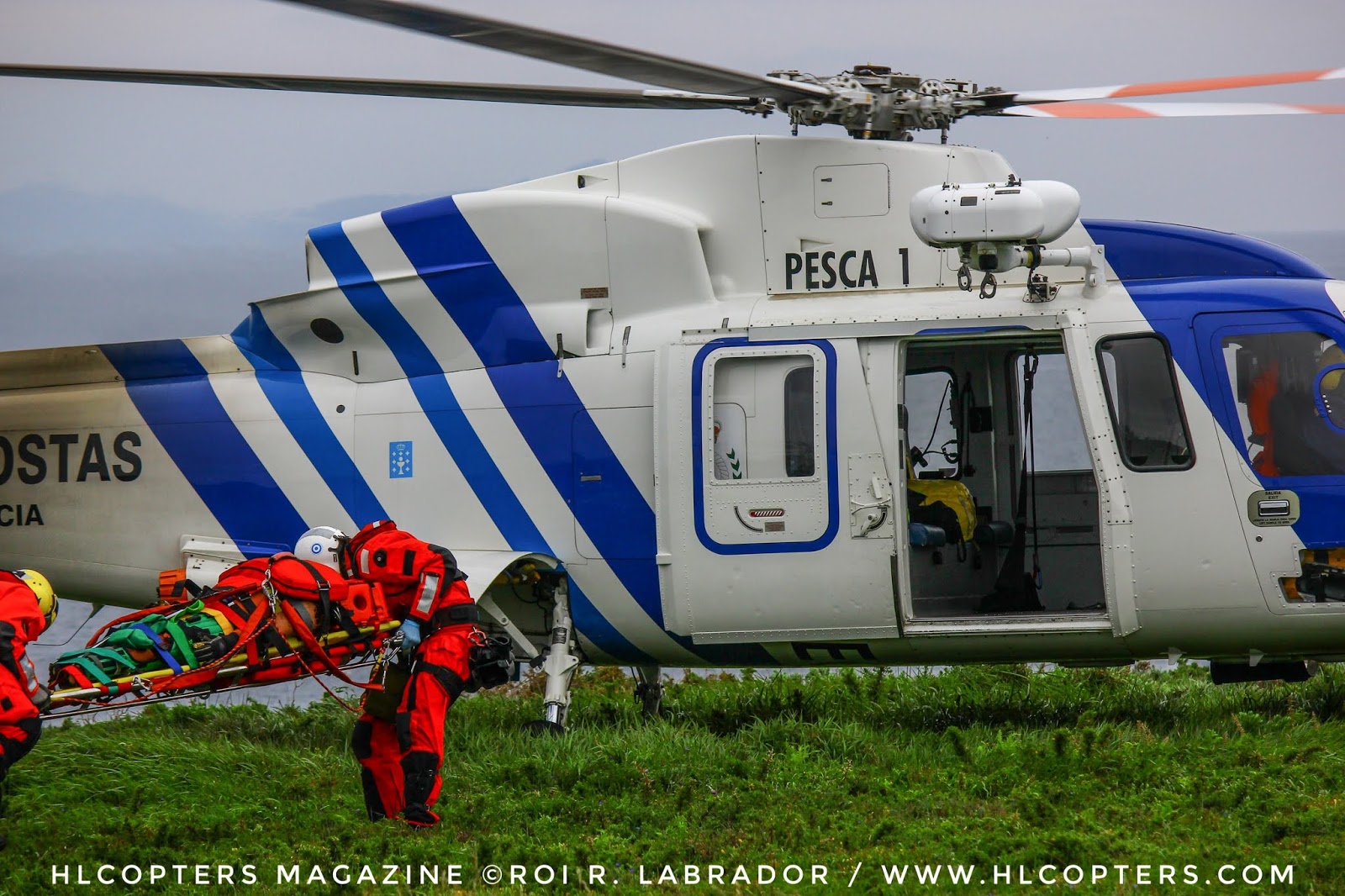
¿Qué es el Gardacostas de Galicia?

El Gardacostas de Galicia es el primer servicio SAR civil que se creó en España.


Aunque su misión es principalmente offshore tiene plena capacidad ya no sólo para realizar operaciones de búsqueda, rescate y evacuaciones tanto sobre el mar como en aguas interiores, sino que las tripulaciones de sus dos helicópteros también están disponibles para atender emergencias onshore si son necesarios, ya que el servicio ha mantenido desde sus inicios acuerdos de colaboración con las diferentes Administraciones para su inmediata movilización en caso de necesidad.


El servicio gallego es el segundo SAR de toda Europa en el uso de helicópteros y tripulaciones civiles, además tiene plena operatividad para realizar vigilancia e inspección pesquera, siendo ésta su segunda misión principal.


Inicialmente denominado como SBSLC (Servicio de Busca e Salvamento e Loita contra la Contaminación Mariña) empezó a rodar el 10 de agosto de 1990 con dos helicópteros Bell 212 de la mano de Fernando Novoa, que es el creador y la persona que ha realizado el estudio sobre la urgente necesidad de una solución eficaz en Galicia para paliar las carencias que había en aquellos años en materia de búsqueda, rescate y vigilancia pesquera.


Novoa no sólo desarrolló la idea consiguiendo llevarla a cabo en una época difícil donde no existía nada ni remotamente parecido, lo que complicó enormemente la captación de pilotos puesto que no había muchos con la experiencia necesaria para este tipo de operación dentro del ámbito civil, sino que además como Director Técnico y expiloto de la Flotilla de Aeronaves de la Armada -a través de la cual obtuvo la preparación y experiencia SAR tras su paso por la 5ª Escuadrilla- se encargó de la selección y preparación de las tripulaciones desde antes de que el SBSLC comenzara a rodar. Él mismo realizó misiones reales con los helicópteros Pesca, se encargaba de organizar los ejercicios de entrenamiento, introdujo a los primeros nadadores de rescate civiles en España, se ocupó de la gestión diaria de toda la flota (marítima y aérea), así como de toda la evolución del servicio hasta lo que es hoy en día.


A pesar de que poco tiempo después de la llegada de los dos S-76C+ en 2005 el puesto de Director Técnico desapareció, Novoa dejó bien asentados los valores sobre los que se basa el servicio:


“Hacemos lo posible.
Intentamos lo imposible.
Nos entrenamos para hacer milagros”


“Una misión de rescate es buena cuando vuelven todos los que salen... y si viene alguien más, mejor”


El Gardacostas de Galicia no sería creado sin los presupuestos y el total apoyo de la Consellería de Pesca y Acuicultura de la Xunta de Galicia (denominada así en aquel momento, hoy Consellería do Mar), ya que el principal responsable de la misma buscaba una solución para hacer frente a la enorme siniestralidad marítima que por aquellos tiempos se registraba frente a las costas gallegas, contando además con la urgente necesidad de disponer de una vigilancia pesquera eficaz.


Aquellos duros comienzos no vinieron solos, hay que sumar las innumerables críticas a las que fueron sometidos ya que desde algunos sectores -incluidos ciertos medios de comunicación- no se hacía más que verter desinformación, lo que trasladaba credibilidad cero ante la opinión pública; algo totalmente infundado que ha quedado patente desde sus inicios al realizar hitos tan importantes como la evacuación en 1991 de un tripulante del mercante “Bristol Lake” a 120 nm al norte de Vigo (40 nm de A Coruña) con el Pesca1, misión que se convirtió en la primera realizada bajo condiciones nocturnas por un helicóptero civil en España, con baja visibilidad acentuada por lluvia y en un Bell 212, que aunque estaba certificado para IFR y montaba radar meteorológico no contaba con AFCS ni ninguna otra ayuda salvo el governor (o anticipador), que incorporan todos los turboejes para controlar la demanda de combustible al detectar cambios de paso, y un Trim que poco tiene que ver con los de hoy en día.


Ésta y otras misiones, como una evacuación a 175 nm (con otro 212), y otra a 204 nm (ya con el Dauphin N2, en este caso el de Viveiro -Pesca2-) han creado historia, demostrando la enorme capacidad y el valor de todas las personas que forman y han formado parte del SAR gallego.


El SBSLC cambió su nombre en 2004, pasando a obtener la actual designación de Gardacostas de Galicia.


Helicópteros


Por el servicio han pasado los siguientes helicópteros:


Dos Bell 212, en Vigo desde 1990 hasta 1996 y en Viveiro hasta 1999.


Un Bell 412 SP, de 1996 a 1999 únicamente en la base de Vigo.


Dos Aérospatiale AS365 N2 Dauphin 2, de 1999 a 2005 en ambas bases (el de Viveiro se incorporó unos meses después).


Dos Sikorsky S-76C+ adquiridos en propiedad en su momento por la CCAA, hoy pertenecen al operador, con los más modernos sistemas de aviónica y equipos de misión (basta recordar por ejemplo que los gimbal para sus faros de búsqueda son los números de serie 1 y 2).


Estos dos helicópteros continúan prestando un servicio intachable, en los que además se les acaban de incorporar nuevos equipos que aumentan su operatividad; aprovechando para ello las paradas técnicas por calendario de revisión anual realizados por su personal de mantenimiento en la base de Vigo.


Mucho hay que contar del servicio de Gardacostas, ya que la historia continúa…


Próximamente a través del Hlcopters Magazine (www.hlcopters.com) y la revista del COPAC (Colegio Oficial de Pilotos de la Aviación Comercial).


Hugo Ramos.