• The new C-27J baseline configuration is characterized by a new avionics system, new cockpit control panels and LED aircraft lights
• Operators will enjoy modern avionics and improved operational cost and performance within the aircraft flyaway price
• C-27J orders total 85 from 14 countries around the world
Rome, 4 December 2018 – The new C-27J Spartan baseline configuration— characterized by a brand new avionics system, new cockpit control panels and LED aircraft lights—completed its first flight yesterday at Leonardo’s Aircraft Division Turin plant.
Lucio Valerio Cioffi, Leonardo’s Aircraft Division Managing Director, said: “New operators will enjoy modern avionics and improved operational cost and performance within the aircraft flyaway price. The main benefits of the new C-27J baseline configuration are compliance with new civil aviation regulations and military requirements obsolescence risk reduction.”
The C-27J new avionic system is designed to comply with Next Generation Air Traffic Control requirements, like SESAR and NextGen, and provides TCAS 7.1 (Traffic Collision Avoidance System) capability. It features many major upgrades such as a new FMS (Flight Management System) with RNP (Required Navigation Performances) and LPV (Localizer Performance with Vertical Guidance) approach capabilities. The IFF (Identification Friend or Foe) Mode 5 has been updated at the latest standard. New cockpit displays, new weather radar, new radio navigation, enhanced satellite communications and radio communication capabilities, new intercommunication system, new cockpit and cargo panels and lighting system with led technology have been also included. Moreover, former avionics and general systems interface boxes have been replaced with new equipment made by Leonardo’s Airborne and Space Systems Division.
The new baseline configuration is also offered in retrofit to Current Operators willing to upgrade the capabilities of their C-27J fleet.
The C-27J Spartan has already been ordered by the Air Forces of Italy, Greece, Bulgaria, Lithuania, Romania, Slovakia, United States, Mexico, Australia, Peru, Kenya, Morocco, Chad and another African country for a total of 85 aircraft.
Hlcopters Magazine Noticias, Helicopters Magazine, aviation and space news, noticias de helicópteros, Helicopter News, Aircraft news, Search And Rescue news, USCG news, SAR news, Offshore news, Hlcopters Magazine news, noticias de aviacion
martes, 4 de diciembre de 2018
Lockheed Martin And Airbus Sign Memorandum Of Agreement On Aerial Refueling
MADRID, Dec. 4, 2018 /PRNewswire/ -- Lockheed Martin (NYSE: LMT) and Airbus have signed an agreement to jointly explore opportunities to meet the growing demand for aerial refueling for U.S. defense customers.
The companies will seek to provide aerial-refueling services to address any identified capacity shortfall and to meet requirements for the next generation of tankers capable of operating in the challenging environments of future battlespace.
"Reliable and modernized aerial refueling is an essential capability for our customers to maintain their global reach and strategic advantage," said Lockheed Martin Chairman, President and CEO Marillyn Hewson. "By combining the innovation and expertise of Airbus and Lockheed Martin, we will be well-positioned to provide the United States Air Force with the advanced refueling solutions needed to meet 21st century security challenges."
"The U.S. Air Force deserves the best aerial-refueling technology and performance available under the sun and this great industry team, Lockheed Martin and Airbus, will offer exactly that," said Tom Enders, Airbus CEO.
The companies are taking a cooperative approach, with the Airbus A330 Multi Role Tanker Transport (A330 MRTT) at its heart, to examine a broad spectrum of opportunities. These may range from ways to support critical near-term air-refueling needs, such as a fee-for-service structure to conceptualizing the tanker of the future.
Airbus Defence and Space Head of Military Aircraft Fernando Alonso said, "The A330 MRTT has been selected by a dozen nations around the world. It is extensively proven in live operations and has been repeatedly praised by major air forces. We are convinced that the combination of Airbus' tanker expertise with Lockheed Martin's extensive U.S. presence, has the potential to provide highly effective solutions for current and future U.S. military aerial refueling requirements."
Lockheed Martin has a long and successful history of systems integration, manufacturing and maintenance, repair and overhaul operations with large airlift and tanker aircraft. When combined with Airbus expertise in this competitive space, the two companies will field a strong team to address future air refueling needs.
"Airbus is an industry leader in the aerial refueling area, and Lockheed Martin is known for cutting-edge defensive technologies and capabilities," said Michele Evans, executive vice president, Lockheed Martin Aeronautics. "This is a great opportunity for our two companies to combine our expertise – cooperating to develop world-class solutions for critical needs around the world."
Northrop Grumman Technologies Support NASA’s InSight Mars Lander
By Kristen Basham
Six months after launch, NASA’s newest Mars explorer, InSight, made its dramatic entrance to the red planet on Monday, Nov. 26, 2018 at 2:52 p.m. EST. InSight, short for Interior Exploration using Seismic Investigations, Geodesy and Heat Transport, will help answer key questions about the early formation of rocky planets in our solar system, including Earth, with help from critical Northrop Grumman-built components. On May 5, 2018, InSight began its 301-million-mile journey to Mars aboard a United Launch Alliance (ULA) Atlas V rocket launched from Vandenberg Air Force Base, California. Northrop Grumman provided key technologies for both the rocket and the lander. Lockheed Martin was responsible for manufacturing the InSight lander.
InSight snapped this photo of Mars shortly after landing on Nov. 26. The Northrop Grumman-built solar arrays ensure InSight can recharge its battery every day as the spacecraft continues to send photos and prepare for the rest of its mission.
“We are proud to support our customers Lockheed Martin and NASA for this exciting mission,” said Frank Culbertson, president, space systems group, Northrop Grumman. “Once again, our flight-proven components are part of innovative missions that help us better understand the universe, and in this instance, answer critical questions about the red planet.”
Northrop Grumman manufactured InSight’s cruise stage heat pipes and instrument heat pipes in Beltsville, Maryland; the diaphragm tanks for the lander in Commerce, California; and a two-wing, light weight Ultraflex Solar Array assembly in Goleta, California. Northrop Grumman also built the Ultraflex Solar Arrays used in the successful Mars Phoenix Lander mission that launched in 2007.
The Northrop Grumman-built Ultraflex Solar Arrays are shown deployed during InSight's production.
Northrop Grumman also produced several components on the ULA Atlas V rocket including the 10-foot diameter composite heat shield, which provides higher performance with lower weight, and essential protection for the first stage engine of the launch vehicle from engine exhaust temperatures in excess of 4,000 degrees Fahrenheit. Technicians fabricated the assembly using advanced fiber placement manufacturing techniques at the company’s Iuka, Mississippi facility.
Northrop Grumman manufactured the reaction control system propellant tank for the ULA Atlas V at its Commerce, California facility. In addition, eight Northrop Grumman retro motors manufactured in Elkton, Maryland supported separation of the spent first stage.
lunes, 3 de diciembre de 2018
Coast Guard rescues U.S. citizen from life raft following vessel capsizing in the Mona Passage
A Coast Guard Air Station Borinquen MH-65 Dolphin helicopter crew rescued a 46-year old boater, who is a U.S. citizen from Texas, from a life raft early Dec. 2, 2018, approximately 30 nautical miles east of Samana, Dominican Republic. The boater's 26-foot outboard powered catamaran capsized and sank in the Mona Passage after taking on water.
SAN JUAN, Puerto Rico – A Coast Guard Air Station Borinquen MH-65 Dolphin helicopter crew rescued a boater from a life raft early Sunday morning, approximately 30 nautical miles east of Samana, Dominican Republic.
Rescued is Justin Smith, a 46-year-old man and U.S. citizen from Dallas, Texas.
"This case demonstrates how being prepared beforehand can save your life,” said Lt. Cmdr. Adam Mullin, MH-65 Dolphin helicopter aircraft commander. “The survivor was in a life raft with a VHF radio, strobe lights, flares, a life vest, and an EPIRB, which made him highly visible and easy to locate. We were able to get on scene, quickly located the survivor, and rescued him with the help of our rescue swimmer."
Coast Guard watchstanders in Sector San Juan received a Mayday radio transmission at 3 a.m. Sunday on VHF-Channel 16 from Smith, who notified he deployed and embarked his life raft after his 26-foot catamaran capsized and sank while transiting from Fajardo, Puerto Rico to Samana, Dominican Republic.
Coast Guard watchstanders in Sector San Juan launched a Coast Guard MH-65 Dolphin helicopter from Air Station Borinquen to search for the reported distress and provide any needed rescue assistance.
The Coast Guard helicopter crew arrived on scene and located a yellow life raft with Smith onboard. The crew deployed their rescue swimmer, who was able to reach and secure the survivor to the aircraft rescue basket and hoist him safely onboard the helicopter.
The Coast Guard aircrew transported the survivor to the Coast Guard Air Station in Aguadilla, Puerto Rico, where he was released after declining medical assistance from awaiting Emergency Medical Service personnel.
-USCG-
Boeing KC-46 Tanker Program Completes Phase II Receiver Certification Testing
EVERETT, Wash., Dec. 3, 2018 – Boeing’s [NYSE: BA] KC-46 tanker program has completed its planned Phase II receiver certification flight testing following three weeks of flights with F-15E aircraft out of Edwards Air Force Base, Calif.
Boeing and U.S. Air Force KC-46 crews kicked off receiver certification testing with F-16 aircraft in April 2018. Since then the joint team also completed testing with KC-135, C-17, A-10, KC-46, B-52, and F/A-18 aircraft.
“This accomplishment is a tribute to the Boeing/U.S. Air Force team and helps set the stage for the start of Initial Operational Test & Evaluation testing next year,” said Mike Gibbons, Boeing KC-46A tanker vice president and program manager. “We are seeing great progress in both test and production and expect the positive momentum to continue as we begin delivering aircraft.”
During the certification flight tests, KC-46 and receiver aircraft flew at different airspeeds, altitudes and configurations to ensure compatibility and performance throughout the refueling envelope of each receiver. Now, the Air Force and the Aerial Refueling Certification Agency will review all test data and paperwork before ultimately “certifying” each aircraft.
"The Air Force crews were with us every step of the way during this critical testing,” said Jake Kwasnik, KC-46 test program manager. “It was awesome to see everyone working together as we conducted flights out of Boeing Field and also at Edwards and Minot Air Force bases.”
Six test aircraft have now completed more than 3,700 flight hours and supplied more than four million pounds of fuel in flight to receiver aircraft.
Phase III receiver certification testing will be conducted by the Air Force at Edwards Air Force Base in 2019. That testing will include additional receiver aircraft.
The KC-46, derived from Boeing’s commercial 767 airframe, is built in the company’s Everett, Wash., facility. Boeing is currently on contract for the first 52 of an expected 179 tankers for the U.S. Air Force.
The KC-46A is a multirole tanker that can refuel all allied and coalition military aircraft compatible with international aerial refueling procedures and can carry passengers, cargo and patients.
Coast Guard medevacs crewmember 46 miles offshore Matagorda, Texas
An Air Station Corpus Christi MH-65 Dolphin helicopter crew transfers a 54-year-old man awaiting emergency medical services personnel at Naval Air Station Corpus Christi, Texas, Dec. 3, 2018. Coast Guard Sector/Air Station Corpus Christi watchstanders received a medevac request from the crew of the platform 105B stating a crewmemeber was exhibiting signs of a heart attack and in need of medical assistance. (U.S. Coast Guard photo by Air Station Corpus Christi)
CORPUS CHRISTI, Texas — The Coast Guard medevaced a 54-year-old man approximately 46 miles offshore of Matagorda, Texas, Monday morning.
Coast Guard Sector/Air Station Corpus Christi watchstanders received a request from the crew of the platform 105B stating a crewmemeber was exhibiting signs of a heart attack and in need of medical assistance. Watchstanders consulted with the duty flight surgeon who recommended the medevac.
An Air Station Corpus Christi MH-65 Dolphin helicopter crew was launched to the scene.
The Dolphin helicopter crew hoisted and transferred the man to awaiting emergency medical services personnel at Naval Air Station Corpus Christi.
Weather on scene was reported as 4-foot seas with 26 mph winds.
-USCG-
Safran to support Royal Danish Air Force Arriel engine fleet
3 December 2018, Bordes
Safran Helicopter Engines has signed a contract with Denmark’s Defence Acquisition and Logistics Organization (DALO), to support 11 Arriel 1D1-powered AS550C2 Fennec operated by the Royal Danish Air Force (RDAF). The engines will now be covered by Safran’s Global Support Package (GSP) and the contract will last until mid-2030s, when the fleet is retired.
In July 2016, Safran signed a seven-year contract to support 14 RTM 322-powered EH101 Merlin operated by the RDAF. Since then, 75 engines have been protected by a Safran GSP.
This new agreement satisfies the RDAF requirement for engine availability in anticipation of domestic and international military operations.
Captain (Navy) Kim Bo Meier, Director Air Force Systems at DALO, said: “DALO looks forward to this agreement ensuring sufficient engines to support operational tasks during the period. The contract reaffirms the excellent working relationship that exists between the parties.”
Olivier Le Merrer, Safran Helicopter Engines Executive Vice President Support & Services, said: “This contract marks a major new milestone in our partnership with DALO and the RDAF. We will deliver world-class services to guarantee the availability of their engines; thus demonstrating that the GSP model is particularly well-suited to supporting the engine fleets of modern armed forces”.
Under the GSP, the customer receives a commitment to have serviceable engines available whenever they need them. Other GSP principles also apply, including budget certainty, fixed price per engine flying hour and a technical partnership with the OEM.
This particular GSP will be managed by Safran Helicopter Engines Germany, which supports more than 280 operators flying in Germany, Scandinavia, Central and Eastern Europe, Russia and Central Asia.
GSP is part of EngineLife® Services, Safran's range of solutions for helicopter engine operators.
![]() |
| AS550 C2 ©Jèrome Deulin (Airbus Helicopters) |
In July 2016, Safran signed a seven-year contract to support 14 RTM 322-powered EH101 Merlin operated by the RDAF. Since then, 75 engines have been protected by a Safran GSP.
This new agreement satisfies the RDAF requirement for engine availability in anticipation of domestic and international military operations.
![]() |
| AS550 C2 ©FLVFOT (Danish Defence) |
Olivier Le Merrer, Safran Helicopter Engines Executive Vice President Support & Services, said: “This contract marks a major new milestone in our partnership with DALO and the RDAF. We will deliver world-class services to guarantee the availability of their engines; thus demonstrating that the GSP model is particularly well-suited to supporting the engine fleets of modern armed forces”.
Under the GSP, the customer receives a commitment to have serviceable engines available whenever they need them. Other GSP principles also apply, including budget certainty, fixed price per engine flying hour and a technical partnership with the OEM.
![]() |
| Arriel 1D1 ©Cyril Abad (Safran) |
GSP is part of EngineLife® Services, Safran's range of solutions for helicopter engine operators.
![]() |
| Arriel 1D1 ©Pons (Safran) |
Etiquetas:
AS550 C2 Helicopter,
Danish Air Force AS550,
Hlcopters Magazine,
Military Ecureuil,
Military Helicopter news,
RDAF Arriel 1D1,
Safran Arriel 1D1,
Safran news
domingo, 2 de diciembre de 2018
Coast Guard medevacs cruise ship passenger 58 miles offshore Galveston, Texas
HOUSTON —The Coast Guard medevaced a 71-year-old woman approximately 58 miles offshore of Galveston, Texas, Sunday morning.
Coast Guard Sector Houston-Galveston watchstanders received a request from the cruise ship Carnival Valor stating a passenger aboard the vessel was in need of medical assistance. Watchstanders consulted with the duty flight surgeon who recommended the medevac.
An Air Station Houston MH-65 Dolphin helicopter crew was launched to the scene.
The Dolphin helicopter crew hoisted and transferred the woman along with a nurse from the Carnival Valor to awaiting emergency medical services personnel at The University of Texas Medical Branch at Galveston.
Weather on scene was reported as 4-foot seas with 17 mph winds.
-USCG-
Coast Guard rescues surfer near Willapa Bay, Washington
Photo by Petty Officer 3rd Class Trevor ©USCG (archive)
SEATTLE -- A Coast Guard aircrew rescued a 40-year-old male who had become caught in strong currents while surfing near Willapa Bay, Saturday afternoon.
A Coast Guard Sector Columbia River aircrew, aboard an MH-60 Jayhawk helicopter, safely recovered and transported the surfer to shore, where Emergency Medical Service personnel were waiting.
Coast Guard Sector Columbia River Command Center watchstanders received a call from Pacific County 911 personnel requesting rescue assistance at approximately 2 p.m.
Three surfers had been in the water when one was swept away by strong currents and went missing for approximately 30 minutes.
Two of the surfers made it back to shore but could not locate their friend. An acquaintance of the surfers made the emergency call to Pacific County.
Sector watchstanders launched the aircrew and a Station Grays Harbor boat crew aboard a 47-foot Motor Life Boat.
The helicopter crew was able to locate the individual in the water with help from locals on shore, who managed to keep the surfer in view until the rescue crew arrived.
The helicopter crew recovered the surfer at 3:15 p.m., landed the helo on the beach and transported him to medical personnel for further assistance.
-USCG-
Unconscious surfer rescued by Coast Guard near Newport, Oregon
Photo by Petty Officer 1st Class Levi Read, ©USCG (archive)
NEWPORT, Ore. -- A Coast Guard aircrew rescued an unconscious surfer at Devil’s Punchbowl State Park, Saturday evening.
A Coast Guard Air Facility Newport aircrew aboard an MH-65 Dolphin helicopter located the subject, deployed a rescue swimmer and with assistance from a local surfer, brought the unconscious subject back to the beach on a surfboard.
Coast Guard Sector North Bend Command Center watchstanders received a report of a surfer in distress at 3:32 p.m. The reporting party stated that the surfer had become separated from his surfboard, was trying to swim to shore but was continually battered by heavy waves.
Initially, a Depoe Bay Fire Department crew arrived on scene and saw the surfer reportedly floating on his back.
Sector personnel launched the helicopter crew and two 47-foot Motor Life Boat crews from Coast Guard Station Depoe Bay.
The aircrew arrived on scene at 4:14 p.m., located the subject and deployed the rescue swimmer, who had help from another surfer in transporting the individual to shore.
The helicopter crew landed the aircraft on the beach and embarked the unconscious surfer along with two Emergency Medical Service personnel. The crew transported the surfer to Newport Hospital.
The status of the surfer is unknown at this time.
-USCG-
sábado, 1 de diciembre de 2018
Coast Guard icebreaker returns home following 129-day Arctic deployment
A Coast Guard Air Station Sitka MH-60 Jayhawk helicopter aircrew conducts deck-landing evolutions with Coast Guard Cutter Healy (WAGB-20) boat crewmembers on Southeast Alaskan waters Nov. 24, 2018. In this evolution, pilots practice landing on the cutter while at sea to maintain proficiencies. U.S. Coast Guard photo by Lt. Kellen Browne.
SEATTLE – The crew of the U.S. Coast Guard Cutter Healy returned home Friday to their homeport in Seattle following a four-month deployment in the Arctic.
In addition to providing presence and access in the Arctic during the 129-day summer deployment, the Healy crew completed three research missions in partnership with the National Science Foundation, the National Oceanic and Atmospheric Administration and the Office of Naval Research, conducting physical and biological research in the Arctic Ocean.
The crew’s first mission was a NOAA-sponsored project aimed at furthering the understanding of the changing biological picture in the Arctic, along with studying the physical oceanography and offshore ocean currents in both the Chukchi and Beaufort Seas. The findings from this mission will aid scientists in studying the biological conditions in the Polar region.
The second mission, supported by the Office of Naval Research, is part of a larger, multi-year Arctic study program. This mission focused on studying the effects of water inflow and surface force changes on ocean stratification and sea ice in the Beaufort Sea. In completing this mission, the Healy crew deployed specialized instruments on ice floes and placed subsurface moorings on the seafloor, which will remain in the Arctic until next year.
Healy’s final mission, sponsored by the National Science Foundation, was aimed at understanding the effects of the Pacific and Atlantic water-inflow and the associated boundary current in the Arctic ecosystem. As part of a multi-year endeavor, this study captures measurements from subsurface moorings deployed on the Barrow Canyon Slope as well as data collected from Healy’s onboard scientific equipment.
Under the command of U.S. Coast Guard Capt. Greg Tlapa, the Healy is the nation’s premiere high-latitude research vessel and is the only U.S. military surface vessel that deploys to and is capable of operating in the ice-covered waters of the Arctic. In addition to science operations, Healy is capable of conducting a range of Coast Guard operations such as search and rescue, ship escorts, environmental protection and the enforcement of laws and treaties in the Polar Regions. Healy provides access and presence throughout the Arctic region to protect U.S. maritime borders and to safeguard the maritime economy.
At 420-feet long with a displacement of over 16,000 tons and a permanent crew of 87, Healy is the largest ship in the U.S. Coast Guard. Commissioned in 2000, Healy is one of two active icebreakers in the U.S. fleet; the other is the Coast Guard Cutter Polar Star, the service’s only heavy icebreaker, homeported in Seattle. Commissioned in 1976, the Polar Star recently departed for a four-month Antarctic deployment to support Operation Deep Freeze 2019.
Operation Deep Freeze is the logistical support provided by the U.S. Armed Forces to the U.S. Antarctic Program. During Operation Deep Freeze the Polar Star carves a navigable path through seasonal and multi-year ice, sometimes as much as 10-feet thick, for supply ships to deliver annual operating supplies and fuel to National Science Foundation research stations in Antarctica.
The Coast Guard has been the sole provider of the nation’s polar icebreaking capability since 1965, and is seeking to increase its icebreaking fleet with six new Polar Security Cutters in order to ensure continued national presence and access to the Polar Regions.
-USCG-
Coast Guard, Alaska Air National Guard, coordinate efforts, battle elements to rescue two stranded hunters from Punuk Islands, Alaska
A Coast Guard Air Station Kodiak MH-60 Jayhawk helicopter crew sits on the ground in Nome after recovering two stranded hunters from the Punuk Islands, near St. Lawrence Island, Alaska, Nov. 29, 2018. The hunters hailed a Ravn Alaska Aircraft as it flies overhead using a VHF-FM radio to report their distress and request a rescue. U.S. Coast Guard photo by Lt. Daniel Beshoar.
KODIAK, Alaska - A Coast Guard Air Station Kodiak MH-60 Jayhawk helicopter crew rescued two stranded hunters on the Punuk Islands, east of St. Lawrence Island, 664 miles Northwest of Kodiak, Alaska, Thursday.
After the aircrew’s roughly 700-mile transit, the men were taken to Nome for further care. One of the men was reported to have been ill for several days, and they had very limited communication devices on hand.
Wednesday, District 17 Command Center watchstanders and RCC Anchorage received an agency assist request from the Alaska State Troopers for two Savoonga male hunters reported to have been stranded after transiting to the Punuk Islands by small boat on Nov. 21. Using a VHF-FM handheld radio, the men were able to hail a Ravn Alaska Aircraft flying overhead and relayed that they were in distress. The men reported that their boat motor was inoperative, therefore leaving them with no means of transportation back to their snow machine on St. Lawrence Island. Ravn Alaska notified RCC Anchorage, who then deployed the 212th Rescue Squadron pararescuemen via a 211th Rescue Squadron HC-130 to assess the condition of the men, drop survival gear to them and provide medical assistance as needed.
District 17 Command Center assumed mission control and directed the launch of an Air Station Kodiak MH-60 Jayhawk helicopter aircrew, along with the Coast Guard Cutter Alex Haley with an MH-65 Dolphin helicopter embarked, to aid in the rescue.
After transiting approximately 1,000 miles total, the MH-60 Jayhawk aircrew found both men and transported them both to Nome for further assistance.
“After flying nearly 700 miles across the state of Alaska through snow squalls and freezing fog, we’ve never seen a happier embrace than from that of the stranded hunters greeting their rescuers,” said Lt. Daniel Beshoar, an Air Station Kodiak pilot on the case. “These men were fortunate to have a working radio-it effectively saved their lives.”
Weather on scene was freezing spray, 14-foot seas, gale-force winds and blowing snow.
-USCG-
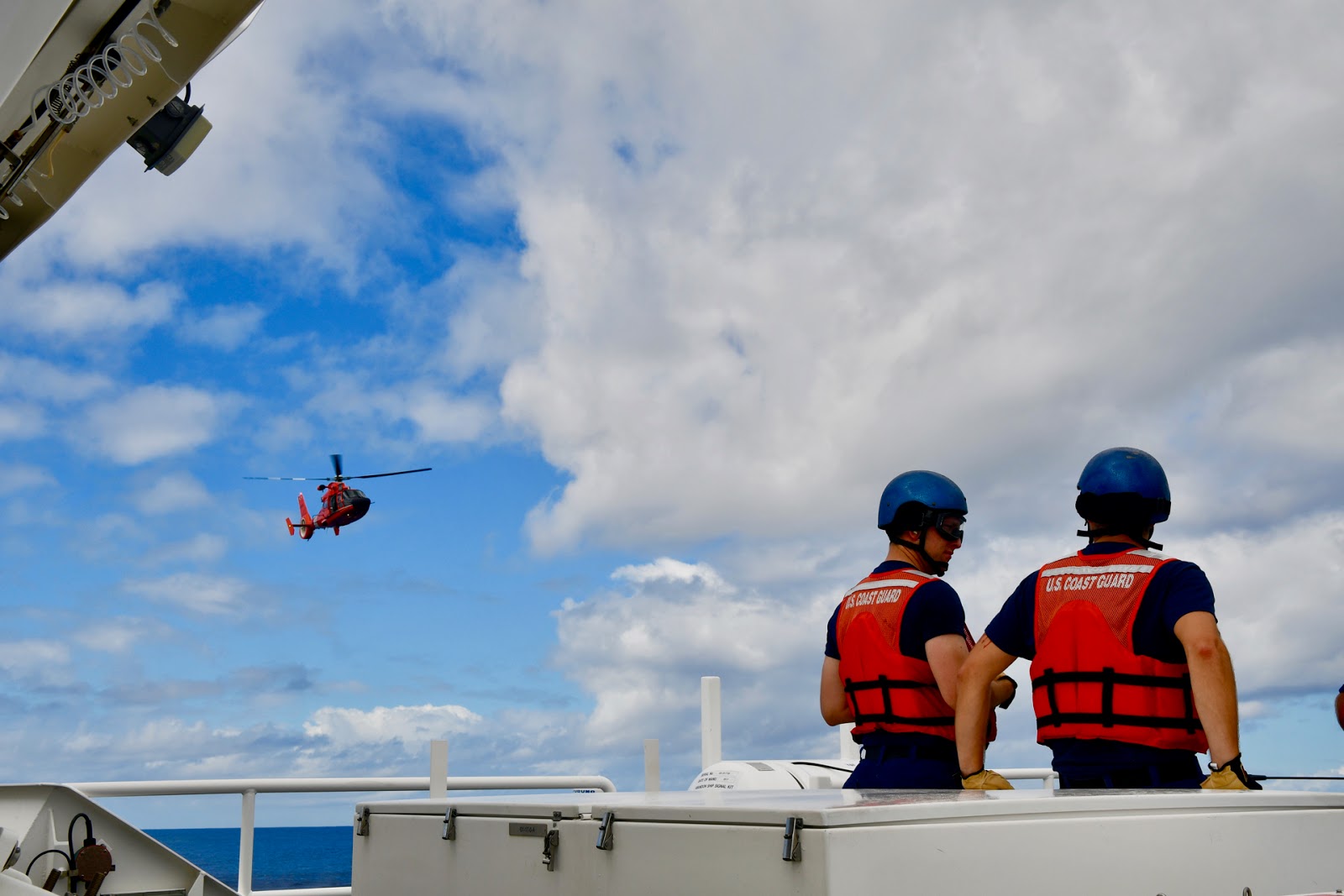
Coast Guard, Honolulu City and County complete successful response exercise off Oahu
HONOLULU — The Coast Guard, Coast Guard Auxiliary, Honolulu Fire Department, Honolulu Police Department, and Oahu Ocean Safety and Lifeguard Services concluded a successful two-day search and rescue exercise in the vicinity offshore from Ko'olina to Kahe Point, Thursday.
"The exercise went very well," said Lt. Brock Blaisdell, command center chief, Coast Guard Sector Honolulu. We're fortunate to work with an all-around great team and enjoy strong partnerships with our fellow search and rescue partners. A lot of effort and resources went toward the event which resulted in the successful discovery of Oscar, our simulated person in distress, about two hours after the initial call."
On day one of the exercise, a group of about 40 members from Coast Guard Sector Honolulu, Honolulu City and County Fire Department, Ocean Safety and the Honolulu Police Department to discuss safety, strategy, communication and demonstrate assets to understand each other's capabilities. The following day a multi-agency search and rescue live exercise was conducted for a simulated lost person in the water off the West Side of Oahu.
Live rescue assets included:
- The Coast Guard Cutter Joseph Gerczak (WPC 1126) and crew
- An MH-65 Dolphin helicopter crew from Coast Guard Air Station Barbers Point,
- A 45-foot Response-Boat Medium and crew from Coast Guard Station Honolulu
- Boat and aircrews from the Coast Guard Auxiliary
- Honolulu Fire helicopter, boat, and fire crews
- Jet Skis from Oahu Ocean Safety
These search and rescue exercises are conducted semi-annually throughout the islands to evaluate notification and response procedures between first responders and to identify shortfalls in communication and coordination of response during SAR incidents. Each agency holds individual capabilities that complement each other's efforts and bolsters the overall success of the SAR system.
''The purpose is to continue building and improving operational cohesion between other agencies and us," said Ensign Seth Gross, a Sector Honolulu search and rescue coordinator. "We hold these exercises semi-annually, and they revolve throughout the islands. The west side of the island is known to be more remote with dynamic currents, but increasingly draws visitors and locals alike. It has also been the site of an aircraft incident in recent years."
-USCG-
Etiquetas:
Country Fire Departament,
Hlcopters Magazine,
Honolulu Police Departamento,
MD Helicopter 500,
MH-65 Dolphin,
US Coast Guard,
US Coast Guard Auxiliary,
USCG Sector Honolulu
Suscribirse a:
Entradas (Atom)