Mostrando entradas con la etiqueta USAF. Mostrar todas las entradas

viernes, 17 de mayo de 2019

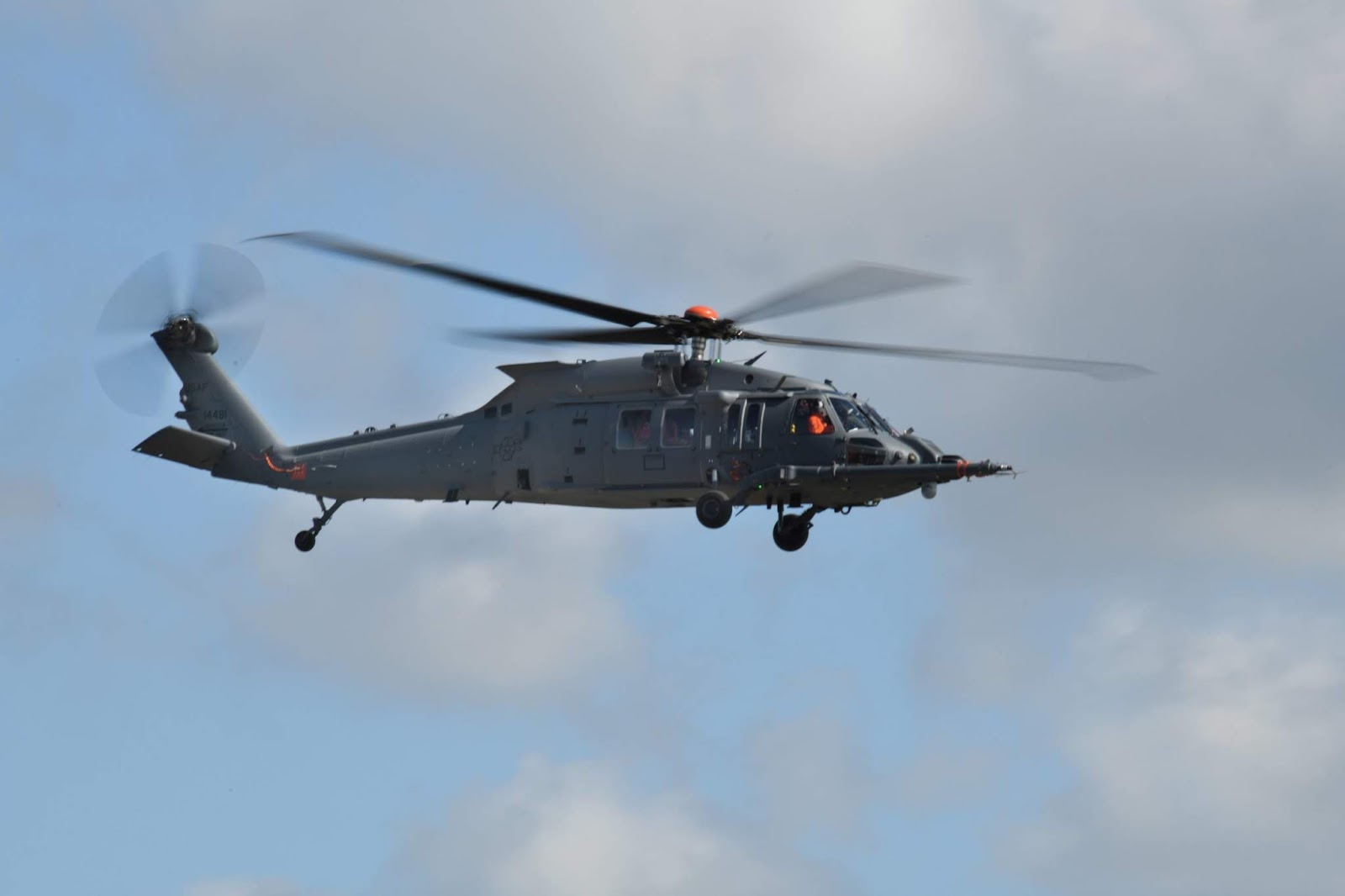
Sikorsky HH-60W Combat Rescue Helicopter Achieves First Flight

Helicopter offers the U.S. Air Force improved reliability, survivability and range

WEST PALM BEACH, Fla., May, 17, 2019 /PRNewswire/ -- The Sikorsky HH-60W Combat Rescue Helicopter achieved first flight today at Sikorsky's West Palm Beach, Florida site, an important step toward bringing this all-new aircraft to service members to perform critical search and rescue operations. The aircraft, developed by Sikorsky, a Lockheed Martin Company (NYSE: LMT) and based on the proven UH-60M Black Hawk, is customized for the U.S. Air Force 's rescue mission and will ensure the Air Force fulfills its mission to leave no one behind.

Total flight time was approximately 1.2 hours and included hover control checks, low speed flight, and a pass of the airfield. 
"This achievement is yet another vital step toward a low rate initial production decision and getting this much-needed aircraft and its advanced capabilities to the warfighter," said Dana Fiatarone, vice president, Sikorsky Army & Air Force Systems. "We are very pleased with the results of today's flight and look forward to a productive and informative flight test program."
Today's flight paves the way for a Milestone C production decision in September 2019, per the original baseline schedule, to which both Sikorsky and the Air Force are committed. A second HH-60W helicopter is expected to enter flight test next week, with a third and fourth aircraft entering flight test this summer. These aircraft will provide critical data over the course of the program which will enable the Air Force to make an informed production decision.
"The HH-60W's first flight is the culmination of significant development and design advances. We are excited to now move forward to begin full aircraft system qualification via the flight test program," said Greg Hames, director of the Combat Rescue Helicopter program. "Together with the Air Force, our team is motivated and committed to advancing this program and delivering this superior aircraft to our airmen and women."
The HH-60W Combat Rescue Helicopter is significantly more capable and reliable than its predecessor, the HH-60G Pave Hawk. The aircraft hosts a new fuel system that nearly doubles the capacity of the internal tank on a UH-60M Black Hawk, giving the Air Force crew extended range and more capability to rescue those injured in the battle space. The HH-60W specification drives more capable defensive systems, vulnerability reduction, weapons, cyber-security, environmental, and net-centric requirements than currently held by the HH-60G.
"With the Combat Rescue Helicopter's successful first flight now behind us, we look forward to completion of Sikorsky's flight test program, operational testing and production of this aircraft to support the Air Force's critical rescue mission," said Edward Stanhouse, Chief, U.S. Air Force Helicopter Program Office. "Increased survivability is key and we greatly anticipate the added capabilities this aircraft will provide."
The U.S. Air Force program of record calls for 113 helicopters to replace the Pave Hawks, which perform critical combat search and rescue and personnel recovery operations for all U.S. military services. A total of nine aircraft will be built at Sikorsky's Stratford, Connecticut, facility during the Engineering & Manufacturing Development (EMD) phase of the program ― four EMD aircraft and five System Demonstration Test Articles (SDTA).

jueves, 16 de agosto de 2018

3rd OSS honors a storied past

U.S. Air Force Staff Sgt. Paul Babbitt, with the 3rd Operations Support Squadron aerospace flight equipment section, holds the 3rd OSS patch he designed at Joint Base Elmendorf-Richardson, Alaska, July 12, 2018. Babbitt had the opportunity to design the new patch after squadron leadership thought an update was necessary. (Photo by Senior Airman Javier Alvarez)

JOINT BASE ELMENDORF-RICHARDSON, Alaska —
It’s been said that every successful air mission begins and ends on the flightline. That’s true for a Joint Base Elmendorf-Richardson unit with a long legacy.

The 3rd Airdrome Squadron was born out of necessity on November 7, 1942 at Lockburne Army Air Base, Ohio.

Tasked to rapidly deploy and establish airstrips in remote locations, the 3rd AS advanced through the Pacific during the island-hopping campaign of World War II. From one location to the next, service members mapped, dug, dragged, plowed, cleared, filled, paved and maintained landing strips, in support of air operations from New Guinea to the Philippines, Okinawa and Japan – all the while combating torrential weather and a relentless enemy.

“You have to be a student of history to understand where we’re going, and you have to be a student of history to know where we can go,” said U.S. Air Force Lt. Col. John Rogers, 3rd Operations Support Squadron commander. “[The squadron showed] you need to have an expeditionary function in your OSS. You don’t just show up with airplanes on an airfield without having someone on the ground doing all the prep work.”

In a Library of Congress archived interview, then-Army Air Corps Capt. Gilbert Brahn, 3rd AS aircraft engineer officer, recalled some of the ever-present dangers faced during the war.

“I remember very vividly a kamikaze plane punching into the water not far off from the ship I was on,” he said. “The anti-aircraft had shot down that plan and another one. There were other planes that were warded off because of it. Things were clear and the sky was clear.”

The heavens would not remain clear for long as Mother Nature had different plans.

“In November 1944, there was 40 inches of rain [in Leyte, Philippines],” Brahn said. “We were in awful mud. There was a real problem with the preparation of the airfields.”

Despite atmospheric drawbacks, the men went on enduring much of the same – ultimately reaching Japan in the summer of 1945.

“The squadron was involved in the Japanese surrender at the end of World War II,” said Christopher Koonce, 673d Air Base Wing historian. “They were brought to Atsugi, Japan just before the formal surrender to establish U.S. presence for Gen. Douglas Macarthur’s arrival. This was the first transient point in the early stages of U.S. occupation.”

By war’s end, the squadron had navigated across three countries, covering more than 3,500 miles in the process. The unit was inactivated soon after the war, reactivated for a short while in Kimpo, Korea, and finally inactivated Oct. 8, 1948.

The 3rd AS remained dormant for 43 years before being rebranded the 3rd Operations Support Squadron and reactivated at then-Elmendorf Air Force Base Dec. 6, 1991.

“It’s a very diverse squadron, and I think being Arctic Wolves, embodies the squadron,” said U.S. Air Force Staff Sgt. Paul Babbitt, with 3rd OSS aerospace flight equipment. “If only one wolf in the pack goes out to hunt, not everyone gets to eat. That fearless adventurous spirit. That’s the spirit of the 3rd OSS.”

Today, 225 Airmen across 26 different Air Force Specialty Codes make up the 3rd OSS.

“[The 3rd OSS] is really unique because you have people like us in aircrew flight equipment who pack chutes and making sure all the survival equipment is good to go so pilots can survive in the sky,” Babbitt said. “You have people in Survival, Evasion, Resistance and Escape teaching aircrew how to survive. You have airfield management who ensure the airfield is good and planes can take off and land, and many others.”

Taking a page from the history books, the Air Force in some ways is reverting to those early days of the squadron, Koonce said.

“With the new Agile Combat Employment, we’re going to a location, flying for a few hours or days, and moving to a new location,” Koonce said. “That’s essentially what they did in WWII. They would get to an island; sometimes the air field would be a small dirt strip and maybe they’d have to extend or expand. Maybe there would be holes because they dropped bombs on it so they’d have to repair that.”

Today’s OSS Airmen face a different set of challenges; with each technological advance comes the need for more stringent airfield requirements. What may have worked for propeller aircraft of days past may not be sufficient for fifth generation fighters.

“We’re now in a position where we’re doing that exact same thing,” Rogers said. “I’m sending people to austere locations, and asking what would it take to get an airplane here?


“This is the most diverse OSS in the Air Force,” he said. “You trust us to go out to these airfields that are in the middle of nowhere, and not only to deploy there and support operations that are ongoing, but research and come up with the shopping list of things we have to get to open them and enable them. That has a national-level impact. That’s a pretty amazing thing.”