viernes, 26 de julio de 2019

Coast Guard, partner agencies continue to search for missing boater in Charleston Harbor

The Coast Guard Cutter Cormorant and an Air Facility Charleston MH-65 Dolphin helicopter search for a missing boater in the Charleston Harbor July 25, 2019. On July 24, Coast Guard Sector Charleston command center watchstanders received a report from the cutter Cormorant of a 20-foot Pro-Line crabbing vessel in idle with no one aboard. (U.S. Coast Guard photo by the Coast Guard Cutter Cormorant).

CHARLESTON, S.C. — The Coast Guard and local partner agencies are continuing to search Thursday for a missing boater in the Charleston Harbor.

Missing is Terrance Singleton from North Charleston, S.C.

On Wednesday, Coast Guard Sector Charleston​ command center watchstanders received a report from the​ Coast Guard Cutter Cormorant​ of a 20-foot Pro-Line crabbing vessel in idle with no one​ aboard.​

The Cormorant crew located a shoe, live bait and catch on board the vessel.

A​ Coast Guard Air Facility Charleston​ MH-65 Dolphin helicopter​ crew and a Charleston County Sheriff's Office helicopter, along with Coast Guard and partner agency vessels, continue to search.
Involved in the search are:


The Coast Guard Cutter Cormorant crew searches for a missing boater in the Charleston Harbor July 25, 2019. On July 24, Coast Guard Sector Charleston command center watchstanders received a report from the cutter Cormorant of a 20-foot Pro-Line crabbing vessel in idle with no one aboard. (U.S. Coast Guard photo by the Coast Guard Cutter Cormorant).

The public is urged to keep a sharp lookout. Anyone with information should contact Sector Charleston at 843-740-7050
South Carolina Department of Natural Resources is investigating the cause of the incident.

For more breaking news follow us on​ Twitter.
-USCG-

miércoles, 24 de julio de 2019

Era Group Announces Q2 2019 Earnings Release Call

HOUSTON, July 23, 2019 (GLOBE NEWSWIRE) -- Era Group Inc. (NYSE: ERA), one of the largest helicopter operators in the world, today announced it will release financial results for its second quarter 2019 after the market closes on Tuesday, July 30, 2019.  In connection with the release, Era has scheduled a conference call for Wednesday, July 31, 2019, to begin at 10:00 a.m. ET (9:00 a.m. CT).
The accompanying investor presentation will be available on July 31, 2019, on Era's website at www.erahelicopters.com.
Era Group
Era is one of the largest helicopter operators in the world and the longest serving helicopter transport operator in the U.S. In addition to servicing its U.S. customers, Era also provides helicopters and related services to third-party helicopter operators and customers in other countries, including Brazil, Colombia, India, Mexico, Spain and Suriname.  Era’s helicopters are primarily used to transport personnel to, from and between offshore oil and gas production platforms, drilling rigs and other installations.  In addition, Era’s helicopters are used to perform emergency response services, firefighting, utility, VIP transport and other services.  Era also provides a variety of operating lease solutions and technical fleet support to third party operators.

Coast Guard ends search for possible person in the water near Freeport, Texas

U.S Coast Guard photo by Petty Officer 3rd Class Paige Hause (archive).

HOUSTON​ — The Coast Guard has ended the search for a possible person in the water off Surfside Beach in Freeport, Texas, Tuesday.

At approximately 9 p.m,​ Coast Guard Sector Houston-Galveston watchstanders received notification from a good Samaritan who reported assisting five adults back to shore after their pool floats were pulled away from the beach. One of the pool floats was not able to be recovered by the good Samaritan and matched the description of the initial​ report.​

The search began when Coast Guard Sector Houston-Galveston watchstanders received a report from a concerned beachgoer that two people on a grey pool float were struggling to make it back to shore.

Brazoria County Sheriff's Deputies were able to confirm with other beachgoers that one person was reportedly seen using the pool float.​

Watchstanders​ issued an urgent marine information broadcast.

A Coast Guard Air Station Houston MH-65 Dolphin helicopter crew and a Station Freeport 29-foot Response Boat-Small boat crew were launched to the scene.
Involved in the search were:
  • Coast Guard Air Station Houston
  • Coast Guard Station Freeport
  • Brazoria County Sheriff's Office
-USCG-

Life Saving Anti-Collision Software Integrated Into First F-35s Seven Years Ahead Of Schedule

F-35 Automatic Ground Collision Avoidance System: Proven life saver.

FORT WORTH, TexasJuly 24, 2019/PRNewswire/ -- The F-35 Joint Program Office, U.S. Air Force and Lockheed Martin (NYSE: LMT) have started integrating the Automatic Ground Collision Avoidance System (Auto-GCAS) on to Air Force F-35As in the fleet. Leveraging a rapid, agile development, test and contracting approach, the joint government and industry team successfully fielded the life-saving technology seven years earlier than previously planned.
"This is a great day for the warfighter as the Auto-GCAS is a proven system that is long overdue," said Lt. Gen. Eric Fick, F-35 Program Executive Officer. "Expediting this life-saving technology into the F-35 across the global fleet will bring more warfighters home. Over the service life of the F-35 fleet, having Auto-GCAS is estimated to prevent more than 26 ground collisions from happening. It is indeed a remarkable achievement in aeronautics which will improve the performance, efficiency, and safety of the F-35. The time and effort expended to deliver this critical warfighting capability is worth it – it will save lives."

Auto-GCAS uses terrain mapping, geolocation and automation to detect and avoid potential ground collisions.

Originally developed for the F-16 in partnership with NASA and the Air Force Research Laboratory, Auto-GCAS uses terrain mapping, geolocation and automation to detect and avoid potential ground collisions. When the program recognizes imminent impact, it will prompt the pilot to take action. If the pilot is unresponsive, Auto-GCAS assumes temporary control to divert the aircraft out of harm's way, and then returns control of the aircraft to the pilot once on a safe trajectory.
The system has been operating successfully aboard the F-16 for more than five years and has already been credited with saving eight F-16 pilots' lives since 2014.
"Early integration of Auto GCAS in the F-35 is bringing game changing safety capability to a rapidly growing fleet.  It couldn't have come at a better time as we near full rate production resulting in more aircraft and pilots exposed to rigorous missions," said Lt. Col. Darren Wees of the Air Force's F-35 Integration Office. "Many thanks to the tenacious efforts of many organizations, primarily the Air Force Research Lab, Air Force Test Center, Lockheed Martin and the F-35 Joint Program Office who made this a technical reality, as well as the U.S. services and F-35 Partner Nations that ensured its inclusion in the program. These efforts have already saved lives and aircraft in the F-16, and will save lives in the F-35."
Auto-GCAS was originally slated for delivery in the 2026 timeframe. To accelerate the technology, Air Force Research Laboratory and Lockheed Martin conducted positive feasibility studies and the F-35 Joint Program Office and Lockheed Martin then implemented an agile approach to develop the technology for integration on the F-35. The 412th Test Wing at Edwards Air Force Base then completed a rigorous flight testing program to validate its performance and safety, which led to the wing's formal recommendation to field Auto-GCAS aboard the F-35.
"The F-35 is the most survivable fighter jet in the world today – and the addition of Auto-GCAS will further enhance safety and save lives," said Greg Ulmer, Lockheed Martin's vice president and general manager of the F-35 program. "The safe and effective acceleration of this technology is a testament to the joint government and industry team partnering in an agile environment to deliver life-saving capability to our men and women in uniform, significantly sooner than planned."
U.S. Air Force F-35As are the first to receive Auto-GCAS, and the system will next be integrated aboard the F-35B and F-35C variants. The Auto-GCAS team was recently recognized with the National Aeronautic Associations' 2018 Robert J. Collier Trophy, and received the prestigious award in June 2019.
With stealth technology, advanced sensors, supersonic speed, weapons capacity and superior range, the F-35 is the most lethal, survivable and connected aircraft in the world. More than a fighter jet, the F-35's ability to collect, analyze and share data, is a powerful force multiplier that enhances all airborne, surface and ground-based assets in the battlespace enabling men and women in uniform to execute their mission and return home safely.
For additional information, visit www.f35.com

martes, 23 de julio de 2019

US Air Force: Exercise Talisman Sabre 19 (Gallery)

A KC-10 Extender assigned to the 32nd Air Refueling Squadron, Joint Base McGuire-Dix-Lakehurst, New Jersey, refuels an F-22 Raptor assigned to the 90th Fighter Squadron, Joint Base Elmendorf-Richardson, Alaska, mid-air, July 21, as part of Exercise Talisman Sabre 19. TS19 provides effective and intense training to ensure U.S. Forces are combat ready, capable, interoperable, and deployable on short notice. (U.S. Air Force photo by Staff Sgt. Kyle Johnson).
A KC-10 Extender prepares to take off from the Brisbane Airport, Queensland, Australia, July 21, as part of Exercise Talisman Sabre 19. TS19 provides effective and intense training to ensure U.S. Forces are combat ready, capable, interoperable, and deployable on short notice. (U.S. Air Force photo by Staff Sgt. Kyle Johnson).
A KC-10 Extender assigned to the 32nd Air Refueling Squadron, Joint Base McGuire-Dix-Lakehurst, New Jersey, refuels an F-22 Raptor assigned to the 90th Fighter Squadron, Joint Base Elmendorf-Richardson, Alaska, mid-air, July 21, as part of Exercise Talisman Sabre 19. TS19 provides effective and intense training to ensure U.S. Forces are combat ready, capable, interoperable, and deployable on short notice. (U.S. Air Force photo by Staff Sgt. Kyle Johnson).
1st Lt. Braden Hicks, a KC-10 Extender pilot assigned to the 32nd Air Refueling Squadron, Joint Base McGuire-Dix-Lakehurst, New Jersey, circles the air above the east coast of Australia, July 21, as part of Exercise Talisman Sabre 19. TS19 provides effective and intense training to ensure U.S. Forces are combat ready, capable, interoperable, and deployable on short notice. (U.S. Air Force photo by Staff Sgt. Kyle Johnson).
Staff Sgt. Allen Johnson, a KC-10 Extender flight engineer assigned to the 32nd Air Refueling Squadron, Joint Base McGuire-Dix-Lakehurst, New Jersey, assists the pilots in the air above the east coast of Australia, July 21, as part of Exercise Talisman Sabre 19. TS19 provides effective and intense training to ensure U.S. Forces are combat ready, capable, interoperable, and deployable on short notice. (U.S. Air Force photo by Staff Sgt. Kyle Johnson).
1st Lt. Braden Hicks, a KC-10 Extender pilot assigned to the 32nd Air Refueling Squadron, Joint Base McGuire-Dix-Lakehurst, New Jersey, circles the air above the east coast of Australia, July 21, as part of Exercise Talisman Sabre 19. TS19 provides effective and intense training to ensure U.S. Forces are combat ready, capable, interoperable, and deployable on short notice. (U.S. Air Force photo by Staff Sgt. Kyle Johnson).

Minister publishes review of the UK search and rescue helicopter service

Post-Implementation Review of MCA helicopter service launched by Minister today.

I am delighted to publish this independently produced post-implementation review of the UK search and rescue helicopter service. The service has been in place since 2015 and in that time, has been responsible for the rescue of thousands of lives. As Minister responsible for the service, I am proud of the work of our helicopter crews who routinely put their own lives at risk to rescue others.
I recognise the high expectations the public has for this service, particularly given the fact that it replaced the much respected military sea king service. I equally recognise the degree to which our stakeholders in the emergency services and the volunteer rescue organisations value our search and rescue helicopters and how critical it is to enable those services to undertake their lifesaving work.
To assure itself that the UK search and rescue helicopter service is meeting our stakeholders’ needs and to evaluate the impact the service has had on the ability to respond to people in distress, the MCA commissioned this review to evaluate the work of the UK search and rescue helicopter service since it has been in operation.
The review draws upon statistical data and insight from partner rescue organisations to reach its conclusions. The general opinion of the review is that the transition to the UK search and rescue helicopter service was successful. It concludes that the anticipated benefits are either met or on track to be met. It further identifies a number of unanticipated benefits that present opportunities for the future to grow the service to be offer even greater value for money to the public.
This review will be used to inform the government’s plans for the next generation search and rescue aviation capability, work on which has now started.
Nusrat Ghani MP
Parliamentary Under Secretary of State for Transport

lunes, 22 de julio de 2019

Airbus scores first ACH160 order in Southeast Asia

Order includes region’s first HCare First premium support package.

Manila, Airbus Helicopters has secured an ACH160 order from an undisclosed new customer in the Philippines, launching this new model in the Southeast Asia and Pacific region. It will be used for private and business flights within the Philippines archipelago.
This aircraft will feature the ACH160 Exclusive version highlighting two wide hinged doors and electrical footsteps combined with a bespoke cabin, welcoming up to eight passengers in an elegant and refined handcrafted interior for a truly business-jet like experience.
Equipped with Blue Edge blades and a new canted Fenestron rotor, the ACH160 sets a new benchmark in corporate transportation with a blend of innovative technology, speed, comfort and style.
As part of the contract, the ACH160 will be backed by HCare First – the first such premium support agreement in the region, catering to the specific needs of operators requiring worry-free aircraft availability.
“Launching the ACH160 in Southeast Asia with a new Philippine customer underlines the global attractiveness of our corporate helicopters offering to meet the evolving travelling needs of our customers,” said Frederic Lemos, Head of Airbus Corporate Helicopters (ACH). “We are equally excited to see our ACH products gaining good success in the growing Philippine private travel market.”
The H160 is Airbus Helicopters’ innovative medium twin-engine helicopter designed to create added value for customers in terms of performance, economic competitiveness, safety and comfort. Versions are available for the offshore transportation, business and private, public services, and commercial passenger transport markets. Its entry into service is planned for 2020.
Renowned for its combination of versatility and comfort, the ACH helicopter range is well regarded by passengers and pilots for its stylish interiors, smooth and quiet ride allied to its technologically advanced Helionix digital avionics systems ensuring carefree handling and a high level of safety.
The full ACH range consists of the ACH125, ACH130, ACH135, new ACH145, ACH160 and ACH175 variants of Airbus Helicopters’ comprehensive and market-leading family of light and medium models. A range of premium-design aircraft completions, including customised solutions, is available for all models.
Airbus has been present in the Philippines for some 40 years leading the corporate and parapublic helicopter market segments. Through its Manila-based customer centre, Airbus Helicopters Philippines provides maintenance, repair and overhaul, support and service solutions to more than 50 customers.

Coast Guard aircrew, good Samaritan boat crew medevac injured vessel captain northeast of Biorka Island, Alaska

An Mh-60 Jayhawk helicopter crew from Coast Guard Air Station Sitka medevacs an injured vessel captain after he reportedly lacerated several fingers aboard a fish processing vessel northeast of Biorka Island, Alaska, July 20, 2019. Good Samaritans aboard the charter fishing vessel North River assisted by transporting the captain from his vessel to a nearby shore where he was transferred to the Jayhawk crew. U.S. Coast Guard video courtesy of Air Station Sitka.

JUNEAU, Alaska — A Coast Guard aircrew and a good Samaritan boat crew medevaced a vessel captain after he was injured aboard a fish processing vessel northeast of Biorka Island, Saturday.

The MH-60 Jayhawk helicopter crew from Coast Guard Air Station Sitka transported the captain from shore near the vessel to the air station, where they transferred him to Sitka Fire Department emergency medical services for further care.

At 10.18 a.m. Coast Guard Sector Juneau watchstanders received a report from a vessel in the area that the captain of the fish processing vessel Northwind potentially severed several fingers. Around the same time the Jayhawk crew was conducting a training flight in the area, heard a request for help over VHF channel 16 and diverted to respond.

"It was great timing for everybody involved," said Lt. Justin Neal, co-pilot on the response. "We were maybe two minutes away and listening to channel 16 like we always do, somebody called out needing help and we were able to respond."

A good Samaritan crew aboard the charter fishing vessel North River took the captain from the Northwind onto their vessel, then transported him to shore where he was transferred to the Jayhawk crew that landed nearby.

"It was great that everybody was willing to help, and do what was required to get this person to a higher level of care," said Neal.

U.S. Coast Guard photo by Lt. Kellen Browne (archive).

-USCG-

domingo, 21 de julio de 2019

Coast Guard rescues woman, dog from bottom of cliff near Ludington, Mich.

Petty Officer 2nd Class Stevie Ray Catala-Vargas, an aviation survival technician stationed at Coast Guard Air Facility Muskegon, deploys from a MH-65 Dolphin helicopter onto the side of a cliff near Ludington, Michigan, July 19, 2019. The aircrew rescued a woman and her dog who had been stranded at the bottom of a cliff overnight. 
U.S. Coast Guard video.


U.S. Coast Guard video.


U.S. Coast Guard video.


CLEVELAND​ —​ U.S. Coast Guard Air Facility Muskegon's​ MH-65 Dolphin helicopter crew rescued a woman and​ her dog after she had been stranded​ on​ Lake Michigan's shoreline at the bottom of a​ sand bluff, near Ludington, Michigan,​ Friday.

The woman and her husband had been hiking with their three dogs along the bluff near Lake Michigan, Thursday. They descended the cliff to the shoreline but were unable to climb back up due to loose soil and sand.

The couple had their cell phones but, due to lack of coverage,​ were unable to notify first responders. The couple spent the night on the shoreline. Friday morning, the husband was able to climb out and notify local responders.

At approximately 10:15 a.m., U.S. Coast Guard Sector Lake Michigan launched Coast Guard Station Ludington's 29-foot response boat​ - small and​ a​ land crew from Station Ludington to assess the situation.​ The small boat was unable to get near the bluff due to small craft advisory conditions and the shallow depth of water.

Ludington fire department's high angle rescue teams rappelled down to the stranded woman but encountered difficulties because of the steep terrain and loose ground.

U.S. Coast Guard Sector Lake Michigan launched​ a MH-65 Dolphin helicopter from Coast Guard Air Facility Muskegon and later, a​ MH-60 Jayhawk helicopter from Coast Guard Air Station Traverse City to assist. Once both helicopters were on scene it was determined that the dolphin helicopter would conduct the rescue and successfully hoisted the woman and one of her dogs at​ 12:44 p.m.

The fire rescue team were able to rescue the remaining two dogs. One of the fire team members suffered a leg injury while descending the bluff. The member was given a life jacket and waded into the water to be assisted onto the small boat and transported to local EMS on shore.

The woman was flown to Mason County Airport in Ludington. No injuries were reported.

U.S. Coast Guard Air Facility Muskegon's MH-65 Dolphin helicopter crew rescued a woman and her dog after she had been stranded on Lake Michigan's shoreline at the bottom of a sand bluff, near Ludington, Michigan, Friday. The woman and her husband had been walking their three dogs along the bluff near Lake Michigan Thursday night when the soil gave way and the couple fell down the cliff to the shoreline. 
U.S. Coast Guard photo.

-USCG-

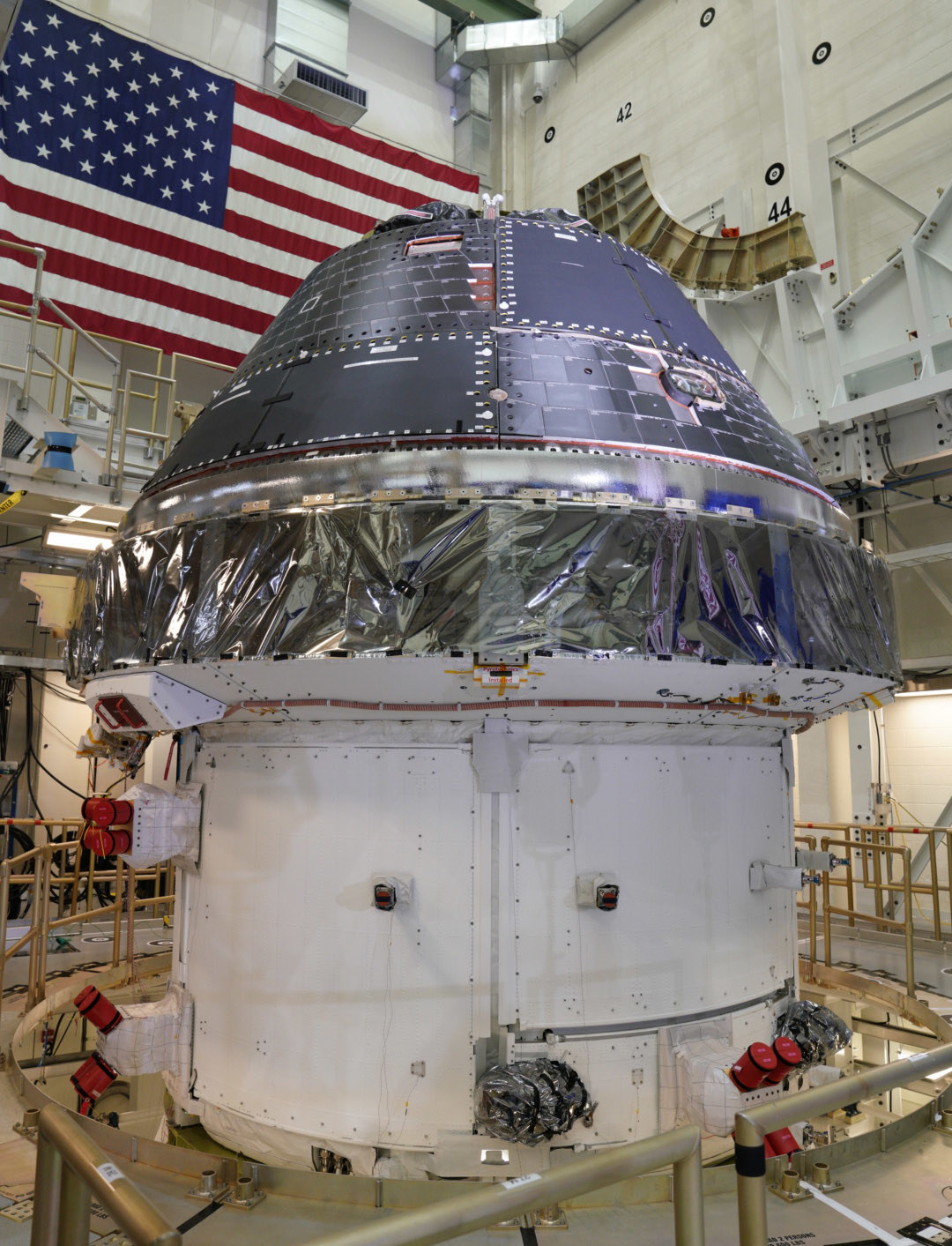
Lockheed Martin Completes NASA's Orion Spacecraft Capsule For Artemis 1 Mission To The Moon

KENNEDY SPACE CENTER, Fla.July 20, 2019/PRNewswire/ -- The goal of humans again walking on the Moon is one giant leap closer. Lockheed Martin (NYSE: LMT) has completed building the capsule for NASA's Orion spacecraft. The crew module capsule for the uncrewed Artemis 1 mission to the Moon has been stacked on top of the Orion service module, which was also recently finished.
Vice President Mike Pence made the announcement today at a ceremony in front of the Orion spacecraft in the aptly-named Neil Armstrong Operations and Checkout Building at the Kennedy Space Center in Florida. The event and announcement commemorated the 50-year anniversary of the Apollo 11 Moon landing.
Lockheed Martin's President, Chairman and CEO Marillyn Hewson also provided remarks at the ceremony, in addition to NASA's Administrator Jim BridenstineKennedy Space Center'sDirector Robert Cabana and Florida's Governor Ron DeSantis.
The Orion spacecraft is like none other in its design and capability.
"Orion is a new class of spaceship, uniquely designed for long-duration deep space flight, that will return astronauts to the Moon and eventually take the first humans to Mars, and bring them all back safely." said Lisa Callahan, vice president and general manager of Commercial Civil Space at Lockheed Martin. "Orion will accelerate scientific discovery of our solar system and will be the cornerstone of the defining space achievement of this era."
Since the crew module pressure vessel arrived in Florida, technicians and engineers from Lockheed Martin, NASA and supporting contractors have meticulously assembled the capsule into its finished state. The work included installing the capsule's avionic computers, harnesses, propulsion system and its 12 engines, 11 parachutes, its large 16-foot-diameter heat shield, forward bay cover and numerous other systems and components. 
"Throughout assembly, the team tested and validated the many systems a hundred different ways to ensure they will operate as designed in the harshness of deep space," said Mike Hawes, Orion program manager for Lockheed Martin. "The Artemis 1 flight will test the design and workmanship of the capsule and its service module during the three-week mission out around the Moon and back. We're excited for this mission as it paves the way for the first crewed mission in 2022, Artemis 2."
The crew module and service module were stacked together earlier in the week in the Final Assembly and System Testing (FAST) cell where they are now being fully integrated, including connecting the physical retention bolts and the umbilical lines between the two modules. The FAST cell is also where the Apollo spacecraft were integrated.
The combined stack will then be powered up and undergo a series of integrated systems tests. In September, the combined stack will be shipped to NASA's Plum Brook Station in Ohio, where it will go through environmental testing in a large thermal vacuum chamber as well as testing for electromagnetic interference and compatibility.
Once Orion returns to Kennedy at the end of the year, the spacecraft will go through final preparations before Lockheed Martin delivers it to ground systems for launch processing in early 2020.
More information about Orion:
Lockheed Martin Orion page: https://www.lockheedmartin.com/orion 
NASA Orion page: https://www.nasa.gov/orion

Luca Parmitano returns to the International Space Station

ESA astronaut Luca Parmitano has arrived at the International Space Station on his ‘Beyond’ mission, marking the start of Expedition 60.
Luca and crewmates NASA astronaut Andrew Morgan and Russian cosmonaut Alexander Skvortsov travelled for six hours in their Soyuz MS-13 spacecraft. They were launched into space from the Baikonur Cosmodrome on 20 July 2019, 18:28 CEST and docked to the Station at 00:48 CEST on 21 July. After docking, the crew conducted thorough checks on the seals before being welcomed on board by NASA astronauts Christina Koch and Nick Hague, along with Russian cosmonaut and current Space Station commander Alexei Ovchinin at 03:04 CEST on 21 July.
Over the next six months, Luca will support more than 50 European experiments as well as 200 international experiments. These include investigations into how aspects of the human body are affected by microgravity and how astronauts could control robots remotely during lunar exploration.
When Alexei Ovchinin departs the Space Station at the end of Expedition 60, Luca will also take on the role of Space Station commander for Expedition 61. This is the third time a European astronaut and the first time an ESA astronaut from Italy has held this position. Luca will follow ESA astronauts Frank De Winne (2009) and Alexander Gerst (2018) when he takes command later this year.
Frank, who is now head of ESA’s astronaut centre in Cologne, Germany, says Luca’s appointment to the role of commander is a reflection of ESA’s standing among international space agencies: “People can rely on us, and they do rely on us,” he said. “Not only in terms of the hardware that we provide - to the Space Station and the​ service module for the Orionspacecraft, but also in the area of crew operations.​ ​ I think that is a very good result of the investment that ESA Member States make.”​

Bringing the Moon into focus
Launching 50 years after the first Apollo Moon landing, it is fitting that Luca will work on experiments designed to aid the future of space exploration.
These experiments include BioRock, which aims to help scientists understand whether microbes used to ‘biomine’ on Earth could also work on other planetary bodies, and to examine how communities of microorganisms grow on rocks in space.
Luca will also test and operate ESA’s Life Support Rack, designed to recycle carbon dioxide into breathable oxygen as part of ESA’s goal to enable astronauts to live independently from Earth on a sustainable basis. He will also operate an Earth-based rover from the International Space Station testing remote operations that could be applied on the Moon.
Results from these experiments will support ESA’s contribution to the lunar Gateway and the Heracles mission to the Moon in ongoing work with international partners.
“What has happened today is part of our journey forward to the Moon,” said ESA Director General Jan Wörner. “With our international partners, we are excited to be part of a new generation of space explorers, giving research opportunities and access to space to all of our Member States.”

Stepping into space
Luca has also been preparing for spacewalks, working with teams on the ground to develop new procedures and tools to repair the Alpha Magnetic Spectrometer (AMS-02).
Installed outside the Space Station in 2011, AMS-02 is a particle physics detector collecting cosmic rays to help scientists understand dark matter and antimatter. It was initially only meant to operate in space for three years, but it was so successful in its mission that its life has been extended. To enable this to happen, three of its four cooling pumps require repair in a challenging spacewalk.

Going Beyond
Luca’s activities during the Beyond mission are part of ESA’s long-term vision to send the first Europeans beyond Earth orbit and establish Europe as a key partner in humankind’s exploration of the Solar System.
Working with international partners, ESA seeks to bring new knowledge, innovation and inspiration to all European citizens and increase accessibility for researchers through new Space Station facilities such as the International Commercial Experiments service (ICE Cubes) installed in the Columbus module in 2018.
“What we are learning in low Earth orbit will enable the next generation to go farther and keep exploring. For us to be able to go back to the Moon and towards Mars, we have to know how to survive and operate in those worlds. That is where the Space Station comes into play,” Luca says.

Latest updates from Luca
The first European press conference with Luca live from the Space Station is planned for 29 July at the Leonardo di Vinci National Museum of Science and Technology in Milan, Italy. This is open to European media and will be broadcast live.
Further updates from the Beyond mission will be published online at: http://lucaparmitano.esa.int/
Here you can also access the ESA Explores podcast, which will feature updates and interviews with astronaut experts throughout the mission.

European Space Agency
The European Space Agency (ESA) provides Europe’s gateway to space.
ESA is an intergovernmental organisation, created in 1975, with the mission to shape the development of Europe’s space capability and ensure that investment in space delivers benefits to the citizens of Europe and the world.
ESA has 22 Member States: Austria, Belgium, the Czech Republic, Denmark, Estonia, Finland, France, Germany, Greece, Hungary, Ireland, Italy, Luxembourg, the Netherlands, Norway, Poland, Portugal, Romania, Spain, Sweden, Switzerland and the United Kingdom. Slovenia is an Associate Member.
ESA has established formal cooperation with six Member States of the EU. Canada takes part in some ESA programmes under a Cooperation Agreement.
By coordinating the financial and intellectual resources of its members, ESA can undertake programmes and activities far beyond the scope of any single European country. It is working in particular with the EU on implementing the Galileo and Copernicus programmes as well as with Eumetsat for the development of meteorological missions.
ESA develops the launchers, spacecraft and ground facilities needed to keep Europe at the forefront of global space activities. Today, it develops and launches satellites for Earth observation, navigation, telecommunications and astronomy, sends probes to the far reaches of the Solar System and cooperates in the human exploration of space. ESA also has a strong applications programme developing services in Earth observation, navigation and telecommunications.

viernes, 19 de julio de 2019

Sea Lion Successfully Completes Mission Demonstration

Donauwörth, The NH90 Sea Lion successfully completed mission demonstrations for its relevant roles in the German Navy, including SAR missions, in July. Representatives of the Navy and the procurement agency BAAINBw participated in the tests that covered operations using a rescue hoist, checking navy reconnaissance capabilities, and dropping off commandos and Special Forces equipment, including an inflatable boat. Delivery of the first Sea Lion helicopters is scheduled for the end of 2019. Altogether 18 helicopters are on order.

Lion Air becomes first A330neo operator in the Asia-Pacific region

Indonesian carrier Lion Air has received its first A330-900, becoming the first airline from the Asia-Pacific region to fly the A330neo. The aircraft is on lease from BOC Aviation and is the first of 10 A330neos set to join the airline’s fleet.
The A330neo will be used by Lion Air for non-stop long-haul services from Indonesia. These include pilgrimage flights from cities such as Makassar, Balikpapan and Surabaya to Jeddah and Medina in Saudi Arabia. The flight time for such routes can be up to 12 hours.
Lion Air’s A330-900 is configured for 436 passengers in a single-class configuration.
The A330neo is the true new-generation aircraft building on the most popular wide body A330’s features and leveraging on A350 XWB technology. Powered by the latest Rolls-Royce Trent 7000 engines, the A330neo provides an unprecedented level of efficiency – with 25% lower fuel burn per seat than previous generation competitors. Equipped with the Airbus Airspace cabin, the A330neo offers a unique passenger experience with more personal space and the latest generation in-flight entertainment system and connectivity.

Coast Guard aircrew medevacs 42-year-old woman off fishing vessel near Noyes Island, Alaska

An MH-60 Jayhawk helicopter crew from Coast Guard Air Station Sitka medevacs an injured 42-year-old woman off a fishing vessel north of Noyes Island, Alaska, July 18, 2019. The woman had suffered a head injury while working aboard the fishing vessel Western Cruiser in the water west of the island. U.S. Coast Guard video courtesy Air Station Sitka.


U.S. Coast Guard photo by Petty Officer 1st Class David Mosley (archive).


JUNEAU, Alaska — A Coast Guard aircrew medevaced a 42-year-old woman off a fishing vessel near Noyes Island, Thursday.

The MH-60 Jayhawk helicopter crew from Coast Guard Air Station Sitka transported her to Sitka where they transferred the woman to waiting emergency medical service personnel, who took her to Mt. Edgecumbe Hospital for further care.

Around 11:40 a.m., Coast Guard Sector Juneau watchstanders received a call from Craig City Harbormaster staff, who stated a member of the crew was bleeding and in an out of consciousness after a blunt object impacted her head.

The Jayhawk crew was already airborne and was diverted based on new information.

A Craig City Harbormaster crew also responded aboard a 25-foot boat and met the crew of the Western Cruiser near Cape Ulitka on the north end of Noyes Island, followed shortly after by the Jayhawk crew.

“A harbormaster had gotten there before us and dropped off an EMT,” said Petty Officer 2nd Class Aaron Eckstein, rescue swimmer on the response. “So he had a chance to look her over and the bleeding was under control at that point.”

Eckstein evaluated her, and with her stable condition combined with fuel constraints the aircrew elected to conduct a basket hoist.

“Overall it was a very smooth hoist, and the crew members on board were very welcoming and helped out,” said Eckstein. “The crew assisted in getting her over to the basket and one of the crew members assisted with the trail line.”

After she was hoisted, the aircrew did a bear hook recovery of Eckstein and made the approximately hour long transit to Sitka.

-USCG-