Mostrando entradas con la etiqueta USCG Cutter Polar Star. Mostrar todas las entradas

miércoles, 27 de noviembre de 2019

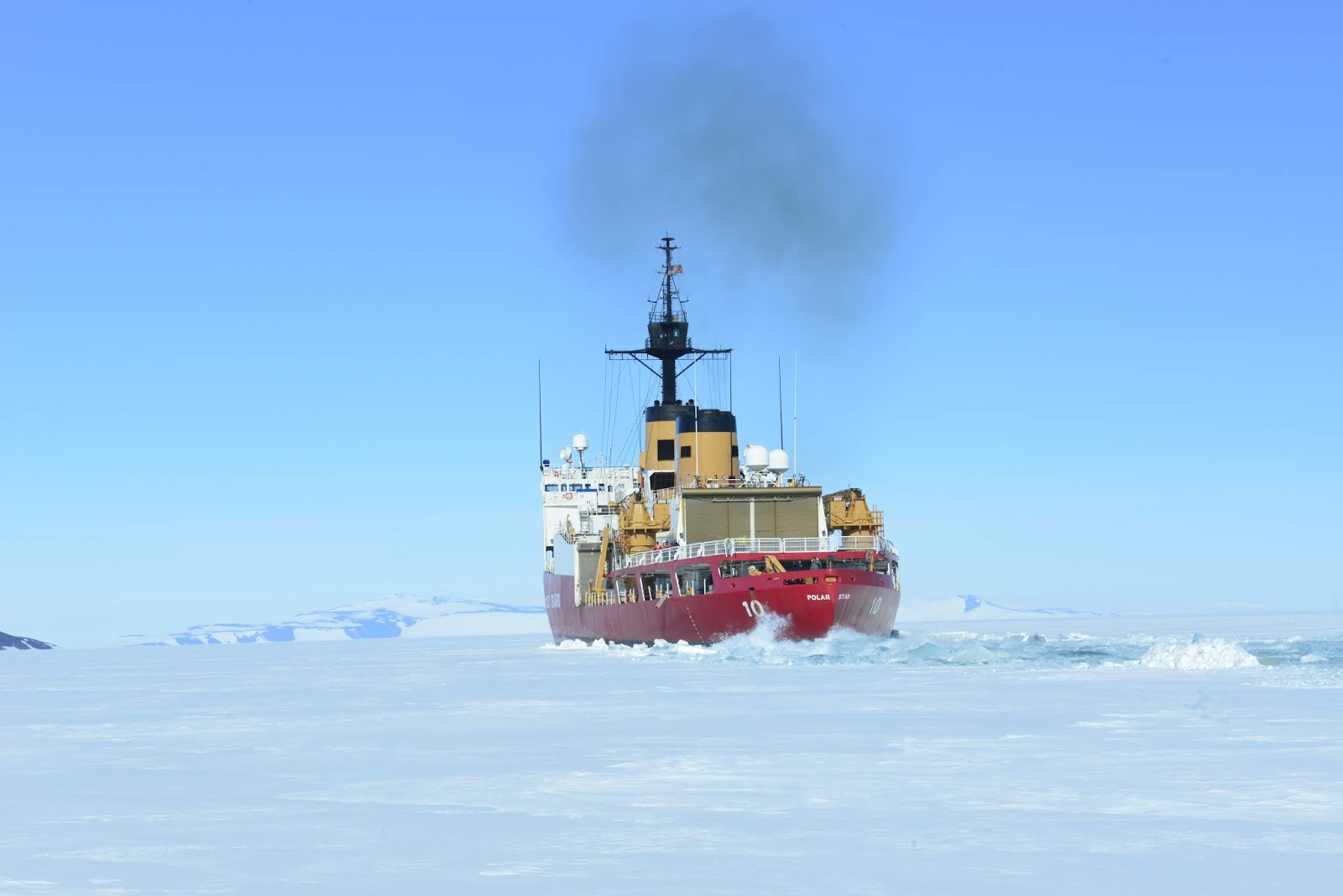
Nation’s only heavy icebreaker departs for Antarctic military operation

USCGC Polar Star (WAGB 10) transits Elliott Bay with the skyline of Seattle, Washington, in the background on Nov. 26, 2019. The cutter is scheduled to assist with ice breaking operations in McMurdo Sound near Antarctica during Operation Deep Freeze 2020. 
U.S. Coast Guard photo by Petty Officer 2nd Class Steve Strohmaier.

SEATTLE — The crew aboard the U.S. Coast Guard Cutter Polar Star (WAGB 10) departed Tuesday commencing their annual deployment to Antarctica where the cutter and crew will support Operation Deep Freeze 2020, a joint military service mission to resupply U.S. interests in Antarctica.

“We set out today on an important mission, saying goodbye to the friends and families who have supported us and our ship for the past seven-months since we returned from Operation Deep Freeze 2019,” said Capt. Gregory Stanclik, commanding officer of the Polar Star. “We are looking forward to this year’s mission to McMurdo Station with a ship that is running the best it has since reactivation. This mission is critical to the United States and our continued strategic presence on the Antarctic Continent and I have the best crew possible to ensure we safely accomplish our goal.”
USCGC Polar Star (WAGB 10).
U.S. Coast Guard photo by Petty Officer 2nd Class Steve Strohmaier.
Homeported in Seattle, the 43-year-old Coast Guard cutter is the United States’ last remaining operational heavy icebreaker. This is the cutter’s seventh deployment in as many years to directly support the resupply of McMurdo Station – the United States’ main logistics hub in Antarctica.

Each year, the crew aboard the 399-foot, 13,000-ton Polar Star create a navigable path through seasonal and multi-year ice, sometimes as much as 21-feet thick, to allow a resupply vessel to reach McMurdo Station. The supply delivery allows Antarctic stations to stay operational year-round, including during the dark and tumultuous winter.

Commissioned in 1976, the Polar Star is showing its age. Reserved for Operation Deep Freeze each year, the Polar Star spends the winter breaking ice near Antarctica, and when the mission is complete, the cutter returns to dry dock in order to complete critical maintenance and repairs in preparation for the next Operation Deep Freeze mission.
The family of a crewmember aboard USCGC Polar Star (WAGB 10) wave from the pier at Base Seattle, Nov. 26, 2019. The Polar Star crew departed its homeport for a deployment that will last several months. U.S. Coast Guard photo by Petty Officer 3rd Class Michael Clark.
The Coast Guard has been the sole provider of the nation’s polar icebreaking capability since 1965, and is seeking to increase its icebreaking fleet with six new polar security cutters in order to ensure continued national presence and access to the Polar Regions.

In the fiscal year 2019 budget, Congress appropriated $655 million to begin construction of a new polar security cutter this year, with another $20 million appropriated for long-lead-time materials to build a second.

The Coast Guard and U.S. Navy, working through an integrated program office, awarded VT Halter Marine Inc., a fixed price incentive contract in April for the detail design and construction of the Coast Guard’s lead polar security cutter, including options for the construction of two additional PSCs.
Antarctica-USCGC Polar Star (WAGB 10) Polar Icebreaker. 
U.S. Coast Guard photo.

“The Coast Guard greatly appreciates the strong support from both the Administration and Congress for funding the polar security cutter program,” said Adm. Karl Schultz, the commandant of the Coast Guard. “These new cutters are absolutely vital to achieving our national strategic objectives in the Polar Regions – presence equals influence, and we must be present to meet the Nation’s national security and economic needs there in the future.”

-USCG-

viernes, 18 de enero de 2019

Coast Guard's only heavy icebreaker arrives at Antarctica

The Coast Guard Cutter Polar Star breaks ice in McMurdo Sound near Antarctica on Saturday, Jan. 13, 2018. The crew of the Seattle-based Polar Star is on deployment to Antarctica in support of Operation Deep Freeze 2018, the U.S. military’s contribution to the National Science Foundation-managed U.S. Antarctic Program. U.S. Coast Guard photo by Chief Petty Officer Nick Ameen.

ALAMEDA, Calif. – The 150 crewmembers of the U.S. Coast Guard Cutter Polar Star arrived Thursday in Antarctica along with a resupply vessel during Operation Deep Freeze – a joint military service mission to resupply U.S. interests in Antarctica.

Homeported in Seattle, the 42-year-old Coast Guard cutter is the United States’ only operational heavy icebreaker, and the crew is making their sixth deployment in as many years to directly support the resupply of McMurdo Station – the United States’ main logistics hub in Antarctica.

Operation Deep Freeze is a joint military service mission in support of the National Science Foundation – the lead agency for the United States Antarctic Program. Since 1955, U.S. Indo-Pacific Command has assisted in providing air and maritime support throughout the Antarctic continent. This year marks the 63rd iteration of the annual operation.

Each year, the Polar Star crew creates a navigable path through seasonal and multi-year ice, sometimes as much as 21-feet thick, to allow a resupply vessel to reach McMurdo Station. The supply delivery allows Antarctic stations to stay operational year-round, including during the dark and tumultuous winter.

The 399-foot, 13,000-ton Polar Star arrived after completing an 18-mile trip through the ice to McMurdo Sound, where 400 containers will be offloaded from the supply ship Ocean Giant.

Presently, the U.S. Coast Guard maintains two icebreakers – the Coast Guard Cutter Healy, which is a medium icebreaker, and the Polar Star. Protecting national interests in the Polar regions is essential to ensure the Coast Guard’s national defense strategy and search and rescue capabilities are ready for action, but in order to do so, the icebreaker fleet requires modernization.

Commissioned in 1976, the Polar Star is showing its age. Reserved for Operation Deep Freeze each year, the Polar Star spends the winter breaking ice near Antarctica, and when the mission is complete, the Polar Star returns to dry dock in order to complete critical maintenance and repairs in preparation for the next Operation Deep Freeze mission. Once out of dry dock, the ship returns to Antarctica, and the cycle repeats itself.

During this year’s deployment, one of the ship’s electrical systems began to smoke, causing damage to wiring in an electrical switchboard, and one of the ship’s two evaporators used to make drinkable water failed.

The ship also experienced a leak from the shaft that drives the ship’s propeller, which halted icebreaking operations in order to send scuba divers in the water to repair the seal around the shaft. A hyperbaric chamber on loan from the U.S. Navy aboard the ship allows Coast Guard divers to make external emergency repairs and inspections of the ship’s hull.

The Polar Star also experienced ship-wide power outages while breaking ice. Crew members spent nine hours shutting down the ship’s power plant and rebooting the electrical system in order to remedy the outages.

If a catastrophic event, such as getting stuck in the ice, were to happen to the Healy in the Arctic or to the Polar Star near Antarctica, the U.S. Coast Guard is left without a self-rescue capability.

By contrast, Russia currently operates more than 40 icebreakers – several of which are nuclear powered.

The Coast Guard has been the sole provider of the nation’s polar icebreaking capability since 1965, and is seeking to increase its icebreaking fleet with six new Polar Security Cutters in order to ensure continued national presence and access to the Polar Regions.

“While we focus our efforts on creating a peaceful and collaborative environment in the Arctic, we’re also responding to the impacts of increased competition in this strategically important region,” said Adm. Karl Schultz, commandant of the U.S. Coast Guard. “Our continued presence will enable us to reinforce positive opportunities and mitigate negative consequences today and tomorrow.”

-USCG-